
Civil Engineering Specializations After B.Tech: Which One Has the Best Career Scope?
Home / B.Tech / Civil Engineering Specializations After B.Tech: Which One Has the Best Career Scope?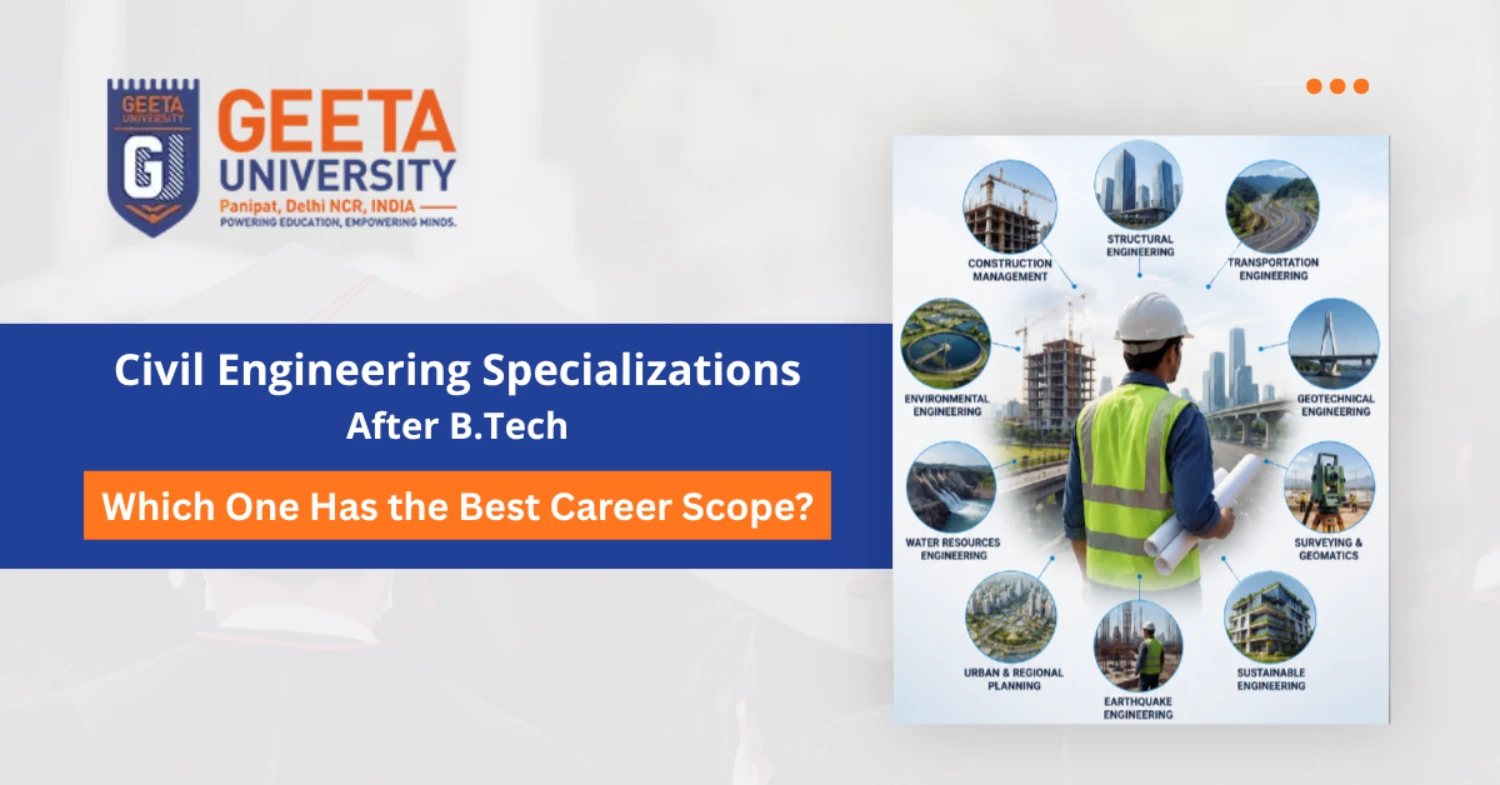
Introduction
India is building at a scale that few countries can match, and that single fact is shaping how engineers plan their futures. Choosing among the available Civil Engineering specializations after B.Tech has become one of the most important career decisions a graduate makes, because the country’s investment in infrastructure, transportation, construction, sustainability, and smart cities has created very different opportunities across different branches of the field.
A civil engineering degree opens many doors, but those doors do not all lead to the same place. Salary, hiring demand, the recruiters who come looking, and long-term growth prospects vary significantly from one specialization to another. A structural engineer, a transportation engineer, and a construction technology specialist may all start with the same B.Tech, yet their pay, their employers, and their day-to-day work can look entirely different a few years into their careers.
This guide walks through the leading specializations available after a civil engineering degree, compares their salary ranges and recruiters, and looks honestly at which directions offer the strongest career scope today. The aim is not to crown a single winner, but to help you match a specialization to your own interests, strengths, and goals.
Top Civil Engineering Specializations After B.Tech
The following are among the most relevant Civil Engineering specializations after B.Tech, each with its own focus, employers, and outlook.
Construction Technology and Management
Construction technology and management combines engineering knowledge with the planning, costing, and delivery of construction projects. It focuses on how to build efficiently, safely, and within budget while applying modern construction technology.
Key responsibilities
- Plan project schedules and manage execution on site
- Control budgets, costs, and resources
- Coordinate contractors, consultants, and quality and safety teams
Career opportunities: Construction manager, project manager, planning engineer, and contracts manager.
Industries hiring: Large construction firms, infrastructure developers, real estate companies, and project consultancies.
Future demand: Strong and rising, driven by India’s continuous infrastructure and real estate expansion.
Salary range: Roughly 4 to 12 LPA in the early to mid stages, rising to 25 LPA and above for senior managers.
Structural Engineering
Structural engineering is the design and analysis of the load-bearing systems that keep buildings, bridges, and other structures standing safely. It is one of the most established and respected civil specializations.
Key responsibilities
- Design and analyse structural systems for safety and durability
- Use software such as STAAD.Pro and ETABS for modelling
- Ensure designs meet codes and withstand loads including seismic forces
Career opportunities: Structural engineer, design engineer, and structural consultant.
Industries hiring: Design consultancies, construction companies, and infrastructure developers.
Future demand: Consistently in demand, with growth tied to high-rise, bridge, and infrastructure construction.
Salary range: Around 4 to 10 LPA early on, reaching 18 to 30 LPA for senior structural consultants.
Transportation Engineering
Transportation engineering deals with the planning, design, and operation of roads, highways, railways, and urban transit systems. It sits at the heart of India’s expressway and metro expansion.
Key responsibilities
- Design road and highway geometry and pavements
- Plan traffic flow and transport networks
- Support metro, rail, and urban mobility projects
Career opportunities: Highway engineer, transportation planner, and traffic engineer.
Industries hiring: Highway developers, metro corporations, government agencies, and infrastructure consultancies.
Future demand: Very strong, supported by national highway programmes and metro projects across cities.
Salary range: About 4 to 9 LPA early on, rising to 15 to 25 LPA for experienced specialists.
Geotechnical Engineering
Geotechnical engineering studies soil, rock, and foundations, ensuring that whatever is built has solid ground beneath it. It is essential for safe construction on challenging sites.
Key responsibilities
- Investigate soil and site conditions
- Design foundations, retaining walls, and earthworks
- Assess slope stability and ground risk
Career opportunities: Geotechnical engineer, foundation engineer, and ground engineering consultant.
Industries hiring: Construction firms, infrastructure developers, mining, and specialist ground engineering companies.
Future demand: Steady demand, with growth wherever large or complex foundations are required.
Salary range: Roughly 4 to 9 LPA early on, reaching 15 to 24 LPA at senior levels.
Environmental Engineering
Environmental engineering applies civil engineering to protect public health and the environment, covering water treatment, waste management, pollution control, and sustainability.
Key responsibilities
- Design water and wastewater treatment systems
- Plan solid waste and pollution control measures
- Support environmental impact assessment and sustainability
Career opportunities: Environmental engineer, sustainability consultant, and water quality engineer.
Industries hiring: Government bodies, utilities, consultancies, and companies with sustainability mandates.
Future demand: Growing quickly as environmental regulation and sustainability commitments tighten.
Salary range: About 3.5 to 8 LPA early on, rising to 14 to 22 LPA for senior specialists.
Water Resources Engineering
Water resources engineering focuses on the management of water through dams, canals, irrigation, drainage, and flood control. It is vital for agriculture, energy, and urban water supply.
Key responsibilities
- Design irrigation, drainage, and water supply systems
- Plan dams, reservoirs, and hydraulic structures
- Support flood management and watershed planning
Career opportunities: Water resources engineer, hydraulic engineer, and irrigation engineer.
Industries hiring: Government irrigation and water departments, hydropower companies, and consultancies.
Future demand: Stable and important, with strong demand in the government and energy sectors.
Salary range: Around 3.5 to 8 LPA early on, reaching 14 to 22 LPA for experienced engineers.
Urban Planning and Smart Infrastructure
Urban planning and smart infrastructure shape how cities grow, blending land use, transport, utilities, and digital systems into liveable, efficient urban environments.
Key responsibilities
- Develop land use and city development plans
- Integrate transport, utilities, and digital systems
- Support smart city and urban renewal projects
Career opportunities: Urban planner, smart infrastructure specialist, and city development consultant.
Industries hiring: Government planning bodies, smart city authorities, and urban consultancies.
Future demand: Expanding rapidly under the Smart Cities Mission and broader urbanisation.
Salary range: About 4 to 10 LPA early on, rising to 18 to 30 LPA for senior planners.
Construction Project Management
Construction project management is the discipline of leading projects from start to finish, balancing time, cost, quality, and risk. It is closely related to construction technology and management, with a sharper focus on leadership.
Key responsibilities
- Lead project planning, scheduling, and delivery
- Manage budgets, contracts, and stakeholders
- Control risk and report on project performance
Career opportunities: Project manager, project director, and programme manager.
Industries hiring: Construction firms, developers, and project management consultancies.
Future demand: Strong, since every major project needs capable managers, and the supply of skilled ones is limited.
Salary range: Around 5 to 12 LPA early on, reaching 25 to 45 LPA for senior managers.
BIM and Digital Construction
BIM and digital construction use data-rich 3D models and digital tools to plan, coordinate, and deliver projects. This is one of the fastest-growing areas in civil engineering.
Key responsibilities
- Build and manage Building Information Models
- Run clash detection and model coordination
- Support 4D scheduling and 5D cost integration
Career opportunities: BIM engineer, BIM coordinator, and digital construction manager.
Industries hiring: Design consultancies, large contractors, and technology-focused construction firms.
Future demand: Rising sharply as BIM moves from optional to standard on major projects.
Salary range: About 4 to 10 LPA early on, rising to 18 to 32 LPA for senior BIM professionals.
Disaster Management Engineering
Disaster management engineering focuses on designing and planning infrastructure that can withstand and respond to earthquakes, floods, and other hazards. It is increasingly relevant in a climate-affected world.
Key responsibilities
- Assess hazard and disaster risk for structures and regions
- Design resilient and disaster-resistant infrastructure
- Support emergency planning and recovery
Career opportunities: Disaster risk engineer, resilience consultant, and hazard mitigation specialist.
Industries hiring: Government agencies, disaster management authorities, and specialist consultancies.
Future demand: Growing, driven by climate change and a stronger focus on resilient infrastructure.
Salary range: Around 4 to 9 LPA early on, reaching 15 to 25 LPA for experienced specialists.
Civil Engineering Specializations: Salary and Recruiters Comparison
The table below compares indicative average salaries in India and examples of leading recruiters across the main specializations. LPA stands for lakh per annum.
| Specialization | Avg Salary (India) | Top Recruiters |
|---|---|---|
| Construction Technology & Management | 6 to 12 LPA | L&T Construction, Tata Projects, Shapoorji Pallonji, Afcons |
| Structural Engineering | 5 to 11 LPA | L&T, AECOM, WSP, Sterling and Wilson |
| Transportation Engineering | 5 to 10 LPA | NHAI Consultants, IRB Infrastructure, Dilip Buildcon, RITES |
| Geotechnical Engineering | 5 to 10 LPA | AECOM, Keller, ITD Cementation, Tata Projects |
| Environmental Engineering | 4 to 9 LPA | AECOM, Ramboll, NTPC, Thermax |
| Water Resources Engineering | 4 to 9 LPA | WAPCOS, Jacobs, Ircon, L&T |
| Urban Planning | 5 to 11 LPA | AECOM, Jacobs, Smart City Authorities, NIUA |
| BIM & Digital Construction | 5 to 11 LPA | AECOM, WSP, Jacobs, L&T |
| Construction Project Management | 6 to 14 LPA | L&T, Tata Projects, JLL, Colliers |
| Infrastructure Engineering | 5 to 12 LPA | L&T, GMR, Adani Infrastructure, AECOM |
Salaries are indicative market estimates and vary by employer, experience, and location. Recruiter names are illustrative examples of firms active in each area. [VERIFY] before publication.
Which Civil Engineering Specialization Has the Best Career Scope?
There is no single answer that fits everyone, because the best specialization depends on what you value most. The rankings below break the question down by the factor that matters to you.
Best for Highest Salary
Construction project management and construction technology and management tend to lead on earnings, because they move engineers into roles that carry responsibility for large budgets and teams. BIM and digital construction is rising fast on this measure as demand outpaces the supply of skilled professionals.
Best for Industry Demand
Construction technology and management, transportation engineering, and structural engineering see the steadiest hiring, since they map directly onto the projects India is building most: roads, metros, buildings, and large infrastructure.
Best for Future Growth
BIM and digital construction, urban planning and smart infrastructure, and environmental engineering have the strongest forward momentum, because they align with digitalisation, smart cities, and sustainability, the trends reshaping the industry.
Best for Government Sector Opportunities
Water resources engineering, transportation engineering, and structural engineering offer the most government roles, through bodies such as public works departments, irrigation departments, railways, and central engineering services.
Best for International Career Opportunities
Structural engineering, construction project management, and BIM and digital construction transfer most easily abroad, particularly to the Gulf, Southeast Asia, and Australia, where Indian civil engineers are widely employed.
Top Civil Engineering Colleges in India Offering Specializations
Several institutions across India offer civil engineering with strong specialization options. The comparison below is indicative and intended to show the range available.
|
Fees, placement rates, and packages are approximate figures compiled from publicly available sources and vary by year, programme, and category. [VERIFY] all institutional data against official sources before publication.
When comparing institutions, the headline numbers matter less than the quality of the experience behind them. A few factors deserve close attention:
- Curriculum quality: A syllabus that keeps pace with industry tools and methods, including BIM and modern construction technology.
- Industry exposure: Site visits, guest lectures, and live project interaction that connect classroom learning to practice.
- Research opportunities: Access to laboratories and projects for students who want to go deeper into a specialization.
- Internship support: Structured internships that place students on real construction and design projects.
- Placement assistance: A dedicated team that prepares students and connects them with recruiters.
- Faculty expertise: Teachers who combine academic depth with real project experience.
Among the private institutions in this space, Geeta University offers civil engineering along with specialization-focused options such as a Civil Engineering programme with AI and Digital Transformation and M.Tech tracks in Transportation Engineering and Construction Technology Management. Its civil engineering curriculum emphasises practical learning through surveying practice, material testing, soil investigation, and industry-standard software such as AutoCAD and STAAD.Pro, which reflects the broader shift towards hands-on, technology-oriented civil engineering education.
Future Scope of Civil Engineering in India
The future scope of civil engineering in India is closely tied to large national programmes and to technology. Several trends point to sustained, evolving demand:
- Smart Cities Mission: Continued investment in integrated, digitally managed urban development.
- Infrastructure expansion: An ongoing pipeline of highways, metros, airports, and industrial corridors.
- High-speed rail projects: Major rail programmes creating specialised engineering demand.
- Sustainable construction and green buildings: Rising standards for energy efficiency and low-carbon design.
- AI in construction: Artificial intelligence supporting scheduling, safety, and design optimisation.
- BIM adoption and digital engineering: Digital models becoming standard practice on major projects.
- Construction automation: Drones, robotics, and prefabrication changing how work is delivered.
Why Construction Technology and Management Is Emerging as a Preferred Specialization
Among the options covered here, construction technology and management has been gaining attention quickly, and the reasons are practical rather than fashionable.
- Growing infrastructure sector: The volume of projects in India creates steady, broad-based demand for professionals who can deliver them.
- Project management demand: Every large project needs people who can plan, cost, and manage it, and skilled managers are in short supply.
- Technology integration: The specialization sits naturally alongside BIM, project software, and digital construction methods.
- Leadership opportunities: It offers one of the clearest routes from technical work into senior management.
- Salary growth: Earnings tend to rise quickly as professionals take on larger budgets and teams.
- Industry relevance: The skills apply across building, infrastructure, and real estate, which keeps options open.
None of this makes it the only strong choice. Structural engineering, transportation engineering, and BIM all offer excellent prospects. The point is that construction technology and management has become one of the most reliably rewarding directions for graduates who enjoy the delivery side of engineering.
Conclusion
Choosing among the Civil Engineering specializations after B.Tech is one of the most consequential decisions in a young engineer’s career, because it shapes the projects you work on, the salary you can command, and the people who will hire you. India’s sustained investment in infrastructure, transportation, sustainability, and smart cities means that opportunity exists across every specialization covered here.
Construction technology and management, structural engineering, transportation engineering, and BIM and digital construction stand out for their combination of demand, salary, and future growth, while environmental, water resources, and urban planning specializations offer strong public sector and sustainability-focused careers. Emerging trends such as digital engineering, green construction, and automation will continue to reward engineers who keep learning.
The most important step is to match your choice to your own interests, the direction of the industry, and your long-term goals. Evaluate the demand, the salary potential, and the future scope of each option carefully, and choose the specialization where your strengths and the market meet.
Frequently Asked Questions
There is no single best specialization for everyone. Construction technology and management, structural engineering, and BIM and digital construction are among the strongest choices today, but the right one depends on your interests, your salary goals, and whether you prefer the design, delivery, or planning side of engineering.
Construction project management and construction technology and management generally offer the highest earnings, because they lead to roles responsible for large budgets and teams. BIM and digital construction is also rising quickly, since demand for skilled professionals currently outpaces supply.
Yes. It is one of the most reliably rewarding specializations in India, supported by a deep pipeline of infrastructure and real estate projects, strong salary growth, and clear progression into leadership. It suits engineers who enjoy planning, costing, and delivering projects.
Popular and high-value M.Tech specializations include structural engineering, construction technology and management, transportation engineering, geotechnical engineering, and environmental engineering. The best fit depends on whether you want design depth, delivery skills, or a route into the government sector.
Construction technology and management, transportation engineering, and structural engineering see the steadiest hiring, because they align directly with the roads, metros, buildings, and infrastructure that India is building most actively.
Yes. BIM and digital construction is one of the fastest-growing areas in civil engineering. As digital models become standard on major projects, demand for BIM engineers, coordinators, and managers is rising, and the skills transfer well to international roles.
Structural engineering has strong and stable future scope. As long as buildings, bridges, and infrastructure are being built, skilled structural engineers will be needed, and high-rise and large infrastructure projects continue to drive demand.
Water resources engineering, transportation engineering, and structural engineering offer the most government opportunities, through bodies such as public works departments, irrigation departments, railways, and central engineering services.
Many institutions offer civil engineering with specialization options, including the IITs, NITs, BITS Pilani, VIT, and private universities such as Geeta University, which offers civil engineering along with M.Tech tracks in transportation engineering and construction technology and management.
Average salaries vary by specialization and experience. Entry-level pay generally ranges from around 4 to 8 LPA, mid-level professionals often earn 8 to 18 LPA, and senior specialists and managers can earn 25 LPA and above, with construction management and BIM roles tending towards the higher end.
Related Blogs

Best Colleges for Cyber Security in India: A Practical Guide for Aspiring Students
Best colleges for cyber security in India are becoming the top choice for students who…

Why the US-China Tech War Matters to Your Engineering Career
Introduction Global politics now shapes engineering careers directly. The US-China tech war is not just…
Best B.Tech Artificial Intelligence & Machine Learning Colleges in India: Top-Ranked Universities
Some of the top colleges in India for B.Tech in AI and ML are IIT…

The Rising Demand for Cybersecurity Professionals: From Ethical Hacker to Cyber Analyst
In the present scenario, the demand for cybersecurity experts has been rising rapidly, driven by…
BCA vs B. Tech in AI & ML: Which Course Is Better After 12th
BCA vs B. Tech in AI & ML: Which is better after 12th? BCA is…

Career After B.Tech CSE with AI ML Specialisation
A B.Tech in Computer Science Engineering with AI and ML specialisation prepares graduates for careers…