
MBA Supply Chain Management Syllabus: Semester-Wise Breakdown
Home / MBA / MBA Supply Chain Management Syllabus: Semester-Wise Breakdown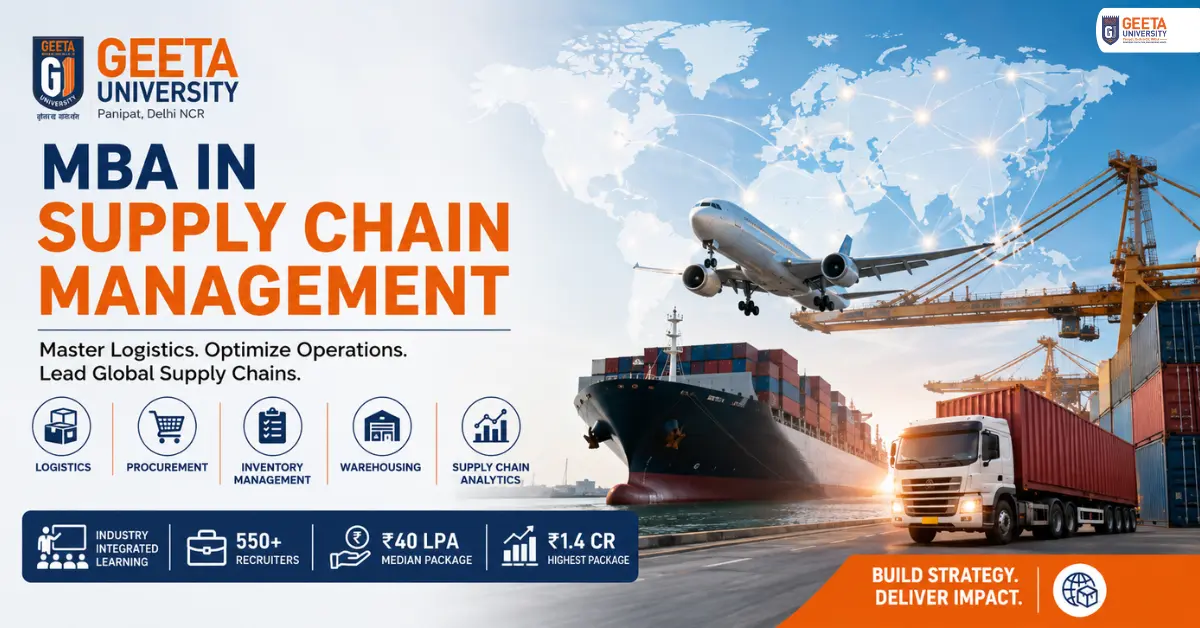
An MBA in Supply Chain Management curriculum incorporates basic management concepts with specialised training on logistics, procurement, inventory, and strategic sourcing. While the core management modules remain constant across universities, variations exist in terms of subject choices, electives, and operational frameworks of the courses.
What is an MBA in Supply Chain Management?
An MBA in Supply Chain Management is a 2-year postgraduate course designed to build managerial skills related to sourcing, procurement, inventory, transportation, and warehouse management. A logistics and SCM course also connects these functions with business strategy, technology, and operational decision-making to improve the movement of goods and services across supply networks.
MBA in Supply Chain Management Course Highlights
|
Feature |
Details |
| Degree Level | Postgraduate |
| Duration | 2 Years (4 Semesters) |
| Eligibility | Bachelor’s degree (minimum 3 years) with a minimum of 50% aggregate marks |
| Admission Process | Entrance Exam Score (GUTS / CAT / MAT / XAT / CMAT) + Merit / Interview |
| Focus Areas | Logistics, Procurement, Sourcing, Warehousing, Supply Network Analytics |
| Average Program Fee | ₹1,50,000 – ₹3,50,000 per annum (Depending on the institute) |
| Core Job Roles | Supply Chain Analyst, Logistics Manager, Sourcing Specialist, Operations Manager |
Supply Chain Management Syllabus: 1st Year
Standard supply chain management course details for the first year cover both the basics of business management as well as supply chain management concepts. This year’s syllabus will also include operations management subjects to make candidates familiar with production planning, process optimization, resource allocation, and other important aspects.
1st & 2nd Semester Subjects
| Semester | Major Areas Covered |
| Semester 1 | Basic business management, operations, supply chain planning, and business processes |
| Semester 2 | Procurement and vendor management, warehouse management, distribution and inventory management operations |
The syllabus for Year 1 based on the SCM curriculum in India looks like this:
- Managerial Economics: Application of microeconomic concepts to business management.
- Organizational Behaviour: Study of individuals and teams in organizations.
- Financial & Management Accounting: Basics of financial statements, cost accounting and budgeting.
- Quantitative Techniques for Business: Basic statistics, probability and business decision-making.
- Operations Research: Basic optimization algorithms, linear programming and queue theory.
- Marketing Management: Analysis of market structure, targeting and distribution channels.
- Corporate Financial Management: Analysis of capital structure, risk management and valuation.
- Human Resource Management: Talent procurement, workforce planning and labour laws.
Supply Chain Management Syllabus: 2nd Year
The second-year subjects extend beyond the traditional logistics management syllabus by addressing sustainability, quality, risk, digital commerce, and international supply networks.
3rd & 4th Semester Subjects
| Semester | Major Areas Covered |
| Semester 3 | International logistics, green supply chains, lean and agile manufacturing, reverse logistics |
| Semester 4 | Risk management, total quality management, e-commerce dynamics, internship or applied learning |
The syllabus for Year 2, based on the standard SCM course subjects semester-wise, looks like this:
- Advanced Logistics Management: Freight system optimization, fleet planning and multimodal transportation networks.
- Warehouse and Distribution Management: Warehouse layout design, automation, inventory classification, and materials handling systems.
- Procurement and Strategic Sourcing: Vendor selection algorithms, negotiations and global procurement management.
- Global Supply Chain and Customs Regulations: Import/export documentation, tariff rates, compliance and international trade law.
- Supply Chain Analytics: Forecasting and data analysis, route optimization and modelling.
- Strategic Supply Chain Management: Alignment of end-to-end networks with company strategy and performance metrics.
- Green Supply Chains & Sustainability: Reduction of carbon footprint, reverse logistics and circular economy integration.
- E-Commerce Dynamics & Fulfilment: Fast-track delivery, last-mile delivery and omnichannel fulfilment.
- Industry Dissertation / Capstone Project: Research project aimed at solving real-world business challenges.
Why Choose Geeta University for MBA in Supply Chain Management?
Geeta University’s MBA programme incorporates both specialization in supply chain and business education. Unlike other programs, Geeta University provides an MBA in Supply Chain Management course that covers logistics, procurement, planning, quality, risk, and digital commerce, apart from transportation activities.
- Program Specializations: Geeta University offers MBA specializations in Finance, Marketing, Human Resource Management, Pharmaceutical Management, and Supply Chain Management.
- Industry-Integrated Education: The university stresses the inclusion of case studies, live projects, business simulations, internships, and capstone projects in its MBA education program.
- Placement Network: The programme page reports 550+ recruiters, 3,500+ job offers, and a median salary package of ₹40 LPA with a maximum of ₹1.4 Cr.
- Skill Development: Geeta Finishing School and Geeta Technical Hub support communication, corporate readiness, technology, and industry-specific skills development.
- Scholarships: Scholarships are available to those who perform well in qualifying exams, national-level entrance exams, and sports, among other categories.
What is the Eligibility Criteria for MBA in Supply Chain Management at GU?
For the MBA Supply Chain Management programme, Geeta University states the following eligibility criteria:
| Criteria Category | Requirement |
| Educational Qualification | Graduation degree (10+2+3 pattern) in any discipline from a recognized university. |
| Minimum Percentage | Aggregate minimum of 50% marks (45% for reserved category applicants as per rules). |
| Entrance Examination | Valid score in GUTS, CAT, MAT, XAT, CMAT, or state-level management entrance tests. |
What is the Admission Process for MBA in Supply Chain Management?
The admission process for the MBA in Supply Chain Management programme is structured to assess candidates’ academic background and analytical skills:
- Application Submission: Candidates have to apply through the university admissions portal.
- Entrance Test Assessment: Candidate performance in entrance exams is analyzed based on national entrance exam scores (CAT/MAT/XAT/CMAT).
- Personal Interview (PI): Shortlisted candidates have to attend the PI round to assess domain interest, communication skills, and logical reasoning.
- Seat Offer and Fee Payment: The process includes merit list announcement, document verification, and seat booking fee payment.
Students Must Know:
Conclusion
The MBA in Supply Chain Management course offered by Geeta University covers the functional areas needed for SCM careers, including procurement, planning, logistics, quality, risk and e-commerce. In addition to the MBA course, this four-semester programme incorporates supply chain management concepts.
Frequently Asked Questions
The program covers procurement strategies, warehouse management, logistics planning, international trade compliance, quantitative techniques and risk management.
Can non-engineering graduates enroll in an MBA in Supply Chain Management? Yes, candidates from any discipline (Science, Commerce, or Arts) can pursue an MBA in Supply Chain Management, provided they meet the minimum graduation percentage requirement of 50%.
Geeta University incorporates real-life case studies, industry-led workshops, capstone projects, and mentorship by corporate experts into the course curriculum.
Graduates can obtain positions such as Logistics Coordinator, Supply Chain Analyst, Procurement Specialist, Inventory Control Manager, and Operations Planner.
Yes. Geeta University lists CAT, XAT, MAT, CMAT, and CUET PG as admission routes for MBA programmes. Applicants should check the current admission requirements applicable to their chosen route.
Related Blogs

Best College for MBA in India 2026: Eligibility & Admission Timeline
An MBA is one of the most sought-after graduate degrees in India. The MBA program…

How Can MBA Students Explore Resilient Supply Chains Post-Pandemic?
TABLE OF CONTENTS Introduction How Can Students Analyse Post-Pandemic Supply Chains? What Are the Core…

What is an MBA in Pharmaceutical Management—Career Scope in Healthcare
Introduction An MBA in Pharmaceutical Management is often chosen by students who want more than…

Best Private Colleges for MBA in India: Fees, Placements and Admission Guide (2026)
Choosing among the best private colleges for MBA in India is rarely a simple decision….

How to Prepare for CAT, MAT & CMAT Exams
You have to study in a way that makes sense for each test. This means…
How to Choose the Right MBA Program In 2023? – Geeta University
The entire MBA application and enrollment process resembles a huge leap into the uncharted. It…