
Importance of Communication and Soft Skills in Every Career
Home / Soft Skills / Importance of Communication and Soft Skills in Every Career
In today’s dynamic economy, higher education and technical skills are not sufficient to ensure career success. Information and technical expertise can get a person in the door, but communication and soft skills determine how far an individual will go in their career. Whether working as an engineer, doctor, teacher, manager, researcher, or in the creative industries, soft skills are increasingly seen as a fundamental prerequisite for personal development, professional capability, and long-term career sustainability.
Understanding Communication and Soft Skills
Communication skills are the skills we use to convey information to others, and include speaking, writing, listening, and non-verbal communication. This includes clear speech, pleasant voice, listening, presentation skills and written communication. Traditionally related to the interaction of skills and the professional environment, now, on the other hand, soft skills are personal attributes that influence the way we interact with others and manage the conditions of the workplace.
Work ethic needs multi-factional soft skills, including teamwork, leadership, adaptability, emotional intelligence, problem-solving, time management, conflict resolution and professionalism. These skills together are the cornerstone of excellent behaviour in the workplace.
Why Soft Skills Matter More Than Ever
Today’s work is more collaborative and multidisciplinary. They do not live as professionals alone, but rather meet, talk with, and are influenced by colleagues, clients, employers, stakeholders, and diversified teams. In these circumstances, clear communication of ideas, active listening, and a positive working attitude with others are necessities.
The job is being reshaped by automation and artificial intelligence. Although machines can take over technical work, they cannot replace human traits like empathy, creativity, ethical decision-making and understanding between people. Consequently, employers are now looking for candidates with soft skills as well as technical ones.
Role of Educational Institutions in Skill Development
Skills development has been closely associated with education and educational institutions that prepare students increasingly for collaborative work-based settings. Developing interpersonal communication, teamwork, adaptability, ethical reasoning, and problem-solving soft skills has, alongside academic learning, become a responsibility for them in an age where automation and artificial intelligence dominate.
Addressing this requirement, Geeta Finishing School (GFS) focuses primarily on communication skills, personality development and professional soft skills. Through weekend training, presentations, group exercises and industry-related grooming sessions, GFS combines theoretical knowledge with practical knowledge in the work environment, making the student graduating a confident, well-spoken and job-ready professional.
Role of Communication & Soft Skills in Career Growth
Effective communication is important to success at all stages of your career. It helps the students and freshers to perform well in interviews, group discussions and also in various academic presentations. For the professional, it enhances collaboration and teamwork, leadership effectiveness and relationships with clients.
Transparent communication reduces confusion, promotes efficiency and generates trust. Those who speak with confidence about ideas are more likely to have an impact on decisions, be acknowledged and become leaders. Excellent writing skills are vital when it comes to writing reports, emails, proposals and research papers, and communication is a valuable skill to have in your professional life.
Soft Skills Across Different Professions
Soft skills aren’t just for corporate jobs; they are just as vital in technical, academic, and service-related professions.
- Engineers and Technologists require teamwork, problem-solving and communication skills to work within multi-disciplinary teams and to communicate complex concepts to non-technical personnel.
- Doctors and Healthcare Professionals employ empathy, active listening, and effective communication to establish rapport with patients and collaborate with other healthcare providers.
- Teachers and Academicians need to have presentation skills, emotional intelligence and be flexible to captivate students and transfer knowledge.
- Researchers and Scientists benefit from communication skills when publishing papers, presenting at conferences and collaborating internationally.
- Entrepreneurs and Managers also rely on their leadership, negotiation, and people skills to inspire teams and create professional networks.
Therefore, communication and soft skills have a direct impact on the professional and career performance of an individual, irrespective of the domain.
Impact on Employability and Workplace Success
Recruiters generally state that the absence of soft skills is one of the biggest reasons job seekers need help in their professional roles. Employers want people who can work under pressure, have good time management skills, can take feedback on board and know how to deal with evolving situations.
Developing strong soft skills results in better work relationships, fewer workplace conflicts, and a more positive work environment. Employees who possess good people skills are more likely to become team leaders, mentors, and decision makers because they can garner trust and cooperation.
Emotional Intelligence: A Key Soft Skill
Emotional intelligence is the capacity to perceive, attend to, and understand one’s own emotions as well as those of others, and it is an important factor in career success. It allows people to manage stress, work through conflicts in a mature way, and think before they act in difficult situations.
Leaders who have high emotional intelligence tend to be stronger, better team players, and more resilient when it comes to problem-solving. Especially in leadership positions, the most successful managers are often those with emotional intelligence.
Developing Communication and Soft Skills
In contrast to technical skills that need specific training, soft skills can be acquired by repeatedly practising and becoming more aware of oneself. Group discussions, presentations, debates, workshops, and extracurricular activities are some other activities, among which you can further build your communication skills.
Reading and writing regularly, soliciting feedback, and watching good communicators are easy but effective improvements to consider. Team projects, internships — and professional interactions, more generally — also offer opportunities for real-world exposure in developing soft skills.
Lifelong Relevance of Soft Skills
The best thing about soft skills is that these basic skills will always be useful. Although technical expertise may be obsolete as a result of accelerating technological advances, communication, adaptability, leadership, and the ability to work with others are still useful throughout one’s career.
People can have confidence when moving through different roles, industries and responsibilities, thanks to strong soft skills. They foster personal development, professional durability, and the potential for enduring career contentment.
Conclusion
In every profession, communication and soft skills are indispensable now. They enrich technical knowledge, contribute to employability and professional identity development. We live in a world where it’s not only what we know, but how we talk, collaborate and connect with people that determines success.
In actively cultivating these fundamental skills, an ethos that is proactively promoted at institutions such as Geeta University, a person is best prepared to face the varying day-to-day demands of the workplace, establish significant professional ties, and experience consistent career advancement. In this high-stakes globalised world, these are the skills that can really differentiate mediocrity from enduring brilliance.
FAQs
Q1. Why are communication and soft skills important for students?
Ans. They assist students in gaining confidence, excelling in interviews and making a successful transition to the professional.
Q2. How do universities support soft skill development?
Ans. The regular classes, along with various workshops, presentations, seminars, guest lectures and industry-related training, are designed to develop the soft skills at universities like Geeta University.
Q3. Can technical skills alone ensure career success?
Ans. No, technical skills are not sufficient by themselves, but they need to be supplemented by communication and other soft skills to long- term career growth.
Q4. Are soft skills important outside corporate jobs?
Ans. Yes, the importance of soft skills is a given in all jobs now, from healthcare to education to research and entrepreneurship.
Q5. How can individuals improve communication and soft skills?
Ans. Any individual can learn communication skills with practice, regular engagement in conversations, feedback, and experiential learning.
Related Blogs
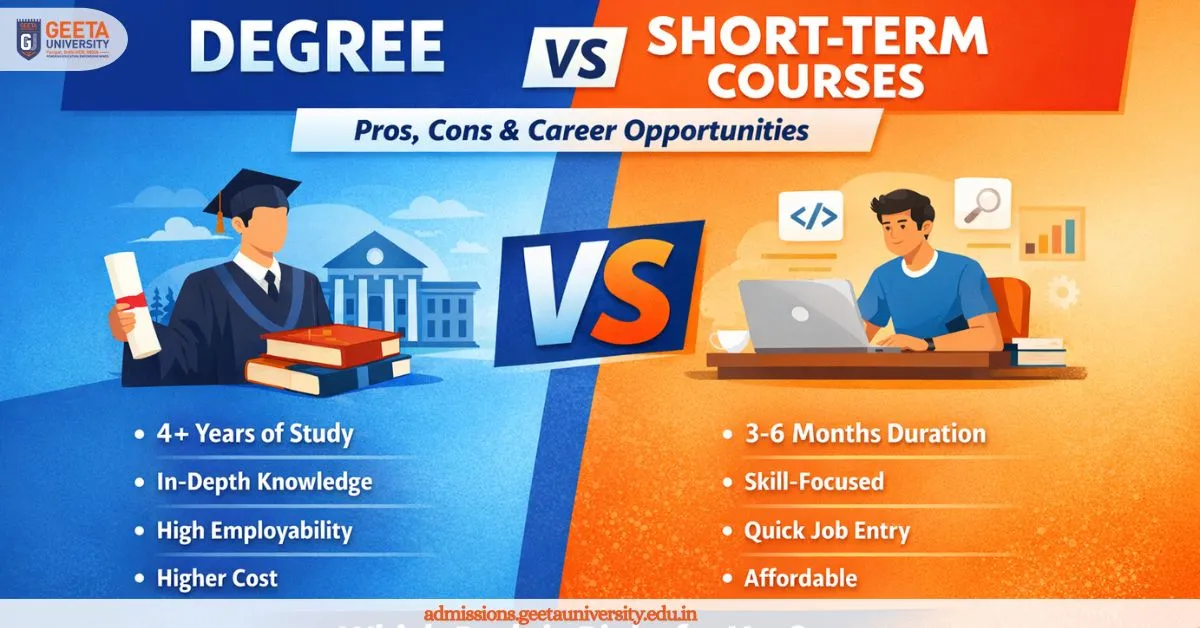
Degree or Short-Term Courses: Pros, Cons & Career Opportunities
Students often face confusion when choosing between a degree or short-term course. Both options support…