
Degree or Short-Term Courses: Pros, Cons & Career Opportunities
Home / Soft Skills / Degree or Short-Term Courses: Pros, Cons & Career Opportunities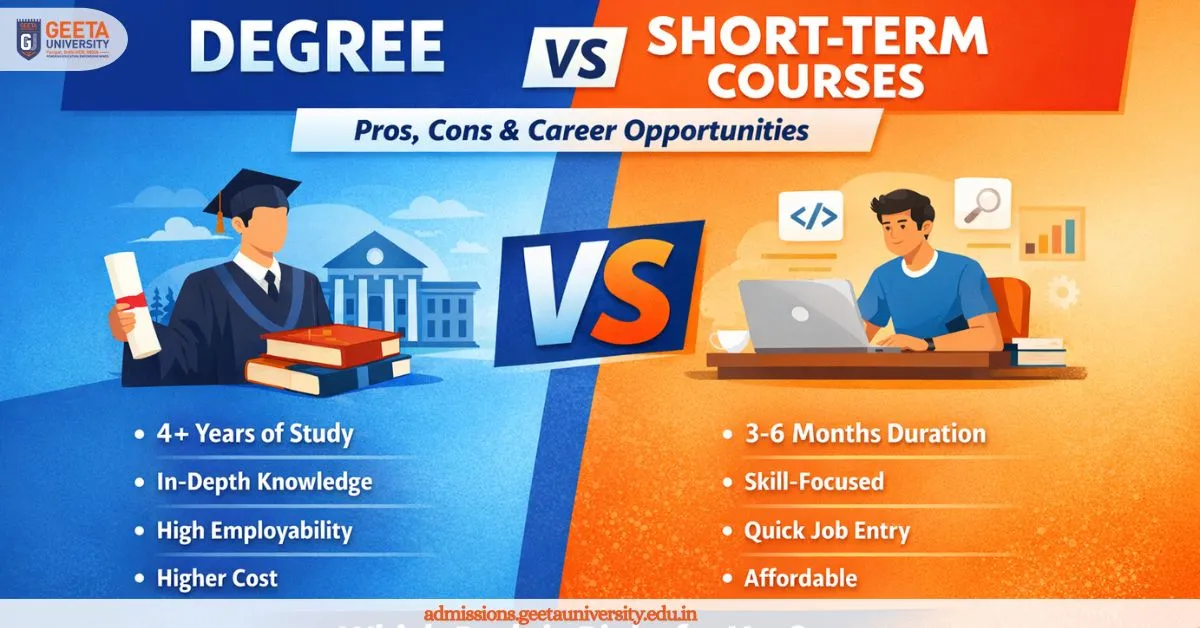
Students often face confusion when choosing between a degree or short-term course. Both options support career development but serve different purposes. A full-time degree provides deeper academic knowledge and long-term career opportunities, while short-term courses focus on specific skills and quicker entry into the workforce.
This article will help you choose the route that best suits your objectives by examining the distinctions between a short term course vs full time degree.
What are Short-Term Courses?
A short course is a condensed educational program that provides basic or intermediate expertise on a particular subject. Short courses are designed to be learned quickly or to improve skills, and are usually available in an online or a face-to-face form.
These courses, which are well-liked by those looking for a quick and adaptable approach to upskill, may include subjects like coding, graphical design, basic financial literacy, or interpersonal skills.
Pros
The certificate programs can be interesting to professionals who have a busy schedule and limited finances because of their numerous benefits. Short courses have been known to be attractive due to the following advantages, when considering degree or short-term course pathways:
- Time efficiency: Finish specialised training in a matter of weeks or months as opposed to years.
- Cost-effective education: Acquire useful, employable skills for a small portion of the price of. Learn practical, marketable skills at a fraction of the cost of a college education.
- Niche, talent-based material: You do not need to be educated broadly, but concentrate on the skills that are quite specific to your future job or industry.
- Adaptable choices for learning: To accommodate your schedule and personal commitments, choose from online, evening, weekend, or self-paced programs.
Cons
- Limited Scope: It may not address more general theoretical underpinnings.
- Recognition: Traditional companies may not appreciate or recognise certain training.
- Less Networking: Compared to programs on campus, there are fewer opportunities to establish a professional network.
See Also:
What is a Full Time Degree?
The degree is a type of academic qualification which is awarded by a college or university to those individuals who successfully pass the comprehensive course of study. Degrees are usually classified into two groups: postgraduate (master’s and doctoral) and undergraduate (bachelor’s).
A degree course is a very broad field with business, technology, science and liberal arts being the major ones. They offer an in-depth knowledge of theoretical concepts, critical thinking, and a range of skills that can be useful in many careers.
Pros
Degree programs are supposed to equip students with a comprehensive range of professional competencies and deep academic knowledge. The benefits of full time degree are as follows:
- Comprehensive Learning: It involves an in-depth analysis of the academic and practical aspects of a subject.
- International Recognition: Degrees are recognised by employers and organisations of all sizes in India.
- Networking Opportunities: Being able to have contacts with instructors, alumni, and participate in activities on campus to create relationships.
- High Employability: Often required in particular professions such as medicine, law and engineering.
- Holistic Development: Promotes cooperation, critical thinking, and problem-solving.
Cons
- Time-consuming: Needs a substantial time commitment (at least two to four years).
- Expensive: More expensive tuition and associated costs.
- Rigid Routine: Full-time studies may restrict options for part-time jobs or other hobbies.
Full Time Degree vs Certification Course: Key Comparisons
In short term courses vs long term courses, the key distinction is in terms of length, level of learning and employment. Short-term programs are characterised by particular practical expertise and early employment, whereas long-term programs offer a more profound academic competence, increased profession and more benefits over time. You can also become familiar with the choice you need to make, a degree or short-term course, by the table below:
| Feature | Full Time Degree | Certification Course |
| Duration | 3 to 5+ years (e.g., B.Tech, MBBS, B.Com, BSc) | 2 years (MBA, MSc) | 3 to 6 months or 6 to 12 months, depending on the programme |
| Eligibility Criteria | Completion of Class 12 for bachelor’s programmes or a bachelor’s degree for postgraduate programmes | Usually, Class 12 or basic knowledge in the relevant field |
| Entrance & Admission Process | Admission is done through national or university-level examinations like JEE, NEET, CAT, or CUET, followed by counselling or interviews. | Mostly, admission is done through direct admission |
| Course Examples | B.Tech in Computer Science, MBA, BSc, MBBS, B. Com | Digital Marketing, Data Science, Cyber Security, UI/UX Design, Cloud Computing |
| Focus | Primary academic education, theory and general knowledge | Preparation and training in certain industry tools |
| Skills Required | Analytical, problem-solving, academic discipline, interest in research skills | Flexibility and desire to learn new tools |
| Skills Developed | Leadership, critical thinking, technical expertise, research ability, and management skills | Practical skills such as Python, SEO, data analytics, and cybersecurity practices |
| Typical Job Roles | Engineer, Manager, Researcher, Business Analyst, Doctor | Digital Marketing Specialist, Data Analyst, Cyber Security Associate, UI/UX Designer |
| Benefits | Proven qualification, good educational background, and long-term career advancement | Can help to get a job faster, can upskill quickly, and have specialised knowledge |
People Also Read:
Which Option Should You Select?
Depending on your professional level and goals, you will need a degree or short-term course:
- A full time degree is the most suitable one when you desire to switch careers or achieve leadership roles.
- A short course is preferred in case you wish to acquire something new or refine your existing skills.
Consider your ultimate objective, for instance, if you’re thinking about a career in business analytics. Having a degree will give you the breadth and depth required should you desire to work as a data scientist or analytics manager. Nevertheless, a short course, in case you need to learn some tools or techniques, such as SQL or data visualisation.
Why Choose Geeta University?
When choosing between a degree or short-term course, selecting the right university ensures strong academic learning and industry exposure. Geeta University offer a balanced approach, focuses on full-time degree programmes with Outcome-Based Education (OBE) and industry-partnered education in such domains as Engineering, Management, Law, Pharmacy, Sciences, Commerce, Media, Design, and Agriculture.
The university facilitates placements with 445+ recruiters, packages up to 67.5 LPA, merit-based scholarships, national entrance exams, sports and GUTS. The CUET is also accepted in undergraduate admissions.
Conclusion
The choice between a degree or short-term course depends on your own goals, time constraints, and available resources. Upskilling is a personal journey. While full time degrees provide a transformational and engaging experience, short-term courses are great for rapid, concentrated learning.
Think about your professional aspirations, the abilities you need, and the amount of time you have available. Whether you decide to pursue a full time degree or a short-term course, keep in mind that ongoing education is essential to be competitive in the fast-paced employment environment of today.
Frequently Asked Questions
Short-term courses impart skills in a short time and allow students to apply them immediately. They focus on learning, money and ti
A degree requires months to years and gives comprehensive education, but short courses focus on specialised skills in a few weeks or months to a few months.
Short-term courses offer brief, specialised skill training to meet the current need, whereas degrees offer a more comprehensive education with more job opportunities.
The four major full time degrees are associate's, bachelor's, master's, and doctoral degrees. From Associate to Doctoral, specialisation, depth, and job progression prospects increase.
Related Blogs

Why Are Multidisciplinary Courses the Way of the Future?
Overview Modern world is now more interdependent, complex and changeable than ever before. Global inequality,…
“Powering Tomorrow: A Deep Dive into Sustainable Energy Resources and Their Transformative Potential”
Introduction In a world grappling with the environmental challenges posed by conventional energy sources, the…
Geeta University’s NextGen Smart Campus in Panipat Redefines Modern Learning
In today’s rapidly changing world of education, students are looking for more than the textbook…
Upholding Integrity and Excellence: The Essence of Work Ethics
Introduction: In the realm of professional life, work ethics serve as the guiding principles that…
Exploring the Transformative Power of Meditation: A Comprehensive Guide
Introduction In today’s fast-paced world, where stress, anxiety, and distractions abound, the practice of meditation…
Soft Skills Supercharge: Your Gateway to Job Market Success
Are you finding yourself hitting roadblocks in your job search journey, despite excelling academically? Do…