
What Is Forensic Evidence? Meaning, Types, and Importance
Home / Forensic / What Is Forensic Evidence? Meaning, Types, and Importance
How Silent Clues Speak the Loudest
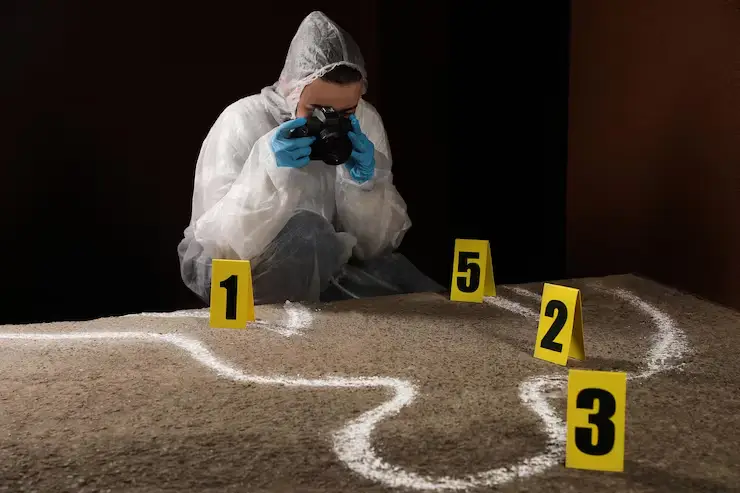
Consider walking into a crime scene just seconds after a criminal activity has happened. It may appear to be a normal room—for example, chairs are in order, the windows are closed, a deafening silence fills the air. However, for a forensic analyst, silence is definitely not present in that environment. Everything in that room is saying a message. These messages are referred to as evidence.
Forensic evidence encompasses more than the realm of “what is seen.” Forensic evidence is the catalyst that builds suspicion into facts, theories into conclusions, and helps transform justice from the realm of reality into reality itself, especially in forensic science colleges in Haryana, Delhi, including high-level academic research programmes such as phd in forensic science in Delhi.
This particular blog lays down the various processes of forensic evidence and explains why forensic evidence plays such a vital role in crime-solving processes.
To see how these types of evidence are used outside textbooks, explore the real-life applications of forensic science in crime investigation
Evidence for Forensic Science
Evidence: Evidence is anything that leads to the facts of a crime. Now, when investigators look for evidence during a forensic investigation, there are three important things the evidence must be:
- It must be legally obtained
- Analysis needs to have a scientific
- The evidence must be documented properly and preserved
Any failure in these steps may make even the most convincing evidence inconclusive in a court of law, regarded as a key principle in bsc forensic science colleges in Delhi, Haryana.
Evidence can be categorized in terms of several aspects related to its nature and source, and can be analyzed in a number of ways. Let’s see each of them in detail.
Physical Evidence: The Most Tangible Truth
Physical Evidence refers to any physical object that might be touched, observed, or quantified. This would ostensibly be the first form of evidence people would think of in regard to forensic science, while examining degree offerings by forensic science colleges in Delhi
Examples of Physical Evidence:
- Weapons (Knives, Guns, blunt objects)
- Bloodstains
- Hair and Fibers
- Broken Glass
- Sand and paint chips
This is because physical evidence is objective, in that its existence is not dependent upon human observation or memory. Unlike eyewitness accounts, physical evidence cannot forget, exaggerate, or lie. There is also a limited time frame in which physical evidence is available. This is
Importance in Investigations:
Physical Evidence Helps:
- Connect a suspect to a crime location
- Reconstitute the sequence of
- Support or contradict witness statements
For instance, a bloodstain pattern on a wall can reveal whether a victim was standing, sitting, or lying down at the point of injury.
Biological Evidence – The Language of Life
Evidence from a living organism will always come from a biological source and is essentially the most important type of evidence today, following the development of DNA technology – key area of specialization, and the best Forensic Science Colleges in Delhi.
Typical Examples of Biological Evidence:
- Blood
- Semen
- Saliva
- Sweat
- Hair with the root
- Skin cells (touch DNA)
- Bones and tissues
DNA: The Gold Standard
DNA evidence has completely changed the way forensic science is conducted. Small quantities of biological evidence are now capable of:
- Suspect identification with high levels of accuracy
- Clear the innocent
- Find unidentified victims of mass disasters
Challenges:
Biological evidence is very delicate. It may be affected or degraded if exposed to temperatures, water, bacteria, or if it is handled incorrectly. This is why proper collection, packaging, and storage of the evidence are very important.
Trace Evidence: Small Clues, Big Impact
Trace Evidence: Trace evidence is a type of physical evidence that is transferred as a result of contact and can often be described using Locard’s Exchange Principle
“Tout contact laisse des traces.”
Trace Evidence: Some of the types of
- Hair
- Fibre
- Glass pieces
- Paint chips
- Soil particles
- Gunshot
Despite its small size, trace evidence might offer considerable associational value, relating to:
- Suspect to a victim
- A suspect at a crime scene
- A victim of a location
For example, fibers from a suspect’s jacket that are discovered to have been present on a victim’s clothing can put the suspect as well as the victim at a certain location at a certain time.
Documentary Evidence: Written Proof of Events
Documentary evidence may include any writing or printed matter that has any bearing on a case. In contemporary times, this also applies to documents in digital form.
Examples:
- Suicide notes
- Threat letters
- Contracts
- Diaries
- Cheques and banking documentation
- Printed emails or messages
Forensic Examination:
Typically, documentary evidence is analyzed by “forensic document examiners” for the following:
- Handwriting
- Signatures
- Ink and paper
- Alterations & forgeries
One forged signature can reveal financial fraud; handwriting analysis can trace an anonymous letter to its writer.
Digital Evidence: Crimes in the Virtual World
With the expansion of crime into cyberspace, evidence obtained electronically assumes a critical role.
Sources of Digital Evidence:
In the
- Mobile phones
- Computers and laptops
- Hard drives
- Email messages and chats
- Social media posts
- CCTV footage
- GPS information
Importance:
Digital evidence may:
- Define timelines
- Locations for
- Patterns in communication
- Prove intent or conspiracy
For instance, deleted messages obtained from a mobile phone may highlight the planning that is done during the commission of a crime.
Challenges:
Digital evidence is very fragile and susceptible to change. Therefore, the use of forensic imaging and hash verification is applied.
Pattern Evidence: Reading Repetition and Design
Pattern evidence is produced when an item makes contact with a surface and a pattern is impressed or transferred onto the object.
Types of Pattern Evidence:
- Fingerprints
- Footprints and a shoe
- Tire marks
- Tool marks
- Bite marks (with caution)
Fingerprints
Fingerprints are still the most trustworthy way to identify a person. This is because no two persons have the same fingerprints—not even twins.
Application:
Pattern evidence helps:
- Identification
- To reconstruct
- Link tools or vehicles to a crime scene
Impression Evidence: Silent Imprints of Action
Impressions evidence does relate to pattern evidence, but it centers on either three-dimensional or two-dimensional impressions.
Examples:
- Footprints in mud or sand
- Tire marks on highways
Tool impressions on doors or locks
These impressions can reveal:
- Size and type of footwear
- Direction of movement
- Force applied for entry
Toxicological Evidence: Chemistry That Kills — or Saves
Toxicological evidence: This involves the identification and examination of poisons, drugs, and alcohol.
Samples Analyzed:
- Blood
- Urine
- Viscera
- Hair & nails
Common Cases:
- Poisoning
- Drug overdose
- Driving under the influence
- Drug-facilitated crimes
Frequently, the answers to important inquiries are to be found in
- What substance was involved?
- How concentrated was it?
- Could it result in death or impairment?
Circumstantial Evidence: Connecting the Dots
It does not directly support a circumstance, but an inference is suggested.
Example:
- A suspect’s proximity to the crime location
- Motive or opportunity
- Behavioral
- Prior threats or disputes
While circumstantial evidence may be underappreciated, it can be very persuasive, particularly in conjunction with other bits of circumstantial evidence that lead to similar conclusions.
Testimonial Evidence: The Human Element
Testimonial evidence may include statements made by witnesses, victims, or experts that are made under oath.
Types:
- Eyewitness
- Victim statements
- Opinions of experts (fore
Limitations
For example, human memory is not perfect because stress, fear, prejudice, and the passage of time can affect memories. This is why eyewitness accounts are most reliable if they are accompanied by physical and/or scientific proof
Transient Evidence: Evidence That Disappears
Transient evidence is only short-term and must be recorded as such.
Examples:
- Fragrances (alcohol, Perfumes)
- Bodily temperature
- Wet blood
- Smoke or fog
Evidence of this type recognizes the significance of a quick response in crime scenes.
To achieve the best crime scene investigation results, new technologies
Chain of Custody: Securing the Evidence
Regardless of how strong the evidence is, nothing can be accomplished if the chain of evidence is broken. This is the process the evidence follows from the point of collection to presentation in the courtroom.
“Any gap or discrepancy can raise a number of questions about:”
- Contamination
- Tampering
- Misidentification
People Also Read: Government Jobs for Forensic Science Graduates
Conclusion: Where Evidence Meets Justice
Evidencle is the quiet witness that talks louder than words. In forensic science, every kind of evidence, be it physical, biological, digital, or circumstantial, is of pivotal significance to reveal the facts of a situation.
The foremost thing that we learn from the subject of Forensic Science is that crimes may be planned in secrecy, but they are hardly ever committed in secrecy; rather, they always leave some evidence behind. The function of a Forensic Scientist is to locate such evidence and let Science do the talking in favor of justice.
In a world where technology and crime are continually evolving, the forms of evidence can increase but will always serve one purpose—to uncover the truth and bring justice by protecting the righteous and holding wrongdoers accountable.
Related Blogs
Real-Life Applications of Forensic Science in Crime Investigation
By: Surbhi Sharma (Assistant Professor, Forensic Science) Introduction If you’ve ever watched a crime show…

Top Government Jobs for Forensic Science Graduates
Forensic science graduates play an important role in repairing India’s justice and security systems. Public…

FORENSIC SOMATOSCOPY AND SOMATOMETRY
Forensic Somatometry Forensic somatoscopy is a branch of forensic science that involves the examination and…

How Technology Is Transforming a Degree in Forensic Science
Forensic science is being revolutionized through technology by accuracy and enhancement of speed in addition…

Role of Impressions in Forensic Science
Mr. Sahil Sharma, Assistant Professor, Forensic Science, Geeta University Introduction Forensic science is a…

Why Forensic Science Represents a Unique Harmony Between Science and Justice
Justice has always rested on our capability to uncover the verity. For centuries, societies reckoned…