Why Choose Nutrition and Dietetics as a Career in 2026?
Home / Nutrition & Dietetics / Why Choose Nutrition and Dietetics as a Career in 2026?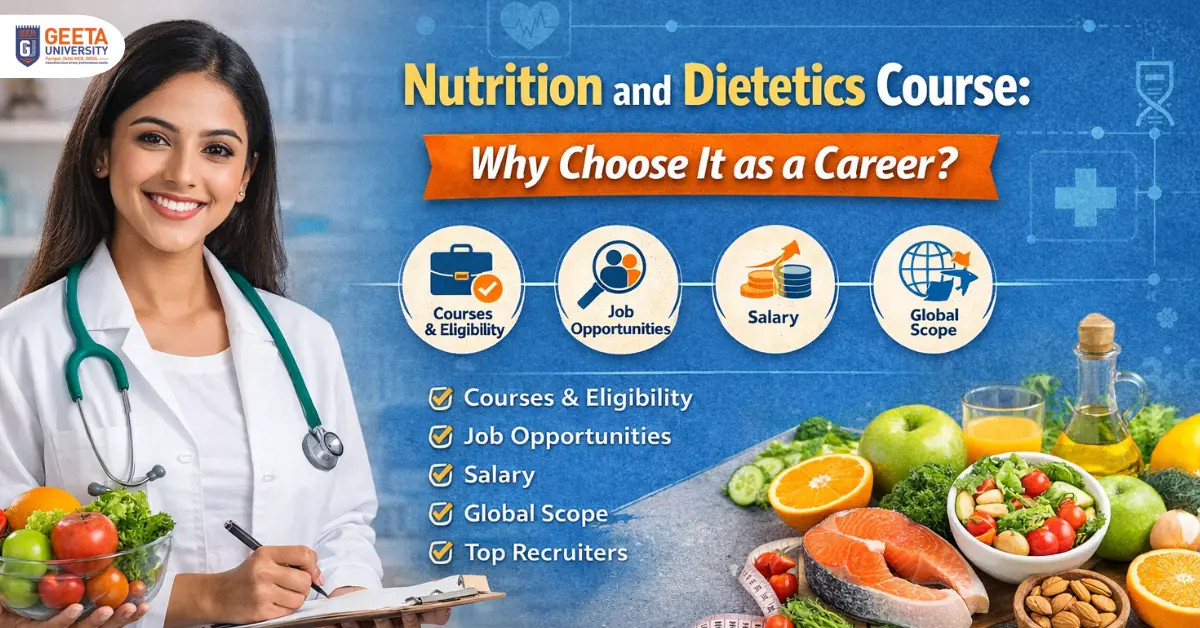
Nutrition and dietetics have become the most important and fastest-developing fields in healthcare as the world turns health-conscious. The demand for nutrition consultants has increased significantly due to unhealthy lifestyles and poor dietary habits. When you are enthusiastic about health, well-being, and assisting people in living healthier lives, a nutrition and dietetics course is the right career choice.
This blog will encompass all the details of the nutrition and dietetics course, including why you should pursue the course, what job opportunities the course can present, and the anticipated salary.
What is a Nutrition and Dietetics Course?
Nutrition and dietetics courses are commonly offered at the graduate and undergraduate levels. The curriculum of a nutrition and dietetics degree is commonly divided into two parts. The first part focuses more on the science of nutrition, and the second part deals more with the practical application of nutrition knowledge.
The course provides an array of topics, such as Community Nutrition, Advanced Nutrition and Dietetics, Practical Workshops, and so on. It exposes students to all the important features of the food industry, nutrition science, and research. Many students also pursue a masters in nutrition and dietetics to gain advanced knowledge and expand their career opportunities in clinical, research, and public health sectors.
Nutrition and Dietetics Course Details
The nutrition and dietetics course covers various aspects of health sciences as a means of analyzing nutrition and dietary lifestyle practices and their impact. The details of the Nutrition and Dietetics course are presented in the table below.
| Course | B.Sc in Nutrition and Dietetics | Diploma in Nutrition and Dietetics | M.Sc in Nutrition and Dietetics | PhD in Nutrition and Dietetics |
| Duration | 3 to 4 years | 1 to 2 years | 2 years | 3 to 5 years |
| Eligibility | 10+2 with Science (Biology preferred) | 10+2 with science | Bachelor’s degree from the science stream | Master’s in a relevant field |
| Entrance Exams | University-level or merit-based tests. | Mostly merit-based. | University/national-level exams (if applicable). | University-level entrance + interview. |
| Admission Process | Application, merit/entrance evaluation, document verification. | Direct admission based on marks | Counselling-based entrance or merit selection. | UGC-NET or CSIR-NET |
| Subjects | Diet Planning, Clinical Nutrition, Human Nutrition, Food Science. | Fundamentals of Nutrition, Diet, Health and Wellness. | Nutrition Research, Methodology, Public Health, and Advanced Clinical Dietetics. | Nutrition Policy Studies, Data Analysis, Advanced Nutrition Science, and Nutrition Research Methodology. |
| Skills Required | Intelligence, communication, and health interest. | Fundamental nutrition, observation. | Analytical skills, research aptitude. | Research skills, critical thinking. |
| What Students Learn | Human nutrition, diet planning, food science, clinical nutrition. | Fundamentals of nutrition and wellness. | Advanced nutrition, clinical dietetics, public health, research. | Advanced research, nutrition science, and academic contribution. |
People Also Read:
Why Choose a Career in Nutrition & Dietetics?
The following are but a few reasons why nutrition and dietetics can be a good career choice:
- Opportunity: There is a growing need for nutrition and dietetics specialists due to the rise of obesity and diabetes. Jobs in dietetics and nutrition are becoming more popular; students can expect high employment opportunities.
- Individuals and community health: Nutrition and dietetics specialists are often satisfied with their jobs. Being able to help others makes employment worthwhile.
- International Scope: Nutrition and dietetics students have an opportunity to seek international employment as talents are demanded globally. In health-conscious countries such as the US, there is an abundance of nutrition and dietitian jobs.
- Career options: After the nutrition and dietetics course, students have a variety of options for career in nutrition and dietetics in India. Students can work in clinical, corporate, and sports settings, as well as in private and other nutrition jobs.
- Practical skills: Nutrition and dietetics go beyond theory. Students may develop practical skills, including client counselling, nutrition planning, and internships, to prepare for real-life issues.
Salary and Career Opportunities in Nutrition and Dietetics
There are diverse job opportunities for nutrition and dietetics graduates in the health and wellness sector in India. The following are a few examples of job descriptions of Nutrition and Dietetics course graduates in the health and wellness sector in India.
| Job Profile | Role Overview | Expected Salary |
| Nutritionist | Plans balanced diets and instructs people on how to eat well. | ₹ 2.5 to 4 LPA |
| Dietitian | Offers clinical diet plans depending on medical conditions. | ₹ 3 to 5 LPA |
| Health Coach | Promotes diet, fitness, and wellness lifestyle change. | ₹ 2.5 to 4 LPA |
| Wellness Consultant | Advises organizations or individuals regarding general health and nutrition plans. | ₹ 3 to 5 LPA |
| Food Quality Analyst | Assures food safety, quality and nutrition in products. | ₹ 2.5 to 4 LPA |
| Clinical Dietitian | Manages disease-specific diets to patients in hospitals. | ₹ 4 to 7 LPA |
| Public Health Nutritionist | Develops nutrition programmes for communities and government initiatives. | ₹ 4 to 6 LPA |
| Research Associate | Conducts nutrition research and assists in scientific studies and data analysis. | ₹ 4 to 7 LPA |
| Sports Nutritionist | Plans diets to improve athletic recovery and performance. | ₹ 4 to 7 LPA |
| Research Scientist | Leads advanced research in nutrition, food science, and health policies | ₹ 6 to 10 LPA |
| Professor/Lecturer | Teaches nutrition and dietetics at colleges and universities | ₹ 7 to 12 LPA |
| Policy Advisor | Research on nutrition-related government or international policies. | ₹ 8 to 12+ LPA |
| Senior Consultant | Offers professional consultancy on healthcare or corporate nutrition activities. | ₹ 7 to 12+ LPA |
Top Recruiters for Nutrition and Dietetics in India
Nutrition and dietetics graduates are employed in the health care, wellness, food, and corporate industries. Graduates can find opportunities in hospitals, wellness companies, FMCG brands, and research organisations..
Leading Recruiters
| Sector | Top Recruiters |
| Hospitals & Healthcare | Apollo Hospitals, Fortis Healthcare, Max Healthcare, AIIMS, Hinduja Hospital |
| Wellness & Fitness | VLCC, Fitelo, HealthifyMe, Talwalkars, Cult.fit. |
| Food & FMCG Industry | Nestlé, Amul, Britannia, ITC, Dabur |
| Pharmaceutical & Healthcare Companies | Abbott, Himalaya Wellness, Patanjali, Sun Pharma |
| Research & NGOs | WHO-linked projects, UNICEF programs, ICMR, Public Health Foundations |
| Corporate & Startups | Redcliffe Labs, Health-tech startups, Nutrition consultancies |
Conclusion
Today, nutrition is not just about food; it is also about research, recovery, sustainability and a high standard of living. The Nutrition and Dietetics course is a good and rewarding option for those who are interested in the health sector and are ready to make a professional contribution towards developing the field.
Choosing the right institution is the first step toward this rewarding career. Geeta University’s highly qualified School of Allied Health Sciences, also it is one of the best B.Sc dietitian and nutritionist colleges & offers students hands-on training and robust placement opportunities.
Frequently Asked Questions
Clinical nutrition in hospitals, sports and fitness nutrition, public health and community nutrition, food sector jobs, and entrepreneurial enterprises.
Sports nutrition requires more accurate food timing, larger calorie intake, and training periodisation and sport-specific nutritional understanding.
A career in nutrition is suitable for individuals who are comfortable analysing basic health data and understanding everyday dietary habits.
A bachelor's degree in nutrition, dietetics, or a similar discipline is normally required to work as a nutritionist.
Some institutions offer specialisations or electives in clinical, sports, paediatric, geriatric, and public health nutrition, letting students adapt their studies to their interests.
Related Blogs
Top 12 Life-Changing Benefits of B.Sc. (Hons) in Dietetics & Nutrition
The B.Sc. in Dietetics and Nutrition provides an individual with good knowledge in nutrition science,…
Top 10 Skills Required to Become a Professional Dietitian
With the rise in lifestyle diseases and growing awareness of healthy eating, the demand for…
Top B.Sc Nutrition and Dietetics Colleges in Delhi NCR: Eligibility, Fees & Admission
There are 40+ recognized colleges offering B.Sc in Delhi NCR. Some of the top BSc…

Holistic Healing of Arthritis through Homeopathy
By Dr. Pooja Yadav, Assistant Professor, SHAS (Nutrition & Dietetics) The word “arthritis” refers to…
B.Sc. Nutrition vs. B.Sc. Nursing: Which is Better?
Selecting the best healthcare program following 12th grade can be a challenge, particularly when trying…