
Building Ethical AI for the Future With MCA Artificial Intelligence and Machine Learning
Home / MCA / Building Ethical AI for the Future With MCA Artificial Intelligence and Machine Learning
Right now, while you are reading this, thousands of students across India are finishing their graduation and asking the same question you are asking – what next? The IT sector grew at over 20% last year. AI-related job postings in India rose by 45% in 2024 alone, according to NASSCOM data. Yet the majority of postgraduate applicants still pick programmes that were designed for the tech world of 2010. If you are seriously thinking about a future in Artificial Intelligence, machine learning, cloud systems, or data engineering, the next decision you make about your master’s degree will determine the first 10 years of your career.
What Is MCA Artificial Intelligence and Machine Learning?
MCA Artificial Intelligence and Machine Learning is a 2-year postgraduate programme that trains students in advanced software development alongside the technologies that now run the modern world. It is not a theory-heavy degree. The focus falls on building actual systems – systems that learn, predict, analyse, and automate.
We are at a point where companies across healthcare, banking, retail, logistics, and manufacturing all require professionals who understand both traditional software engineering and the newer disciplines of deep learning, data analytics, computer vision, and cloud architecture. A student who completes an MCA Artificial Intelligence and Machine Learning programme with strong hands-on training walks out with a skill set that most organisations are actively trying to hire.
According to the World Economic Forum’s Future of Jobs Report 2025, AI and machine learning specialists rank among the fastest-growing roles globally. India, with its expanding IT services base and growing domestic tech market, stands to create millions of such roles over the next decade. Choosing the right programme, at the right institution, at this particular moment, is not a minor decision.
Programme at a Glance
| Feature | Details |
| Programme Name | MCA – Master of Computer Applications (Artificial Intelligence and Machine Learning) |
| Duration | 2 Years (4 Semesters) |
| Eligibility | Graduation with 50% marks; Mathematics at 10+2 or Graduation level preferred |
| Lateral Entry | BCA graduates eligible for direct second-year entry |
| Mode of Study | Full-Time, On-Campus at Geeta University, Panipat, Haryana |
| Session | 2026–2027 (Admissions Open) |
What Does the MCA Artificial Intelligence and Machine Learning Curriculum Actually Cover?
Students often ask us whether the curriculum is too broad or too narrow. The honest answer is that it has been designed to give a working foundation across every layer of modern IT, with dedicated depth in the AI and machine learning tracks. You will not graduate knowing only one language or one framework.
The programme runs across 4 semesters. By the time students complete it, they have covered advanced programming, database architecture, web technologies, operating systems, cloud computing platforms, and a dedicated stream of AI & Machine Learning subjects, including big data tools, deep learning, and IoT applications. A mandatory industry internship sits within the programme structure – not as an optional add-on, but as a requirement.
Curriculum Structure – Key Areas
| Area | Core Subjects | Specialisation / Applied Tracks |
| Programming & Systems | Advanced Programming, Operating Systems | Cloud Computing, DevOps Fundamentals |
| AI & Data | AI & Machine Learning, Big Data Tools | Deep Learning, Computer Vision, Data Mining |
| Web & Design | Web Technologies, UI/UX, IoT | Full Stack Development, MEAN/MERN Stack |
| Engineering Practice | Software Engineering, Database Systems | Agile Practices, System Design |
| Industry Exposure | Mandatory Industry Internship | Live Projects, Corporate Mentorship |
The structure above reflects a deliberate balance. Core engineering subjects keep the foundation solid. The applied AI tracks ensure that students are working with tools and methods that are actually in use inside companies hiring right now. Industry internships bridge the gap between classroom work and real project environments.
Who Teaches You – and Why Faculty Credentials Matter More Than You Think
The quality of a postgraduate programme depends heavily on the people standing in front of the room. Not just their degrees, but their actual research output, their industry connections, and the relevance of their work to what companies currently need.
The School of Computer Science and Engineering faculty includes researchers with active publications in indexed journals, patent holders, and professionals who have spent careers inside top-tier companies before entering academia. Professors of Practice from organisations such as Samatrix Consulting, Coding Blocks, and senior figures from FICCI and Samsung bring applied industry knowledge directly into the teaching environment.
Faculty Highlights
| Faculty Member | Designation | Key Expertise |
| Dr Kapil Saini (HoD) | Ph.D. | AI, ML, Cloud Computing; 25+ Scopus/WoS papers; 3 Patents; Best Teacher Award 2022 |
| Mr. Hemant Singh | M.Tech., Gold Medalist | AI & ML specialist; Research experience at IIT Roorkee |
| Dr. Poonam | Ph.D. | Machine Learning, Big Data; 5 Patents; 15 Research Papers; 2 Awards |
| Mr Vishal Jain (PoP) | IIT KGP & IIM-A Alumnus | Data Analytics, AI, Blockchain; 20 years at Tata Steel and Intel |
| Mr Varun Kohli (PoP) | CEO, Coding Blocks | Large-scale application development; serial EdTech entrepreneur |
Mr Kartik Mathur, an NSUT graduate and Founding Member of Coding Blocks, has personally trained over 40,000 students. His former students currently hold positions at Google, Amazon, Microsoft, Adobe, and other leading companies. This is the kind of teaching environment where the person guiding your final-year project has a direct line to the companies you want to work for.
What Career Roles Can an MCA Artificial Intelligence and Machine Learning Graduate Pursue?
This is the question that matters most to most families. What happens after the degree? The Indian IT sector – already worth over $245 billion – continues to expand its AI and cloud verticals at a rate that outpaces the supply of qualified professionals. An MCA Artificial Intelligence and Machine Learning graduate enters this market with a genuine skills advantage.
Career Roles and Starting Salaries
| Job Role | Industry Sector | Avg. Starting Salary (India) |
| AI/ML Engineer | IT, Product, Research | ₹8-15 LPA |
| Data Scientist | Finance, Healthcare, Retail | ₹7-14 LPA |
| Software Developer | IT Services, Startups | ₹5-10 LPA |
| Cloud Solutions Architect | Enterprise IT, SaaS | ₹10-18 LPA |
| Full Stack Developer | Product, Agency, Startup | ₹6-12 LPA |
| Business Analyst (Tech) | Consulting, BFSI | ₹6-11 LPA |
The roles above are not aspirational. They are the actual job descriptions that come through campus placement rounds. The salary figures reflect current market rates reported across platforms such as AmbitionBox, LinkedIn, and Glassdoor for fresh postgraduate entrants in India.
Placement Record – Numbers That Reflect Actual Outcomes
We understand that every parent and every student wants to know whether the investment in a 2-year postgraduate programme will lead to employment. The placement data below comes from Geeta University‘s verified placement records.
Placement Highlights
| Metric | Figure | What It Means for You |
| Highest Package | 40 LPA | Top performers secure high-value roles at leading firms |
| Recruiting Partners | 550+ | Wide industry access across IT, consulting, and product companies |
| Total Job Offers | 3,500+ | Strong pipeline across multiple batches and disciplines |
Top Recruiting Companies
| Tier 1 IT | Consulting | Product Companies | Mid-Tier Growth |
| Infosys | Accenture | Tech Mahindra | |
| TCS | Capgemini | IBM | HCL |
| Wipro | Cognizant | Oracle | Amazon |
A placement office with 550+ active recruiting partners covers IT services giants like TCS, Infosys, and Wipro, as well as global consulting firms and product companies. Students who perform well academically and engage with the placement preparation process – mock interviews, aptitude training, communication workshops – have a strong track record of converting campus interviews into offer letters.
What Makes This Campus Different – the NextGen Smart Campus Infrastructure
The physical and digital environment where you study matters. A NextGen Smart Campus is not just a marketing phrase. It refers to AI-enabled classrooms, high-speed connected labs, digital research libraries, and a technology infrastructure that lets students work on real cloud platforms, run machine learning experiments, and collaborate on live projects – all within the campus perimeter.
The School of Computer Science and Engineering operates dedicated labs for AI, cloud computing, and cybersecurity. Certification partnerships with Amazon AWS, Microsoft Azure, RedHat, Cisco, Oracle, and GitHub mean that students have pathways to earn recognised industry credentials alongside their postgraduate degree.
Beyond labs, the campus operates under the New Education Policy framework, which allows students to design elements of their own academic pathway. The Design Your Own Degree feature, the Geeta Technical Hub, the Geeta Finishing School, and the GU Global Edge programme all give students opportunities that go well beyond a conventional university calendar.
Scholarships and Financial Support – Because Cost Should Not Stop Talent
Fees are a real concern for many families. We want to be direct about this. Geeta University offers scholarships based on academic merit in qualifying examinations, performance in national entrance tests such as CUET and JEE, social responsibility criteria, and sports achievement. The Geeta University Test of Scholarship (GUTS) is an internal entrance examination specifically designed to identify deserving candidates for financial support.
Students who have performed well in their undergraduate programmes should check their scholarship eligibility early in the admissions process. The Scholarship Predictor tool on the university website gives an immediate estimate based on academic scores. Applications for the 2026-2027 session are currently open.
Key Learning Outcomes of the MCA Artificial Intelligence and Machine Learning Programme
By the end of the programme, students can:
- Build and deploy software solutions using computational logic and modern development frameworks
- Develop enterprise-level applications that integrate cloud platforms and AI-based decision systems
- Manage IT projects through the full lifecycle using industry-standard tools and agile practices
- Apply machine learning models to real datasets across domains such as healthcare, finance, and e-commerce
- Work with big data tools and cloud infrastructure at a production-ready level
- Communicate technical findings and project outcomes to both technical and non-technical stakeholders
- Demonstrate professional ethics and responsible practices in the development and deployment of AI systems
Who Should Apply – Eligibility and Ideal Candidate Profile
The MCA programme is designed for candidates who:
- Hold a BCA, B.Sc. (Computer Science or IT), or any graduation with Mathematics at 10+2 or graduation level
- Have secured at least 50% marks in their qualifying degree examination
- Come from non-CS backgrounds with a Science graduation and 50% marks are also welcome, provided they are ready to engage with technical coursework
- BCA graduates qualify for direct lateral entry into the second year of the programme
- Students with a genuine interest in building a career in AI engineering, data science, cloud computing, or software development
Admissions for the 2026–2027 session are now open. If you are a graduate with a Mathematics background and a clear interest in AI, machine learning, cloud systems, or data engineering, visit geetauniversity.edu.in to check your scholarship eligibility, explore the programme structure, and submit your application. The placement preparation process begins from semester one – the earlier you enrol, the more preparation time you have.
Frequently Asked Questions
1. What is the scope of MCA Artificial Intelligence and Machine Learning in India in 2026?
The scope is considerable. India’s IT sector reported over $245 billion in revenue in FY2024-25, and AI-specific hiring has grown by 45% annually, according to NASSCOM. An MCA Artificial Intelligence and Machine Learning graduate qualifies for roles in AI engineering, data science, cloud architecture, and software product development – sectors that are actively expanding headcount across both service companies and product firms.
2. Is an MCA with AI and Machine Learning better than a general MCA for career growth?
A general MCA covers core IT skills. An MCA Artificial Intelligence and Machine Learning goes further by adding specialised tracks in deep learning, computer vision, big data, and cloud platforms. For students targeting roles in AI, data analysis, or cloud engineering, the specialised programme provides a more direct skill match with current job descriptions. Recruiters at companies like Infosys, TCS, and Capgemini specifically list ML and cloud skills as preferred requirements for postgraduate IT roles.
3. Can students from non-Computer Science backgrounds apply for MCA Artificial Intelligence and Machine Learning at Geeta University?
Yes. Graduates from any Science stream with 50% marks are eligible, provided they have studied Mathematics at 10+2 or graduation level. Students without a formal CS background are welcome as long as they are prepared to engage fully with the technical coursework. The faculty at the School of Computer Science and Engineering provides structured support for such students during the initial semesters to ensure no one falls behind on core programming and software concepts.
Related Blogs
MCA Top Colleges in India: How to Choose the Right University for a Successful IT Career
The technology sector continues to create exciting career opportunities in software development, artificial intelligence, cloud…
Top 10 MCA Colleges in Delhi NCR 2026 — Fees, Placements & The Ones That Actually Deliver
Every year around March–April, thousands of students across North India start typing the same thing…
Top Reasons to Pursue MCA: Benefits & Career Opportunities
Strong computer application skills are becoming more important in an increasingly automated global economy. Many…

Cybersecurity Courses in Delhi: Your Path to a High-Paying IT Career
If you are searching for cybersecurity courses in Delhi, you have picked one of the…

Can Blockchain Improve Security in Financial and Healthcare Systems?
TABLE OF CONTENTS Introduction What Is Blockchain and How Does It Work? How Blockchain Improves…
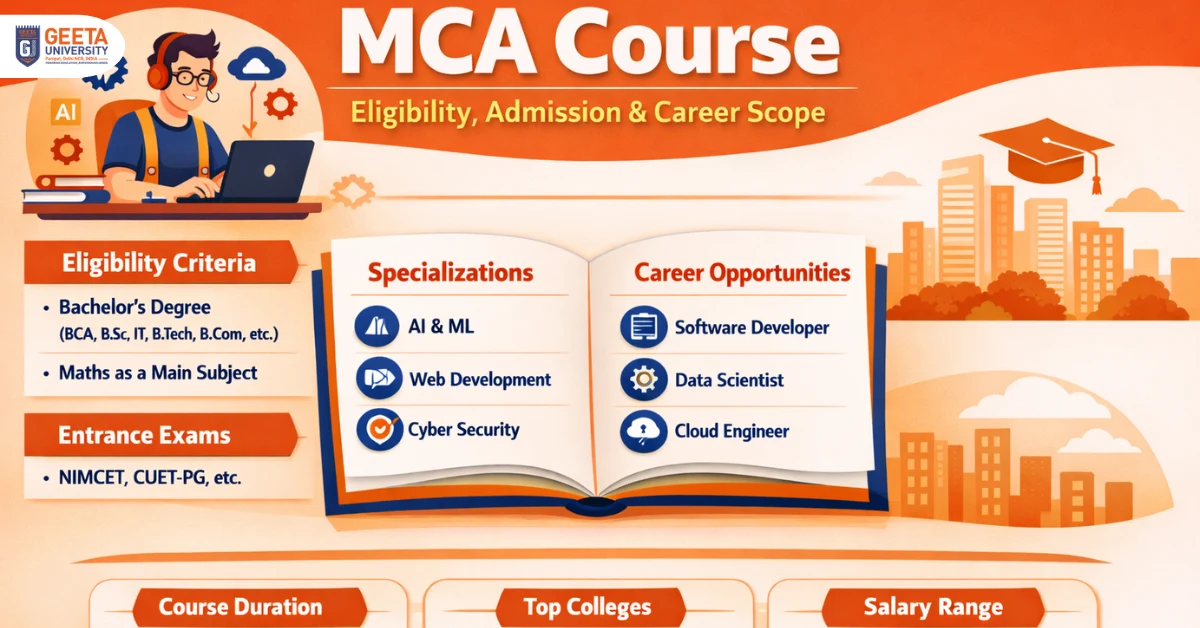
What is MCA Course – Eligibility, Admission, & Career Scope
MCA Course is a postgraduate program that covers topics related to software industry, computer applications,…