
CUET 2026 for BTech: Eligibility, Subjects & How to Apply at Private Universities
Home / B.Tech / CUET 2026 for BTech: Eligibility, Subjects & How to Apply at Private Universities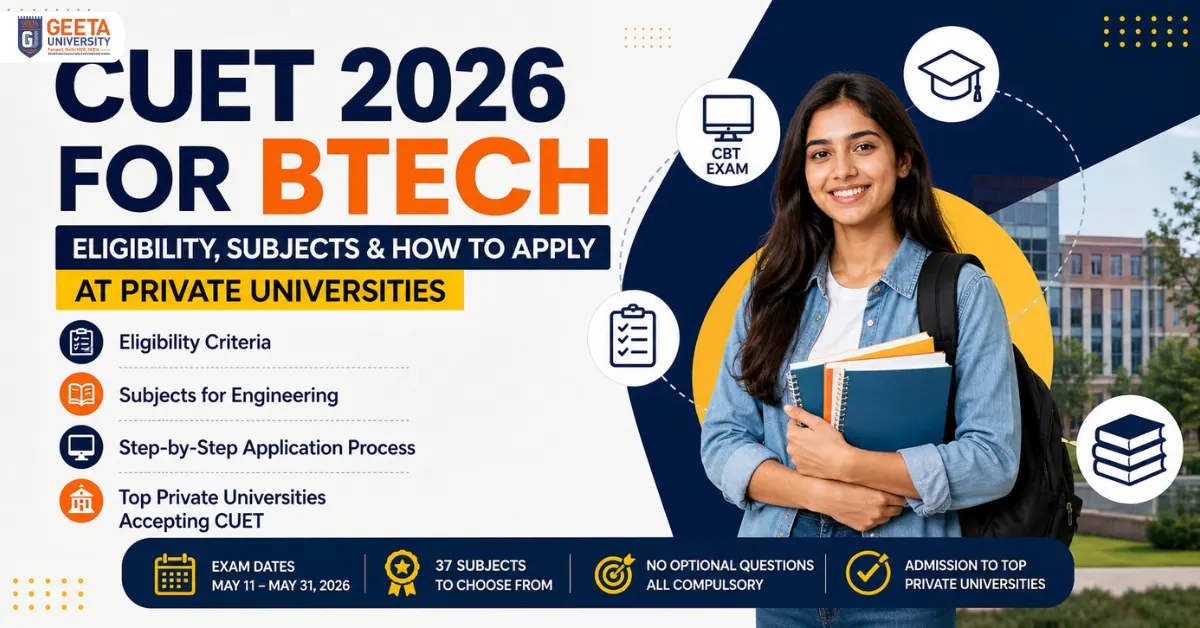
The CUET for B. Tech 2026 acts as a one-stop solution for admission seekers who wish to join prestigious private universities. To be eligible, candidates need to pass class 12 in Physics, Chemistry, and Mathematics (PCM) with at least 50% marks. Applicants must select these core domain subjects on the official NTA portal. By matching your subject combinations to specific university requirements during registration and clearing the exam, you can successfully secure your spot in a premier engineering program.
What is CUET?
Common University Entrance Test (CUET) is a countrywide standardized test conducted by the National Testing Agency (NTA) in India. This exam provides a single-window application procedure in which students can apply to various Central, State, and Private Universities depending on their CUET entrance scores.
What Changed in 2026?
The UGC introduced several notable modifications for this cycle:
- No subject restrictions. The students can now choose any domain subject, even if they didn’t study it in Class 12.
- Domain subjects reduced from 63 to 37.
- No optional questions; all 50 questions in every paper are compulsory.
- CBT mode only and no pen-and-paper option.
CUET UG 2026 Highlights
For students planning their academic journey, understanding the core structure of the exam is the first step toward success. Here are the essential highlights for the upcoming session:
| Details | CUET UG 2026 Information |
| Name of Exam | Common University Entrance Test (CUET) UG 2026 |
| Conducting Body | National Testing Agency (NTA) |
| Mode of Exam | Computer-Based Test (CBT) |
| Total Number of Subjects | 37 subjects (13 Languages, 23 Domains, and 1 General Aptitude Test) |
| Maximum Subjects to Choose | Up to 5 subjects (reduced from the previous limit of 6 to 10) |
| Duration of Each Exam | 60 minutes each for all subjects |
| Question Format | All questions are compulsory |
| Scoring System | +5 marks for correct response; -1 mark for wrong response |
| Eligibility Criteria | No restrictions on choosing the subjects |
| CUET UG 2026 Date Sheet | May 11, 2026, to May 31, 2026 |
What is the CUET B. Tech Eligibility 2026?
Here are the general eligibility criteria set by the National Testing Agency (NTA). However, some private universities can add their own eligibility criteria on top of it.
- Education: Students must have passed class 12 or an equivalent examination from a recognized board. Those students who are appearing in 2026 are also eligible to apply.
- Mandatory Subjects: For B. Tech admissions, students have studied Physics, Chemistry, and Mathematics.
- Marks: Generally, the minimum percentage of 50% for the General category and 45% for reserved categories (SC/ST/OBC).
- Age limit: There is no upper age limit set by the NTA. Some private universities may set an age criterion for engineering admission.
People Also Read:
What are the CUET Subjects for Engineering Admission?
There are several CUET subjects that students should take to apply for their respective BTech programs. Below is a breakdown of the standard CUET subjects for engineering admission.
Students should carefully review the syllabus before selecting subjects. You can explore the detailed CUET exam pattern and syllabus here.
| Section | Subject Category | Specific Subject Recommendations |
| Section IA | Language | English (Most common) or Hindi, overall, CUET offers 13 languages. |
| Section II | Domain Subjects | Mathematics (Mandatory) |
| Physics (Mandatory) | ||
| Chemistry, Computer Science, or Biology (based on branch selection) | ||
| Section III | General Aptitude Test (GAT) | Required by many private and state universities |
How to Apply for BTech through CUET?
The online application process for CUET BTech is entirely handled by the NTA. Here is how you can apply to the CUET for BTech engineering programs.
Step-by-Step Application Guide
Step 1: Visit the official portal at cuet.nta.nic.in. Register yourself as a new candidate on the CUET portal using your email ID and mobile number.
Step 2: Log in to your account and enter your personal and academic information carefully.
Step 3: Select your private universities of interest. Also, make sure to mention ‘BTech’ in the program dropdown list.
Step 4: Select your desired test papers according to your selected universities. Add a minimum of Mathematics, Physics, and a language. Add the General Aptitude Test if required by your target universities.
Step 5: Upload the scanned copies of your photograph and signature (JPG/JPEG format). Photographs should show about 80% of your face area.
Step 6: Make your payments online via net banking/Credit/Debit Card, or UPI. Fees vary according to the number of subjects you select.
Step 7: Save your CUET application form after successful payments. Also, download the confirmation page.
Along with applying, it is important to start early preparation with the right strategy. Read our complete guide on how to prepare for CUET 2026 for expert tips and study plans
What Documents are Required?
| Document | Format | Size |
| Passport Photo | JPG/JPEG | 10 KB – 200 KB |
| Signature | JPG/JPEG | 4 KB – 30 KB |
| Category Certificate | 50 KB – 300 KB |
The Advantages of Pursuing BTech via CUET in 2026 Compared to JEE Main
There are two main advantages of pursuing your BTech program via CUET 2026 over JEE Mains.
- Firstly, in addition to engineering admissions, CUET provides admission opportunities to a variety of other courses. If you opt for Physics, Chemistry, and Mathematics as your CUET domain subjects, then you will get admission to BSc, BCA, BSc IT programs offered by various Central and State Universities.
- Secondly, CUET has a different syllabus compared to the JEE Mains. The JEE Mains syllabus covers concepts of class 11th as well as class 12th, whereas the CUET syllabus is limited to class 12 courses only. Unlike CUET, the JEE Mains curriculum requires candidates to study various disciplines.
Geeta University is among the best private universities accepting CUET for engineering courses. Being located in Panipat, the University has been receiving recognition for its advanced engineering programs.
Geeta University, Panipat (Delhi NCR) offers BTech specializations in Computer Science (AI & ML), Cyber Security, Data Science, and Mechanical Engineering
Admission Note
It’s highly suggested to select Geeta University as your engineering university when submitting your CUET 2026 application form. Also, remember to fill out your subject choices (Physics, Mathematics, and General Test) for engineering admissions at the University.
Conclusion
With increasing popularity, CUET for BTech offers an expanding opportunity for candidates. JEE Main/Advanced provides a direct path for admissions in technical institutes such as IITs and NITs, whereas CUET allows candidates to combine technical studies with a multidisciplinary approach.
If you are a technology aspirant, consider CUET UG for BTech as an alternative pathway. Look for institutions, assess eligibility, choose topics judiciously, and use CUET as a strategic contingency alongside JEE.
For a complete breakdown of courses and admission options, read our guide on what to do after CBSE 12th result 2026
Frequently Asked Questions
While being optional, more and more prestigious institutions have started taking CUET BTech into consideration. Geeta University takes CUET for BTech to ensure standardized and merit-based admissions for engineering students.
Generally, students are required to take the following subjects as CUET domains: Physics, Mathematics, and Chemistry. Apart from it, private universities usually expect students to choose the General Aptitude Test and at least one language paper for admission to B.Tech. programs.
Yes. CUET portal of the NTA lets you select more than one private university, including Geeta University in your single application for BTech admission.
Application fees depend on the number of domains and languages that you are applying for. In case of General Category students, the fees are 1,000 for up to three subjects. Further, there is an additional charge of 400 for each extra subject. Candidates must check cuet.nta.nic.in for the latest fee details as it keeps updating.
Generally, NTA opens a correction period after the registration for CUET 2026 closes. During this period, students can change some important CUET fields.
Related Blogs

How to Prepare for CUET: Strategy for Beginners
The clever and organized CUET preparation for beginners involves knowing the syllabus and a realistic…

CUET 2026 Guide: Syllabus, Exam Pattern, Preparation Strategy
CUET 2026 is an important entrance examination that is used to apply to undergraduate courses…

Artificial Intelligence & Employability: Future Skills and Career Choices of Students
Now a sci-fi novel is no longer set far into the future. The year is…

Best Quantum Computing degree in Delhi NCR | Benefits & Career Options
For those considering technology-oriented programs with futuristic approaches, a Quantum computing degree with a computer…

How to Check CUET UG result 2026? Direct Link & Step-by-Step Guide
Is CUET UG result out? Yes, Candidates can check the CUET UG result 2026 by…

Best Colleges for Cyber Security in India: A Practical Guide for Aspiring Students
Best colleges for cyber security in India are becoming the top choice for students who…
Leave a comment