
What to Do After Low NEET Score 2026 | Best Career Options & Courses
Home / Informative / What to Do After Low NEET Score 2026 | Best Career Options & Courses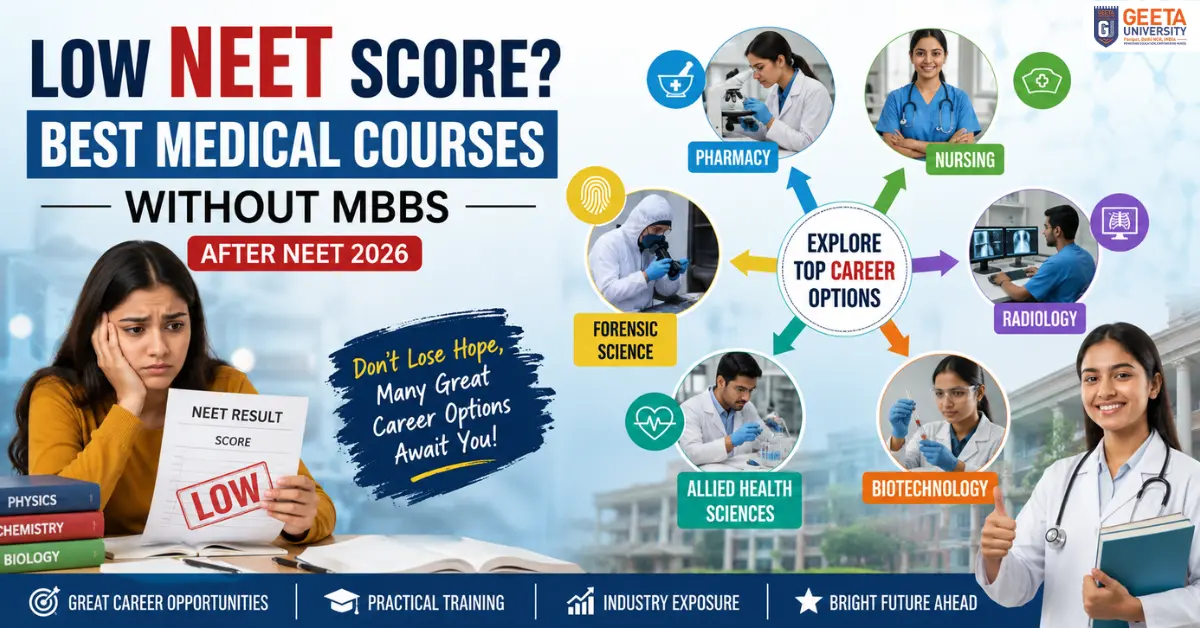
Low NEET scores are not a reason to stop studying in the medical sphere. The smartest thing to do is to switch your career to a growth branch of the health industry – such as Allied Health Sciences, Pharmacy, or Forensic Science. These subjects are taught at Geeta University and provide great practical training and career placement opportunities without any stressful competition.
As you all know, the recent NEET paper has been cancelled due to widespread irregularities. The exam is now rescheduled for 21 June 2026 (Sunday). Instead of waiting, the best option now is to secure your academic future by exploring alternative, highly rewarding healthcare career paths immediately.
What Next After Scoring Low in the NEET Exam?
There are still multiple career options available in healthcare or the sciences that students can explore if they have lower scores. The academic and professional opportunities in courses like BDS, BAMS, BHMS, B.Sc. Nursing, physiotherapy, biotechnology, and allied health sciences are still very high. Some students even attempt NEET again with a systematic preparation plan emphasizing NCERT concepts, mock test papers, and weaker subjects. It should be based on career aspirations, preparation, and long-term interests.
What Are the Alternative Options/Courses After a Low NEET Score?
If your score is low in NEET, there are still multiple options and medical courses without MBBS after NEET to explore that will allow you to work in the medical field. Here are some of the options you can consider:
Re-Attempting NEET
The students who want to get a seat in MBBS or a government medical school can opt for a drop year and retake the exam. This is a discipline, a consistent and mentally focused option.
How to Make the Drop Year Work for You?
- Review past errors and pinpoint problem areas.
- Set realistic weekly and monthly study goals.
- Use NCERT books and reliable study material.
- Take practice tests frequently to improve speed and accuracy.
- Improve time management and minimise negative marking errors.
Choosing Medical Courses Without MBBS After NEET
Even with a low score in NEET, you can still pursue a medical career by opting for alternative clinical medical degrees.
| Degree | Full Form | Duration | Focus Area |
| BAMS | Bachelor of Ayurvedic Medicine and Surgery | 5.5 Years | Traditional Ayurvedic medicine and clinical systems |
| BHMS | Bachelor of Homeopathic Medicine and Surgery | 5.5 Years | Homeopathic medical systems and holistic treatment |
| BDS | Bachelor of Dental Surgery | 5 Years | Dental surgery, oral health, and dental hygiene |
| BPT | Bachelor of Physiotherapy | 4.5 Years | Physical therapy, rehabilitation, and injury recovery |
| B.Sc. Nursing | Bachelor of Science in Nursing | 4 Years | Patient care, hospital nursing, medical assistance |
Considering Paramedical Courses After NEET
If your NEET results are low, but you are still interested in the medical sphere, you can choose paramedical and laboratory courses as your alternative.
| Course | Specialization | Duration | Primary Career Role |
| B.Sc. MLT | Medical Laboratory Technology | 3 Years | Clinical pathology labs, blood analysis, and testing |
| B.Sc. Radiology | Radiology and imaging technology | 3 Years | Handling X-Rays, MRI, and CT scanners |
Pure Sciences & Biotechnology
Students interested in biology, research, pharmaceuticals, or laboratory-based careers can explore pure science and biotechnology programmes through admission based on Class 12 marks.
| Course | Specialization | Duration | Primary Career Role |
| B.Sc. / B.Tech Biotechnology | Genetics, molecular biology, and applied sciences | 3 to 4 Years | Vaccine manufacturing, biopharma, and drug development |
| B.Sc. Life Sciences | Microbiology, biochemistry, botany, and zoology | 3 Years | Research labs, healthcare, and biological sciences |
| BS / Integrated M.Sc. Courses | Research-focused science programmes | 4 to 5 Years | Scientific research and higher studies |
| B.Sc. Forensic Science | Criminal investigation and molecular forensics | 3 Years | Forensic laboratories and investigation agencies |
| B.Sc. Biomedical Sciences | Human biology and medical research | 3 Years | Diagnostic labs and healthcare research |
| B.Sc. Microbiology | Microorganisms and laboratory science | 3 Years | Clinical labs, food industries, and research centres |
| B.Sc. Food Technology | Food processing and quality control | 3 Years | Food safety and production industries |
| B.Sc. Nutrition | Nutrition and diet planning | 3 Years | Healthcare centres and diet consultancy |
Join A Private Medical College
Another opportunity to become a doctor, even if your NEET score is low, is to join a private medical school. Of course, the tuition is quite high and varies between ₹10 lakhs to ₹25 lakhs depending on the college.
Studying MBBS Abroad
For students who cannot attend Indian schools, studying MBBS abroad is a wonderful choice. You will need to invest money and time, but this way leads to the realization of your dream of becoming a physician. There are many countries with affordable and recognized MBBS degrees in medical sciences. Popular destinations include:
- Russia
- Uzbekistan
- Kazakhstan
- Philippines
How to Switch Career After NEET?
Switching your career track after NEET involves shifting focus from intensive clinical medicine to core biomedical, diagnostic, and technical support frameworks. The transition is straightforward because your foundational training in Physics, Chemistry, and Biology perfectly matches these specialized health fields.
Instead of waiting out prolonged admission disputes, making a structural switch ensures you stay within the expanding healthcare ecosystem. To transition successfully, prioritize professional lines that connect you with actual industrial workflows, commercial healthcare operations, or scientific diagnostic services.
Which Courses are Best to Switch After NEET?
The wider medical sector relies on technical specialists to manage pharmaceuticals, legal investigations, and laboratory diagnosis. Top programs include:
- Bachelor of Pharmacy (B.Pharm): Handles drug design, formulation, pharmacology, and chemical distribution logistics.
- BSc Forensic Science without NEET: Focuses on crime scene investigation, legal biology, toxicology, and evidence analysis.
- B.Sc. Medical Laboratory Technology (MLT): Focuses on managing modern diagnostic instrumentation, pathology testing, and clinical biochemistry.
- B.Sc. Nutrition & Dietetics: Addresses therapeutic nutrition, metabolic management, and public healthcare planning.
What is Geeta University Offering You?
Students aspiring to shift their career to the healthcare and life sciences can opt for programmes offered by the School of Allied Health Sciences at Geeta University.
What Makes Geeta University Different:
- Students can get up to a 100% fee-free scholarship via GUTS.
- Up-to-date laboratories and laboratory instruction.
- Industry-oriented curriculum and clinical exposure.
- Internships in health-related fields.
- Practical experience with medical and diagnostic machines
- Strong placement assistance for healthcare professions.
Conclusion
Your NEET scores are low, and the test was called off? There is no reason to give up because the healthcare industry employs many pharmacists, forensic experts, and diagnostic technicians. At Geeta University, you can receive the highest-quality education and obtain a great career right after graduation.
Frequently Asked Questions
You can build excellent medical careers in Pharmacy, Forensic Science, or Advanced Diagnostics. To make this change successful, Geeta University offers industry-focused healthcare degrees built around clinical practice and professional lab experience.
Yes, fields like pharmaceutical development and laboratory management offer exceptional financial growth and job security. Geeta University ensures these outcomes by embedding corporate training and hospital internships directly into its healthcare curriculum.
Taking a drop year can help students improve their NEET preparation with focused study and better planning. At the same time, students should also keep other healthcare and science-related career options open due to changing competition and admission trends.
Allied Health branches focus on important technical aspects of medicine and diagnostics, such as clinical practice, forensic tests, and laboratory research. All the fields mentioned above guarantee job placement much faster. At Geeta University, students train using modern diagnostic instruments.
You can secure direct admissions based entirely on your Class 12th science merit marks. Geeta University provides an easy, direct admission process for its allied health programs, eliminating competitive counselling delays.
Related Blogs

What to Do After CBSE 12th Result 2026: Course & College Guide for GU Students
The result for CBSE 12th class is out, and once again, students in India are…
Unveiling the World of Surveying: Navigating the Depths with Precision
Introduction Surveying is an age-old practice that has evolved over centuries, playing a crucial role…
Top Universities in Haryana 2026: Rankings, Fees & Placement Record
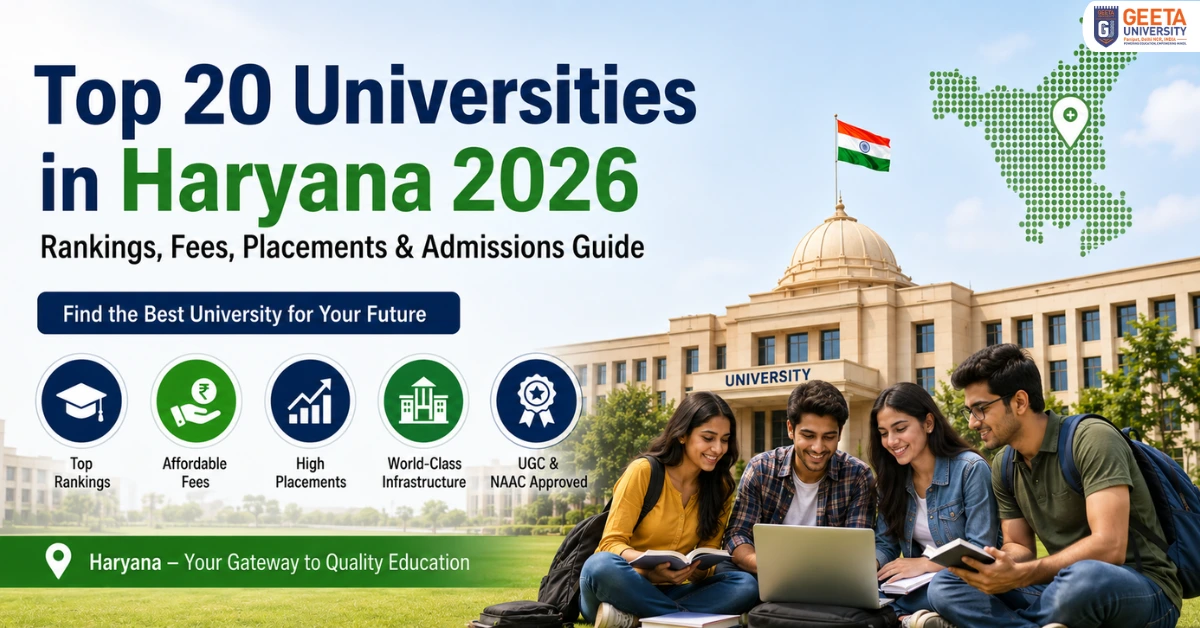
Choosing an institution entails considerations based on rankings, fee costs, and future employment opportunities. Universities…

What are the top 10 Private Colleges in Delhi for Placement-Driven Education in 2025
Not the dramatic kind, just the quiet moment where you try to understand why a student searches…
Introduction to leadership : Cultivating leadership qualities in students
In this world that is always changing, there has never been a time when the…
Top Courses with 100% Placement Opportunities in 2026 | Best Job Guaranteed Programs
The top courses with 100% placement opportunities in 2026 include Artificial Intelligence, Data Science, Cybersecurity,…