
How to Become a Supply Chain Manager in India: Complete Career Path
Home / MBA / How to Become a Supply Chain Manager in India: Complete Career Path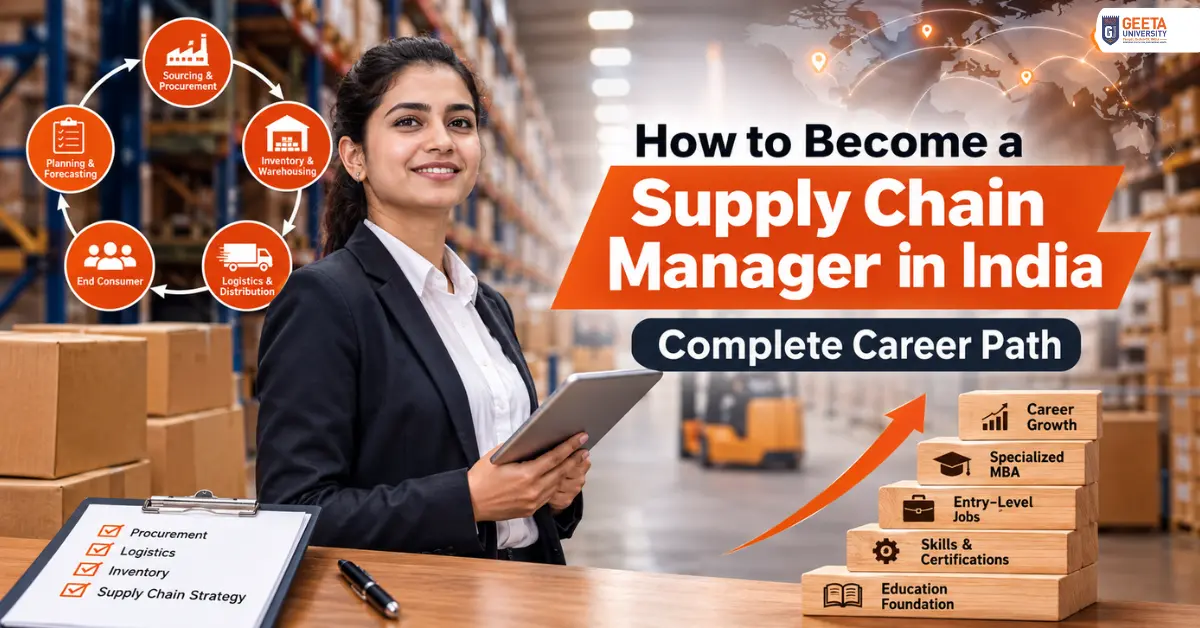
Understanding how to become a supply chain manager requires the completion of a bachelor’s degree program in business, engineering, or commerce, followed by an MBA/PGDM in Supply Chain Management. Becoming proficient in data analytics, procurement, inventory control, and obtaining professional certifications is the primary path to gaining entry-level and managerial positions.
What are the Roles and Responsibilities in Supply Chain Management?
Supply chain managers are responsible for the transfer of goods, services, and information from the raw material stage to the end consumer. Main execution areas of supply chain managers include:
- Demand Forecasting & Strategic Planning: Analysis of the historical data of the market and sales to plan inventory production according to consumer demands;
- Vendor & Procurement Management: Searching, assessing, and negotiating with suppliers for receiving high-quality raw materials at the lowest price possible;
- Inventory & Warehouse Management: Implementation of lean inventory approaches (e.g., Just-In-Time) to minimize holding costs and avoid stockouts;
- Logistics & Distribution Network Design: Creation of routes and selection of carrier networks for the timely delivery of the products;
- Risk Mitigation & Compliance: Assessment of political, economic, or environmental factors and compliance with national laws of import and export.
What are the Key Skills Required for Supply Chain Management?
Achieving a successful supply chain manager career path in India requires a combination of analytical skills, strategic execution, and technology knowledge.
Main skills required for supply chain manager positions are:
- ERP System Literacy: Practical skills in operating software like SAP MM, SAP APO, Oracle SCM to automate purchases and track them;
- Data Analytics & Quantitative Forecasting: Skills in using Advanced Excel, Python, or Tableau to analyze logistics data;
- Negotiation & Strategic Sourcing: Financial skills to create favorable long-term vendor contracts;
- Project & Operations Management: Knowledge of Six Sigma principles to optimize manufacturing processes;
- Problem Solving & Crisis Management: Abilities to reroute freight networks in cases of supply interruptions.
What are the Career Opportunities in Supply Chain Management?
The field of SCM is developing fast and creating numerous supply chain manager job scope in India in the retail, e-commerce, manufacturing, pharmaceutical, and 3PL companies. The table below breaks down supply chain management courses and salary structures:
| Job Role | Recommended Qualification | Entry/Mid Level Salary (INR) | Primary Focus |
| Logistics Manager | B.Com / B.Tech / MBA | ₹4.5 LPA – ₹9.0 LPA | Fleet operations, freight routing, shipping schedules. |
| Procurement Specialist | BBA / B.Tech / PGDM | ₹4.0 LPA – ₹8.5 LPA | Vendor negotiation, material sourcing, purchase order auditing. |
| Supply Chain Analyst | B.Sc Analytics / B.E. / MBA | ₹5.0 LPA – ₹10.0 LPA | Data modelling, demand planning, bottleneck analysis. |
| Warehouse Operations Manager | Graduate Degree / Diploma in SCM | ₹4.5 LPA – ₹8.0 LPA | Storage optimization, inventory auditing, order fulfilment. |
| Supply Chain Manager | MBA in Logistics & SCM | ₹10.0 LPA – ₹22.0 LPA | End-to-end supply strategy, budget control, vendor management. |
How to Become a Supply Chain Manager?
Knowing how to become a supply chain manager requires following a systematic career path, which includes the following steps:
- Completion of the Senior Secondary Education (10+2): Passing Class 12 exams from a recognized board in Commerce, Science, or Arts with a minimum of 50% aggregate marks;
- Completion of the Undergraduate Degree: Enrollment in one of the relevant bachelor’s programs (B.Tech in Industrial/Production Engineering, BBA, B.Com, or B.Sc in Data Analytics);
- Taking Master’s Level Entrance Examination: Registration for competitive MBA entrance exams like CAT, MAT, XAT, or CMAT. Alternatively, candidates may take university-specific entrance tests or enter master’s degree programs based on merit;
- Taking Specialized MBA or Post-Graduation Program: Gaining admission in an MBA program focused on Logistics, Operations, or Supply Chain Management;
- Gaining Entry-Level Position: Start a logistics manager career or procurement associate, inventory planner, or supply analyst for gaining industry experience;
- Gaining Managerial Status: Achieving a senior-level position after gaining experience in inventory management and supply operations.
Students must know:
Which Certifications and Internships Can Help Become a Supply Chain Manager?
Apart from the degree, there are specialized SCM certification courses that will validate operational skills and distinguish candidates:
- Certified Supply Chain Professional (CSCP): Offered by the Association for Supply Chain Management (ASCM), covers end-to-end operations of the global network;
- Certified in Production and Inventory Management (CPIM): Focuses on internal operations, capacity planning, and materials management;
- Certified Professional in Supply Management (CPSM): Issued by the Institute for Supply Management (ISM), focuses on strategic sourcing and procurement;
- Lean Six Sigma Green/Black Belt: Focuses on process improvement, root-cause analysis, and operational cost reduction.
Internships in e-commerce logistics centres, shipping operations, and manufacturing plants provide practical training for future professionals. Students gain hands-on experience with using software for inventory tracking, observe warehouse layouts, and learn to solve real-life logistics problems.
How Can Geeta University Help?
For students evaluating how to become a supply chain manager, Geeta University Panipat (Delhi NCR/Haryana) provides an active placement portal, connecting students with corporate partners in manufacturing, retail, and e-commerce logistics.
- Industry-Focused MBA: Gain specialised knowledge in logistics, procurement, inventory, planning, and supply chain operations.
- Practical Learning: Develop job-ready skills through internships, projects, case studies, and industry exposure.
- Specialised Curriculum: Learn about international logistics, green supply chains, e-commerce, risk management, and lean manufacturing.
- Career Opportunities: Prepare for roles such as Supply Chain Manager, Logistics Manager, Procurement Officer, and Operations Analyst.
- Strong Placement Support: Access structured placement drives, internships, industry interactions, and career development activities.
- Top Placement Package: Students can access placement opportunities with packages of up to ₹1.4 Cr.
- Wide Recruiter Network: More than 550+ companies have participated in recruitment, offering over 3,500+ job opportunities.
- Corporate Readiness: Geeta Finishing School helps students strengthen communication, soft skills, and workplace readiness.
- Technical Skill Development: Geeta Technical Hub provides hands-on training in relevant technologies and industry skills.
Conclusion
A profession in the SCM area ensures reliable career growth and global mobility with constant demand in diverse industrial sectors. Through completion of a relevant bachelor’s degree, pursuit of an MBA, mastery of software tools, and industry certifications, candidates get a solid foundation for career advancement. Prospective SCM professionals who evaluate how to become a supply chain manager may use this path for a successful career in modern logistics and supply chains.
Frequently Asked Questions
Logistics deals with the storage and transport of goods within the company, while supply chain management covers a larger scope and includes supplier procurement, production, inventory planning, and delivery logistics.
MBA is not mandatory but helps with career advancement. Candidates with a bachelor's degree in engineering or business may enter junior positions, but the MBA program helps professionals advance to managerial and executive positions much faster.
Geeta University, located in Panipat, Haryana, offers specialized management programs like an MBA in Supply Chain Management and Logistics, which involve ERP software training, warehouse management systems, and industry internships.
Yes. Candidates with a background in commerce, business administration, arts, or science may enter this field. The development of quantitative skills, analytical abilities, and inventory management concepts is more important than an engineering background.
Geeta University pays attention to practical learning through industrial visits, real-life case studies, supply chain simulation, and internship placement support.
Related Blogs

Best Career Options After MBA in Pharmaceutical Management
An MBA in pharmaceutical management enables the graduate to possess business and industry-specific knowledge that…

Why MBA Is The Bridge Between Knowing Your Business And Leading Your Business
MBA education reflects the overall transformation of the ecosystem in India attracting students from all…

MBA After Engineering: Salary, Benefits, Jobs & Career Scope
Engineering graduates are increasingly choosing to pursue an MBA after earning a BTech. This career…
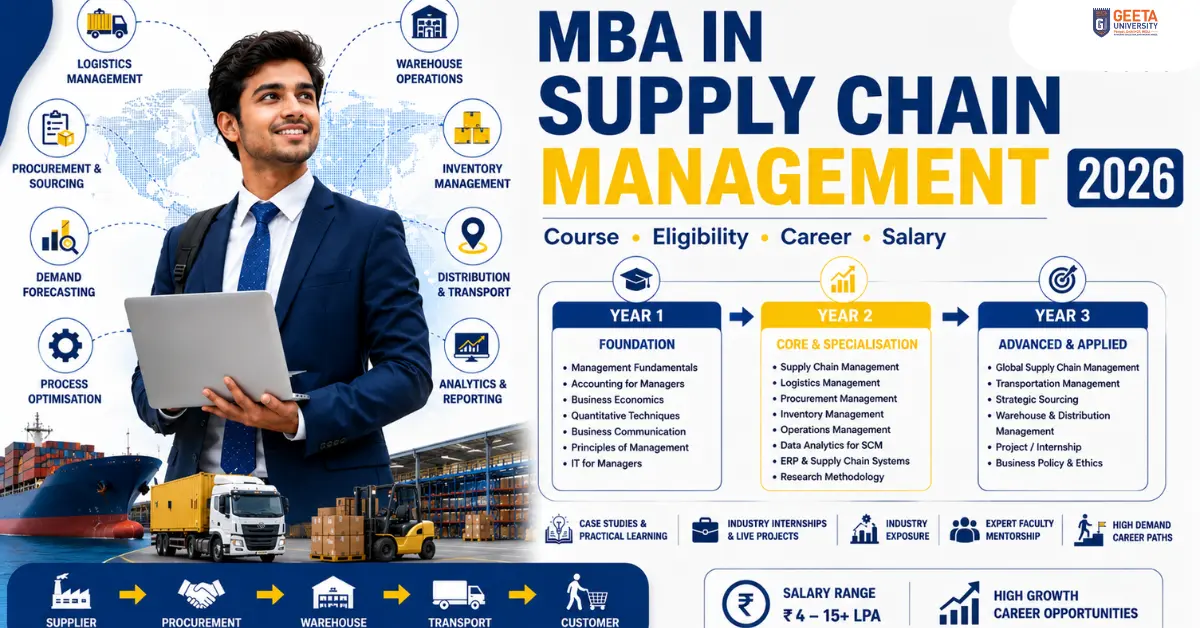
MBA in Supply Chain Management: Course, Eligibility, Career & Salary
MBA in Supply Chain Management is a 2-year postgraduate degree focused on logistics, procurement, inventory,…

Leadership Skills In The AI Era: Do You Still Need Them?
While artificial intelligence efficiently handles supply chains and writes code, many professionals question the future…
Which Field is Best in MBA – Specialisations to Choose
Which field is best in MBA is a question that defines long-term academic and professional…