
MBA in Supply Chain Management: Course, Eligibility, Career & Salary
Home / MBA / MBA in Supply Chain Management: Course, Eligibility, Career & Salary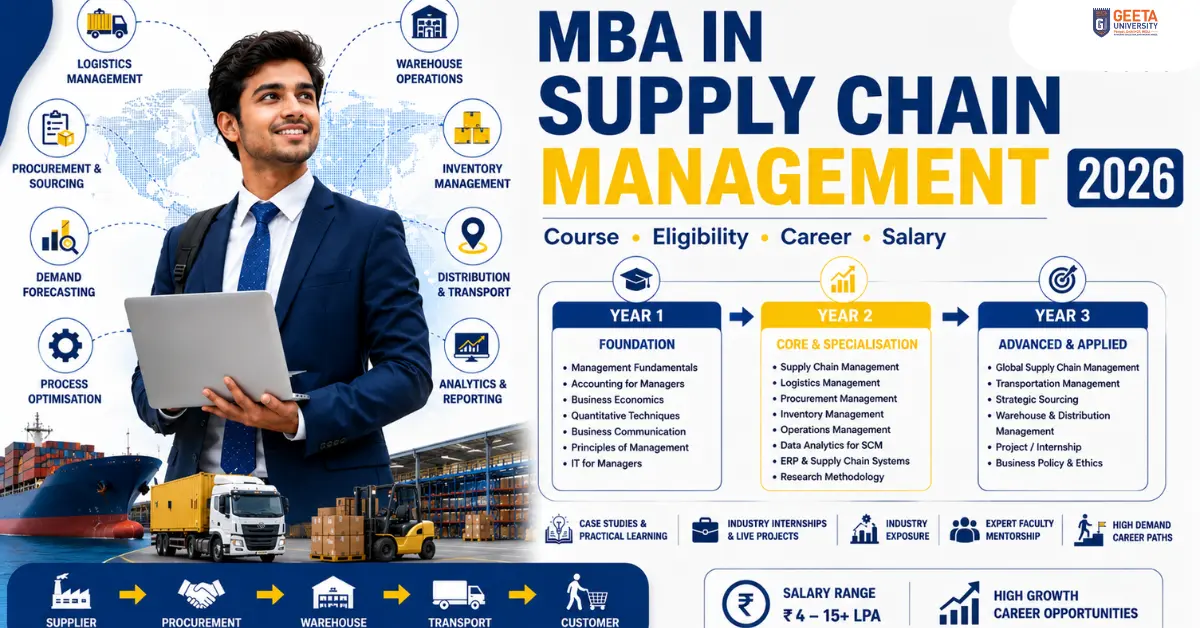
MBA in Supply Chain Management is a 2-year postgraduate degree focused on logistics, procurement, inventory, and distribution management. Eligibility requires a bachelor’s degree from a recognized university, with admission via an entrance test or merit. Graduates work as Supply Chain Managers, Logistics Managers, and Procurement Officers, earning ₹4–15+ LPA. Geeta University offers 550+ recruiters and packages up to ₹40 LPA.
What Is Supply Chain Management?
The process of coordinating, managing, and optimising the flows of suppliers, goods, and services between suppliers and the end consumer is called supply chain management. It brings proper coordination to production and shipping.
Key responsibilities of supply chain management include planning, sourcing, production coordination, logistics management, and on-time shipping to ensure successful and cost-effective business practices.
- Vendor and supplier collaboration
- Demand forecasting and stock planning
- Logistics and transport management
- Warehouse operations
- Cost control and process optimisation
- Technology-based tracking and reporting
How Is the MBA in Supply Chain Management Structured?
The MBA in Supply Chain Management is a postgraduate business certificate that concentrates on logistics, sourcing, and shipping systems. It combines management concepts with applied learning in transportation, inventory control, and supply network design. This program trains students for managerial roles in manufacturing, retail, logistics firms, and international trade organisations.
Course Structure
The academic structure is designed to provide both management fundamentals and specialised supply chain knowledge.
|
Academic Component |
Learning Focus |
| Core Management | Finance, marketing, human resources, operations |
| Supply Chain Subjects | Logistics, procurement, inventory, distribution |
| Technology | ERP systems, data analytics, and planning tools |
| Practical Learning | Case studies, projects, and industry exposure |
| Final Semester | Internship or applied project |
Eligibility: It is necessary to graduate from a well-known institution, and admission is determined through academic assessment and university choice factors.
- Bachelor’s degree from a recognised university
- Minimum qualifying marks as per university norms
- Admission through an entrance test or a merit-based process
Who Can Apply for MBA in Logistics and Supply Chain Management?
Candidates with a bachelor’s degree from a recognized university can apply for MBA in Logistics and Supply Chain Management. Admission is based on academic merit or entrance exam scores, along with university-specific criteria.
Eligibility at a glance:
- Bachelor’s degree from a recognized university (any stream)
- Minimum qualifying marks as per university norms
- Admission through entrance test or merit-based selection
- Open to commerce, arts, and science graduates alike
Which Career Paths Open Up After an MBA in Supply Chain Management?
The students of this program are employed in the manufacturing, e-commerce, pharmaceuticals, and international logistics companies
Key career roles include:
- Supply Chain Manager
- Logistics Manager
- Procurement Officer
- Inventory Planner
- Operations Analyst
- Distribution Manager
- Warehouse Manager
Where Can You Get a Job After an MBA in Supply Chain Management?
Supply chain management offers many roles across the following industries and more like these.
|
Industry |
Common Roles |
| Manufacturing | Production planner, logistics coordinator |
| Retail & E-commerce | Inventory manager, distribution analyst |
| Logistics Companies | Freight manager, warehouse supervisor |
| FMCG & Pharma | Supply planner, procurement executive |
| Export-Import Firms | Trade and shipping manager |
How Much Is the MBA in Supply Chain Management Salary in India?
The MBA in Supply Chain Management salary career path offers strong income potential based on experience, sector, and organisational scale.
| Experience Level | Salary Range (₹ per annum) |
| Entry level | 4–6 lakh |
| Mid-level | 7–12 lakh |
| Senior level | 15 lakh and above |
The salary of an MBA in logistics and supply chain management increases considerably with exposure to the industry and leadership roles.
Why Choose Geeta University for MBA in Supply Chain Management?
Geeta University has an established MBA course that is meant to fit in the present-day requirements in the industry in terms of management of logistics and operations. The theoretical model combines specialisation of supply chain management with business management to prepare it professionally.
Academic Strengths: The program is based on an industry-relevant curriculum with a high degree of emphasis on logistics, operations, and supply chain technology that are supplemented by case-based learning and mentoring provided by professors with extensive academic and industry experience.
Program Coverage at Geeta University: The program is a blend of management studies and advanced training in logistics, procurement, inventory control, and distribution systems.
It also entails technology-based planning, internships, and industry-based projects as an aid in the preparation for the profession.
Students also benefit from Geeta University’s dedicated support ecosystem, including the GUTS (Geeta University Talent Scholarship) for meritorious students, the Geeta Finishing School (GFS) for corporate readiness and soft-skill training, and the Geeta Technical Hub (GTH) for hands-on technical and industry-relevant skill development — together strengthening students’ overall placement preparedness.
Which MBA Specializations Does Geeta University Offer Along With Supply Chain Management?
|
MBA Specialisation |
Learning Focus |
| Supply Chain Management | Logistics, procurement, inventory planning, and distribution systems |
| Marketing | Branding, digital marketing, sales management, and consumer behaviour |
| Human Resource Management (HRM) | Talent acquisition, training, performance management, and labour relations |
| Pharmaceutical Management (Pharma) | Pharmaceutical marketing, healthcare operations, and regulatory systems |
| Finance | Corporate finance, financial analysis, investment management, and risk control |
Eligibility: Graduation from a recognised institution is required, and selection is based on academic evaluation and the university’s admission criteria.
How Good Are Geeta University’s Placements for MBA Supply Chain Management Graduates?
Placement Support & Outcomes: Geeta University’s placement program connects students with employers via structured placement drives, internships, industry interaction, and skill-development activities that support corporate preparedness. The university has recorded involvement from over 445 companies, offering more than 3,000 job opportunities across business, IT, finance, and engineering sectors, with salary results differing by role and performance.
Key placement highlights include:
- Over 445 recruiting companies are visiting the campus
- More than 3,000 job opportunities are offered
- Highest package up to ₹40 LPA
- Average salary range of ₹4–6 LPA
- Recruiters include Amazon, Infosys, HCL, Wipro, and Capgemini
Conclusion
MBA supply chain management produces candidates capable of controlling procurement, logistics, inventory, and distribution within complex business networks that are complex. The program promotes manufacturing, retail, e-commerce, and global trade careers. Graduates acquire growth-friendly and secure career prospects with high demand in the industry and an increase in the complexity of supply chains. Academic preparations and practical exposures offered in universities like Geeta University reinforce professional preparedness in the field.
Read Related Blogs:
FAQs
1.Who should study for this MBA?
Graduates interested in business process management, logistics, and operations.
2. Can this MBA be used with graduates of commerce and arts?
Yes, all academic background graduates are welcome.
3.What are the competencies that are achieved during this course?
Inventory control, logistics planning, operations analysis, and management of vendors.
4.How big is this MBA career-wise?
Graduates are employed in supply planning, logistics management, procurement, and operations.
5.Is Geeta University industry exposed?
Yes, there are internships, projects, and interaction with the industry in the program.
6.Does it have placements post-completion?
Yes, through university recruiting drives we do offer placement assistance.
7.Does this MBA contribute to a global career?
Yes, the supply chain management promotes international trade and activities of multinational corporations.
8.Does this MBA help in long-term career development?
Yes, the field is good in terms of progression to higher operational and managerial positions.
Related Blogs

Best Career Options After MBA in Pharmaceutical Management
An MBA in pharmaceutical management enables the graduate to possess business and industry-specific knowledge that…

MBA in Human Resource Management: Course, Subjects & Placements
Considering an advancement in the people side of business? Human resource management may be the…

How to Become a Supply Chain Manager in India: Complete Career Path
Understanding how to become a supply chain manager requires the completion of a bachelor’s degree…

Role of AICTE Model Curriculum in Shaping MBA Education
The All-India Council for Technical Education (AICTE) Model Curriculum plays an imperative role in shaping…

How to Prepare for CAT, MAT & CMAT Exams
You have to study in a way that makes sense for each test. This means…

Which Field is Best in MBA – Specialisations to Choose
Which field is best in MBA is a question that defines long-term academic and professional…
Leave a comment