
BCA in Cyber Security: Scope, Salary & Top Job Roles in 2026
Home / BCA / BCA in Cyber Security: Scope, Salary & Top Job Roles in 2026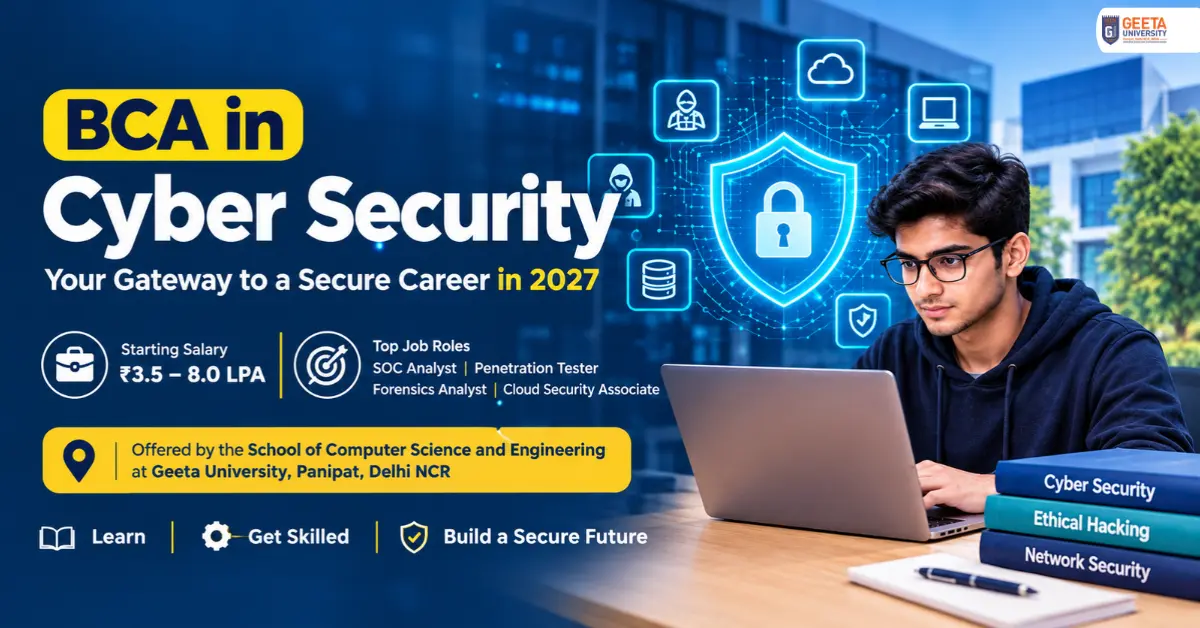
Taking up a BCA in Cyber Security in the year 2027 will lead to a wide range of career opportunities, with starting salaries ranging from ₹3.5 LPA to ₹8.0 LPA. Core entry-level job roles include SOC Analyst, Junior Penetration Tester, Cyber Forensics Analyst, and Cloud Security Associate.
The course is offered by the School of Computer Science and Engineering at Geeta University, Panipat, Delhi NCR, and is ideal for students seeking placement right after graduation.
What is a BCA in Cyber Security and What Skills Will You Learn?
Students engage in practical learning of key defenses such as networks, cloud, ethical hacking, and incident response. One acquires knowledge in technical areas of the curriculum that are used in the industry to fight off cyber-attacks.
Some of the basic concepts that are taught in this course include:
- Networking and protocols: used in IP networks such as TCP/IP, routing, and firewall technologies.
- Ethical hacking: uses Kali Linux and the associated tools, including Nmap and Metasploit for penetration testing and vulnerability assessment.
- Cyber forensics: involves digital forensics and network security and incident response to network-related crimes.
- Secure coding: web application security, secure coding techniques and practices, and prevention of SQL injection and scripting attacks.
- The operating systems and cloud security: contain elements related to the security aspects of Linux, Windows, Amazon Web Services, and Microsoft Azure.
- Cryptography and legal issues: comprise encryption and IT governance, network and information security policies, and the law as it relates to networks and computer crime.
How does BCA in Cyber Security compare to B.Tech and BSc in 2026?
A specialized undergraduate degree in cybersecurity focuses primarily on practical tool application and job readiness in just 3 years. In contrast, a B.Tech program requires 4 years with a heavy emphasis on engineering mathematics, while a BSc degree centers mostly on theoretical science and academic research.
| Factor | BCA in Cyber Security | B.Tech CSE (Cyber Security) | BSc Cyber Security |
| Duration | 3 Years (4 Years for Hons. track) | 4 Years | 3 Years |
| Primary Focus | Practical security tools & applications | Engineering math & CS theory | Theoretical science & research |
| Eligibility | 50% in 10+2 (Any recognized stream) | PCM with entrance exams | Science stream |
| Fees & ROI | Good ROI & Job prospects | High tuition fees | Moderate tuition fees |
| Placements | Strong in IT & Cyber Security | Strong opportunities across cybersecurity, software, and IT roles | Good opportunities across cybersecurity, software, and IT roles |
| Career Options | Cybersecurity Analyst, SOC Analyst, Security Support Specialist, IT Security Executive | Cybersecurity Engineer, Security Analyst, Penetration Tester, Security Consultant, Security Architect | Cybersecurity Researcher, Information Security Associate, Security Support Specialist |
Students Must Know:
What is the BCA Cyber Security Eligibility, Entrance & Admission Process?
The Eligibility Criteria for Candidates are Given Below:
Candidates from the Science, Commerce, and Arts streams are eligible for this course if they meet the minimum percentage of marks given below.
- Standard Route – Candidates must secure a minimum of 50% aggregate marks in the Class 10+2 exam conducted by a recognized board in any stream.
- Relaxed Route – Minimum 45% aggregate marks for SC/ST/OBC candidates.
- Diploma Route – Students with a Diploma in Commercial Practice and at least 50% marks are also eligible
What Entrance Exams do Private Institutions require?
Most private universities accept CUET UG scores or run their own online entrance tests evaluating general aptitude, reasoning, and basic computer knowledge. Some colleges also offer direct merit-based admission on 12th board marks. Meanwhile, Geeta University accepts both CUET UG and/or 12th Class merit as a prerequisite for admission.
What is the exact Admission Process at Geeta University?
- Apply Online: First, fill out the application form on admissions.geetauniversity.edu.in.
- Merit & Scholarship Exam (GUTS): You will get admission based on Class 12 marks or CUET scores. You can also take GUTS (Geeta University Test of Scholarship) to grab a chance to avail up to a 100% tuition waiver.
- Counseling & Verification: Attend a brief counselling session & verify your Class 10th/12th mark sheets & ID.
- Seat Confirmation: Pay your initial deposit fee to reserve your seat.
What is the Fee Structure and Scholarship Scheme for this Course?
Most private institutions charge fees ranging from 80,000 to 1,80,000 rupees per annum, as stated by Shiksha. Meanwhile, Geeta University has a clear fee structure as well as a merit-based scholarship:
- Annual Fee: ₹1,10,000 per year (or ₹55,000 per semester).
- Scholarships (2026–2027): Up to 100% tuition fee waivers available based on Class 12 board merit scores or university’s scholarship exam (GUTS) performance.
What is the Career Scope and Industry Demand for Cybersecurity Graduates in 2026?
The demand for trained security professionals has risen over the last few years, as per ISACA’s State of Cybersecurity 2025 report. The proliferation of Data protection laws and the rise of AI-related risks are forcing companies to hire specialists for their defense departments.
What Higher Education Options Are Available After BCA in Cyber Security?
- Technical Degrees & Exams: Eligible to pursue M.Sc./MCA in Cybersecurity / Digital Forensics via entrance exams like CUET PG.
- Techno-Management Tracks: Eligible for an MBA in IT Management or Business Analytics (via CAT/XAT) to pivot into cybersecurity governance and risk auditing.
Get detailed info on Higher Education:
- MCA in Cyber Security: Career Opportunities in India
- Cyber Security Engineering – Syllabus and Future Scope
What Entrepreneurship & Independent Opportunities Exist for BCA Cyber Security Graduates?
- Consultancy & Audits: Provide penetration testing, vulnerability assessment, and ISO 27001/GDPR-compliance auditing services to SMEs on a contract basis.
- Startups & Bug Bounties: Can build a Managed Security Service Provider (MSSP) niche or participate in corporate/bug bounty programs via platforms like HackerOne.
What are the Top Job Roles and Expected Starting Salaries for Graduates?
Graduates will find plenty of entry-level job opportunities in IT companies, banks, and core security agencies.
What is the Expected BCA Cyber Security Salary Growth in 2026?
The average salary for freshers ranges from ₹3.5 LPA to 8.0 LPA. Candidates who complete additional technical certifications or advanced training can secure higher starting packages of ₹7 LPA to ₹10 LPA.
| Experience Level | Career Stage | Expected Salary Range |
| Entry-Level | Freshers (0–2 Years) | ₹3.5 LPA – ₹8.0 LPA |
| Mid-Level | Mid-Level Roles (3–5 Years) | ₹8.0 LPA – ₹15.0 LPA |
| Senior Level | Senior Roles (6+ Years) | ₹18.0 LPA – ₹30.0+ LPA |
What are the Top Job Roles and Expected Starting Salaries for Graduates?
Graduates will find plenty of entry-level job opportunities in IT companies, banks, and core security agencies.
| Job Role | Key Responsibilities | Approx. Starting Salary (Freshers) |
| SOC Analyst (Tier 1) | Live monitoring of logs, event triaging to detect and prevent cyber threats | ₹3.5 LPA – ₹6.0 LPA |
| Junior Penetration Tester | Performing authorized tests on company applications to resolve security vulnerabilities | ₹4.0 LPA – ₹7.0 LPA |
| Cyber Forensics Analyst | Collecting digital evidence after the breach and preparing incident reports | ₹3.8 LPA – ₹6.5 LPA |
| Cloud Security Associate | Setting up firewalls, identity/access management, and security policies in AWS or Azure | ₹4.5 LPA – ₹8.0 LPA |
| IT Security Auditor | Auditing organizational networks and systems for ISO 27001 and GDPR compliances | ₹4.0 LPA – ₹6.5 LPA |
Are There Government Job Opportunities for BCA Cyber Security Graduates?
- Government Tech Support & Data Cadres: Unlock eligibility for central government technical positions—such as Data Processing Assistants via SSC Selection Posts—focusing on system monitoring, secure network maintenance, and data administration across union ministries.
- Cyber Police Cells & Contractual Forensics: Open pathways into state law enforcement wings as a Contractual Cyber Forensics Analyst or Digital Evidence Consultant, assisting police investigation teams with data extraction, cybercrime tracking, and incident triage.
What are the Future Scope & Emerging Trends in Cybersecurity?
- Key Focus Areas: Increasing demand for expertise in AI/ML-driven threat detection, Zero Trust architecture, IoT security, and post-quantum cryptography.
Which Certifications Boost Your Career Prospects?
Earning industry certifications during your BCA in Cyber Security degree helps distinguish your resume during campus placement drives.
- CompTIA Security+: Entry-level benchmark certification for a security analyst role.
- Certified Ethical Hacker (CEH): Preferred qualification for pentesting and offensive security specialist roles
- Cisco CyberOps Associate: Valuable certification for aspiring SOC Analysts.
Why Choose Geeta University for a Cyber Security Degree?
A Premier Education Destination in Panipat, Haryana (Delhi NCR), Geeta University takes pride in being amongst the best, known for its technical education and UGC approval.
Key Highlights :
- Strong Placements: 550+ recruiters visited the campus for 3,500+ job drives, with a highest package of ₹40 LPA and an average package of ₹6 LPA.
- Top Recruiters: Amazon, TCS, Infosys, Wipro, Deloitte, and Quick Heal are some of the top companies that recruit regularly from Geeta University.
- Geeta Technical Hub (GTH): Provides hands-on labs for Kali Linux, Wireshark, Metasploit, and ethical hacking.
- Geeta Finishing School (GFS): Focuses on personality development, mock interviews, communication skills, etc.
- Recognized Standard: The AI-powered campus has an updated NEP-compliant course curriculum.
Conclusion
With the claim made in the report published by MarketsandMarkets that the Indian cybersecurity market is projected to reach $ 16,863.2 million by 2030, building a career in cyber defense offers strong long-term growth. Geeta University stands out among top BCA Cyber Security colleges by providing an ideal platform with industry-aligned curricula, GTH practical labs, a 550+ recruiting network, and up to 100% GUTS scholarships. Check your eligibility and Apply Now for the 2026–2027 academic session today!
Frequently Asked Questions
The fee for the course is ₹1,10,000 per annum (₹55,000 per semester) with 100% waivers on your fees if you meet GUTS criteria. For more information, visit GUTS.
Yes, Geeta University is among the best, located in Panipat, Delhi NCR, offering UGC-approved, SOC labs, GTH technical training, and more than 550 hiring partners.
The eligibility criteria require that you have 50% aggregate marks in Class 12th (45% for SC/ST/OBC) from any recognized board or 50% marks from a recognized diploma.
Yes, Geeta University also provides up to 100% scholarships on tuition fee based on your class 12th board examination results and GUTS examination scores.
Yes, admissions are currently open to every undergraduate program starting from the 2026-2027 session.
Students receive career support through Geeta Finishing School (GFS), which has made possible over 3,500 job offers across 550+ recruiting partners.
The curriculum covers essential scripting languages like Python and Bash for automating security tasks, but does not require heavy software development.
Yes, completing a BCA in Cyber Security with practical training enables graduates to secure job offers without pursuing further post-graduate studies.
Yes, students who completed Class 12 in Commerce, Arts, or Science with at least 50% marks satisfy the eligibility criteria.
The average salary for a BCA Cyber Security fresher is INR 3.5 LPA to 8.0 LPA; however, an experienced candidate would be able to earn INR 8 LPA to 30 LPA+.
Related Blogs

BBA vs BCA: Which Course Should You Choose After 12th?
After completing 12th grade, many students struggle to decide on BBA vs BCA. Both are…

Best BCA Colleges in Uttar Pradesh 2026: Rankings, Fees, Eligibility & Career Scope
Choosing among the best BCA colleges in Uttar Pradesh is one of the biggest decisions…

Edge Computing & Cloud: Preparing BCA Students for Emerging Tech Trends
Edge computing is regarded as a procedure that processes data locally near its source that…
Planning to Study BCA? – Know Course, Eligibility, Fees & Career
BCA (Bachelor of Computer Applications) is a 3-year undergraduate degree in computer science and application…
What to Do After BCA? Top Career Options, Jobs & Salary
A Bachelor of Computer Applications (BCA) is an undergraduate program focused on developing a strong…

Top Career Opportunities and Future Scope After BCA in AI & ML
A BCA in AI and ML is highly in demand in today’s ever-changing technology environment….