
BBA Course Guide: Eligibility, Subjects, Career Opportunities
Home / BBA / BBA Course Guide: Eligibility, Subjects, Career Opportunities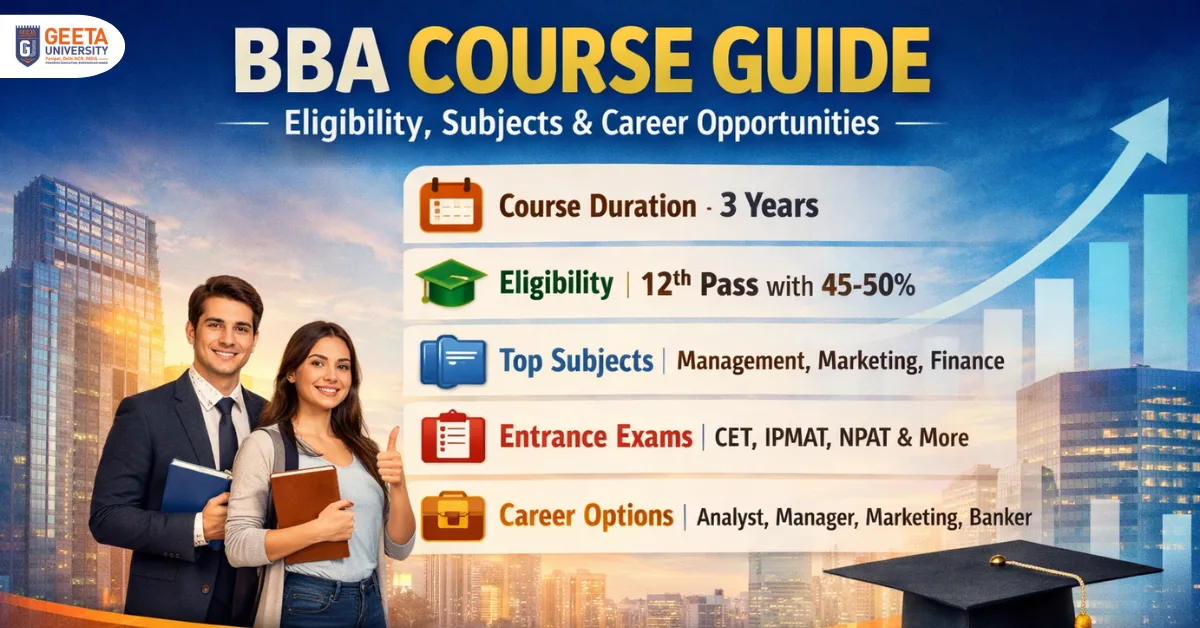
A BBA degree helps graduates effectively pursue professions in healthcare, finance, consulting, e-commerce, and other fields by opening up several opportunities in fields like management, finance, marketing, and operations. This guide has all the information you need, whether you’re wondering what a BBA is, what you’ll study, or what employment you can get after graduation and the skills required for BBA students.
Let’s take a straightforward, student-friendly look at the full specifics of the BBA course after 12th, including the syllabus, length, eligibility, costs, and job opportunities.
What is BBA?
BBA stands for Bachelor of Business Administration. It is a three-year undergraduate degree program that focuses on management strategies, leadership abilities, and business concepts. The degree program is appropriate for students who want to pursue an MBA in the near future, enter the corporate sector, or start their own business.
A business management course after 12th prepares you for the workforce right away by providing you with a foundation in fields including marketing, finance, human resources, operations, and communication. Depending on your interests and professional aspirations, you may also choose from a variety of BBA specializations, such as Business Analytics, International Business, or Hospitality Management.
BBA course after 12th: Duration, Syllabus, Specializations, Fees and More
The BBA course covers more than simply textbook concepts. It is a practical, hands-on program that teaches students how companies operate in the current world. Key specifications of the BBA course after 12th are:
| Category | Details |
| BBA Full Form | Bachelor of Business Administration |
| Course Level | Undergraduate |
| BBA Course Duration | 3 years (6 semesters) |
| Examination Type | Semester-wise |
| Eligibility | 10+2 in any stream with 45to50% marks, admission may require students to clear the BBA entrance exams in India |
| BBA admission process | Merit-based, entrance-based, or interview, depending on the institute |
| BBA course fees in India | Government: ₹20,000 to ₹60,000 per annum
Private: ₹70,000 to ₹2,00,000 per annum, Top B-schools: ₹2,50,000 to ₹5,00,000 total |
| Average Salary After Degree | ₹3 LPA to ₹5 LPA |
| Recruiting Companies | Accenture, Tata Consultancy Services, HDFC, EY, Capgemini and more |
| 1st Year Subjects | Principles of Management, Business Communication, Financial Accounting, Microeconomics, Computer Applications, Business Mathematics |
| 2nd Year Subjects | Marketing Management, Human Resource Management, Financial Management, Business Law, Macroeconomics, Organizational Behaviour |
| 3rd Year Subjects | Strategic Management, Entrepreneurship Development, International Business, E-commerce, Project Management, Internship/Live Project |
| BBA Specialisations | Finance, Human Resource, Foreign Trade, Banking and Insurance, Sales and Marketing, Hospitality and Hotel Management, Information Technology, Communication and Media Management, Hospital and Healthcare Management |
| Required Skills | Professional communication skills, Leadership, Team player, Persuading skills, Multi-tasking, Adaptability, Time management |
| BBA entrance exams in India | CET (State-level), SET (Symbiosis), IPMAT (IIM Indore/Rohtak), DU JAT, NPAT (NMIMS), Christ University Entrance Test, St. Xavier’s Entrance Exam, AIMA UGAT, GGSIPU CET, AMU Entrance Test, CUET-UG |
| University-specific admissions | Geeta University accepts GUTS (online test), CUET-UG, or 10+2 merit. GUTS offers up to 100% scholarship. The eligibility requires 40 to 50% in 10+2 |
| Top BBA colleges in India | IIM Indore (IPM), Shaheed Sukhdev College of Business Studies, Christ University, NMIMS Mumbai, Symbiosis Centre for Management Studies, St. Xavier’s College Mumbai, Amity University, Loyola College, Mount Carmel College, Geeta University. |
Why Choose the BBA Course After 12th?
Management education is revolutionary due to the many BBA management employment options. Management education gives students valuable abilities that are appreciated throughout businesses. Here are some perks and reasons why the demand for the BBA course after 12th is rising:
- Early Career Start: While still in college, learn about business and get internships.
- Broad Industry Scope: A BBA may lead to opportunities in IT, marketing, finance, HR, and logistics.
- Strong Foundation for MBA: It provides you with a distinct advantage while getting ready for MBA admission tests.
- Practical Learning: Case studies, projects, group debates, and exposure to the actual world are all common in higher education. Additionally, some educational institutions use management games to help students enhance their strategic thinking and decision-making abilities in an entertaining way.
- Versatile Skillset: You’ll improve your critical thinking, problem-solving, leadership, and communication abilities.
If you’re considering jobs after BBA in management or business, it’s worthwhile to look into the specifics of BBA courses since these are only a few of the major advantages of a BBA course after 12th.
People Also Read:
What are the Career Options after BBA?
One great thing about having a BBA is that it can help you get a lot of different jobs. You can go straight into the job market or go to college for higher studies after BBA, such as MBA, M. Com, PGDM, or a diploma school.
Here are some great options for jobs and salary after BBA, and their salary:
| Job Role | Average Salary (LPA) |
| Business Analyst | ₹5 to ₹9 |
| Financial Analyst | ₹4 to ₹8 |
| Digital Marketing Specialist | ₹4 to ₹8 |
| Data Analyst | ₹5 to ₹10 |
| HR Executive | ₹3 to ₹5.5 |
| Marketing Executive | ₹3.5 to ₹6 |
| Operations Manager | ₹4 to ₹7 |
| Business Development Executive | ₹3 to ₹5.5 |
| Sales Executive | ₹3 to ₹5 |
| Investment Banker | ₹10 to ₹20+ |
| Product Management Associate | ₹6 to ₹12 |
| Management Consultant | ₹6 to ₹12 |
| Government Roles (UPSC/Bank/SSC) | ₹5 to ₹9 |
Read Also:
What Skills will Students Learn by Choosing the BBA Course After 12th?
Bachelor of Business Administration (BBA) programs focus on professional development, not only business and management theory. Students get real-world experience and crucial skills for business success throughout the program. Communication, critical thinking, leadership, and problem-solving are taught to create well-rounded workers. These abilities help BBA students succeed in school, internships, and professions, making BBA a strong stepping stone to success.
- BBA communication skills: Proposing ideas.
- Leadership skills in BBA graduates: Team management and motivation.
- BBA Business & Management Skills: Strategic planning, problem-solving, decision-making.
- Skills: Analytical, enterprising, networking.
Conclusion
Get started in business and leadership with a Bachelor of Business Administration. You can find endless chances in a wide range of fields if you take the right education, learn the basics, and get hands-on experience.
It’s crucial to pick the right institution if you want to pursue a BBA course after 12th and receive a high-quality education with good placement support. Find schools that offer hands-on learning, teachers with a lot of experience, and an introduction to the field. You can look into choices like Geeta University, which is among the top BBA colleges in India, to get the best education and job advice that will help you do well in the business world.
Frequently Asked Questions
BBA stands for Bachelor of Business Administration. It is a three-year undergraduate program in management and business.
Students must have completed their 12th with at least 45 to 50% from any stream. The course lasts for three years, or six semesters.
Principles of Management, Marketing, Finance, Human Resource Management, Economics, Business Law, and Communication Skills are all included in the BBA curriculum.
Indeed, depending on your area of interest and expertise, a BBA may lead to successful career pathways in both marketing and finance.
Of course, because it teaches fundamental business ideas early on, a BBA is one of the greatest starting points for an MBA.
Marketing, finance, human resource management, and business analytics are popular and in-demand BBA specialities. Your professional objectives will determine which is better.
Related Blogs
BBA vs BCA: Which Course Should You Choose After 12th?
After completing 12th grade, many students struggle to decide on BBA vs BCA. Both are…
BBA Career Options in 2026: What Can I Do After BBA?
BBA is an undergraduate degree which equips students with good business and management skills. With…

Top 10 Career Paths After BBA in AI & Data Analytics
A BBA in AI and data analytics would provide good career prospects in the post-BBA…

Which BBA College in India Offers the Highest Placement in 2026
Selecting the best BBA colleges in India in 2026 is not only about the reputation….