
Why Choose BCA Over Traditional IT Degrees in 2026? A Smarter Path to a Successful Tech Career
Home / BCA / Why Choose BCA Over Traditional IT Degrees in 2026? A Smarter Path to a Successful Tech Career
Picking a course after Class 12 is one of those choices that can feel far too big for your age. If computers and software pull at your interest, you have probably bumped into the same question that thousands of students ask every year. Should you take a BCA, or go for a more traditional degree like a B.Tech in Computer Science or a B.Sc in IT?
This blog looks closely at why so many students now choose BCA over traditional degrees, and whether that choice is the right one for you in 2026. The honest answer is that BCA has changed a great deal. It is no longer a backup plan. For a lot of students who want to build real skills and start working sooner, it has become a smart first choice.
We will compare both paths fairly, share salary and cost figures, and walk through where each degree really shines. By the end, you should be able to decide with confidence rather than guesswork.
What Is BCA, and What Counts as a Traditional IT Degree?
Before comparing them, it helps to be clear about what each course actually is.
BCA (Bachelor of Computer Applications): A three-year degree focused on software, programming, web and mobile development, and databases. The teaching leans towards practical, job-ready skills. Under the new education policy, some universities now offer a four-year BCA Honours version with a research-focused final year.
B.Tech in CSE or IT: A four-year engineering degree. It goes deep into theory, mathematics, algorithms, hardware, and system design, alongside coding. It is classified as an engineering qualification.
B.Sc in IT or Computer Science: A three-year science degree that sits somewhere in between. It covers computing fundamentals with a more academic, less application-heavy approach than BCA.
When people say traditional IT degrees, they usually mean the B.Tech route, and sometimes the B.Sc IT route. These have been the default for years. BCA is the option that has quietly caught up, and in some ways moved ahead, for students who want a faster, skills-first start in software.
BCA vs Traditional IT Degrees: A Quick Comparison
Here is a side-by-side view of the main differences. Read it as a starting map, not the final word, because the best fit still depends on your own goals.
| Factor | BCA | Traditional IT Degree (B.Tech CSE/IT) |
| Duration | 3 years (4-year Honours option) | 4 years |
| Main focus | Software, applications, practical coding | Engineering theory, systems, hardware, deep computer science |
| Eligibility | 10+2 in any stream, maths often not required | 10+2 with Physics, Chemistry, and Maths, plus an entrance exam |
| Maths in 12th | Usually not mandatory | Mandatory |
| Typical private cost | Lower, around 1.5 to 4 LPA in total | Higher, around 4 to 12 LPA in total |
| Classification | Computer applications / science | Engineering degree |
| Best suited for | Quick entry into software and IT roles | Core engineering, hardware, and deep-tech roles |
| Higher studies | MCA, MBA, PG diploma | M.Tech, MS, MBA |
What Career Options Do You Get After BCA?
A common worry is that BCA leads to fewer or weaker job options. In practice, BCA graduates work across the same software and IT roles that the industry hires for in large numbers. The table below shows common roles and indicative entry-level salaries in India.
| Role After BCA | What You Do | Entry Salary (India) |
| Software Developer | Build and maintain software applications | 3 to 6 LPA |
| Web / Full-Stack Developer | Create websites and web applications | 3 to 6 LPA |
| Data Analyst | Turn data into useful business insights | 3.5 to 7 LPA |
| AI / ML Associate | Support machine learning models and tools | 4 to 8 LPA |
| Cyber Security Analyst | Protect systems and data from attacks | 4 to 8 LPA |
| App Developer | Build mobile applications | 3 to 6 LPA |
| Cloud Associate | Deploy and manage cloud services | 4 to 7 LPA |
| Software Tester / QA | Check software quality before release | 3 to 5 LPA |
BCA Salary vs Traditional IT Degree Salary in India
It is fair to say that a B.Tech CSE graduate from a top college can start with a higher package than a BCA graduate. But the gap is often smaller than people assume, and it narrows fast once skills and experience take over from the name of the degree.
| Stage | BCA | B.Tech CSE/IT | B.Sc IT |
| Entry, general profile | 2.5 to 4.5 LPA | 4 to 8 LPA | 2.5 to 4 LPA |
| Entry, specialised profile | 4 to 8 LPA | 6 to 12 LPA | 3.5 to 6 LPA |
| After 3 to 5 years | 6 to 12 LPA | 8 to 18 LPA | 5 to 10 LPA |
| After PG (MCA / M.Tech) | 7 to 15 LPA | 10 to 22 LPA | 7 to 14 LPA |
The lesson here is simple. Your degree gets you the interview. Your skills, projects, and the way you present yourself get you the offer and the raise. A driven BCA graduate often out-earns a passive engineering graduate within a few years.
Does a BCA Limit You Compared to a B.Tech?
An honest guide has to cover where the traditional degree still holds an edge, so you can make a fair choice.
- Core engineering and hardware roles: If you dream of working on chip design, embedded systems, robotics hardware, or deep research, a B.Tech gives the theory base you will need.
- Some government and PSU jobs: A few technical government posts and exams, such as those linked to GATE, are designed around engineering degrees. Check the eligibility for any specific role you are targeting.
- Certain campus recruiters: A handful of companies still prefer B.Tech profiles for specific engineering roles, though this is fading as skills-based hiring grows.
The good news is that none of these gaps are permanent. A BCA graduate can do an MCA, earn industry certifications, and build a project portfolio that competes strongly with engineering graduates for most software and IT jobs. For the large software services sector, which hires in huge numbers, BCA graduates are a natural fit.
How Has BCA Changed Under NEP 2020?
Part of the reason BCA looks stronger today is that the course itself has been upgraded.
- AICTE approval is now standard: BCA programmes increasingly follow an approved, industry-aligned curriculum, which improves quality and trust.
- UGC recognition holds firm: A BCA degree is recognised for both private jobs and government roles where a general degree is accepted.
- A four-year Honours option exists: Under the new education policy, some universities offer a four-year BCA with a research-focused final year and exit options at earlier stages.
- Modern topics are built in: Newer curricula include machine learning, cloud, cyber security, and data science rather than only the basics.
In short, the BCA of 2026 is closer than ever to what the IT industry actually wants from a fresh graduate.
Which BCA Specializations Do Employers Want in 2026?
A general BCA is good. A specialised BCA can be even better, because it signals focused, in-demand skills. These are the specialisations drawing the strongest recruiter interest right now.
| Specialization | What You Learn | Roles It Leads To |
| AI and Machine Learning | ML algorithms, deep learning, NLP, computer vision | ML associate, AI developer, data analyst |
| Cyber Security | Network security, ethical hacking, digital forensics | Security analyst, ethical hacker, SOC analyst |
| Data Science and Analytics | Data handling, statistics, visualisation | Data analyst, business intelligence analyst |
| Full-Stack / Web Development | Front-end, back-end, and database skills | Full-stack developer, web developer |
| Cloud Computing | Cloud platforms, deployment, basic DevOps | Cloud associate, support engineer |
What Should You Look for in a Good BCA College?
If you decide BCA is your path, the college you pick matters as much as the degree. A strong programme turns three years into a real launchpad. Watch for these signs of quality:
- An updated, practical curriculum: One that teaches current tools and includes AI, cloud, and cyber security, not just the basics.
- Specialisation options: Dedicated tracks in AI and ML, cyber security, or data science, rather than a generic course with renamed subjects.
- Hands-on labs and projects: Real lab time, live projects, and internships that build a portfolio.
- Certification support: Help to earn industry certificates from providers such as AWS, Microsoft, Cisco, or Oracle.
- Placement and grooming support: A team that prepares you for interviews and connects you with recruiters. Ask for the number of companies that visited, not only the highest package.
- Scholarships: Merit-based fee support that eases the cost for strong students.
As an example of how this looks in practice, Geeta University offers BCA with dedicated Honours specialisations in Artificial Intelligence and Machine Learning and in Cyber Security, alongside a general BCA. Its students gain practical training through the Geeta Technical Hub, which runs certification tracks in tools such as AWS, Cisco, and Python, and receive interview preparation through the Geeta Finishing School. The university also offers merit scholarships through its GUTS scholarship test. These are the kinds of features worth checking for at any institution you consider, whether or not it is the one you finally pick.
What Is the Future Scope of BCA Graduates in India?
The outlook is bright, and it is getting brighter. India’s IT sector keeps growing, and newer waves such as artificial intelligence, cloud, and cyber security are creating fresh roles every year. Software services alone account for a large share of tech hiring, and these jobs map closely to what BCA teaches.
Demand is rising for people who can build, secure, and analyse digital systems. A BCA graduate who keeps learning, earns a certification or two, and builds a few real projects is well placed to grow with the industry rather than chase it. That is a strong reason why students continue to choose BCA over traditional degrees as a launchpad into tech.
Conclusion
Choosing between a BCA and a traditional IT degree is really a choice about how you want to start. If you value a faster, more affordable, skills-first route into software and IT, the case for why students choose BCA over traditional degrees becomes easy to see. Three years, friendlier entry rules, lower cost, and a sharp focus on practical skills add up to a genuine head start.
A B.Tech still has its place, especially for core engineering, hardware, and deep research. But for the large and growing world of software, applications, data, and cyber security, a well-chosen BCA can take you just as far, and often sooner.
Whatever you decide, pick the path that matches your strengths, your interests, and your budget, and then commit to building real skills. The degree opens the door. What you do inside those years is what truly shapes your career.
Frequently Asked Questions
Students choose BCA over traditional degrees because it is shorter at three years, usually cheaper, open to any stream without compulsory maths, and focused on practical software skills. It lets you enter the IT job market sooner while keeping options like MCA open for later.
Neither is simply better. BCA is a faster, application-focused route that suits software, web, and IT services roles. B.Tech goes deeper into engineering theory and suits core engineering, hardware, and research. The right choice depends on your goals, your comfort with maths, and your budget.
Yes. Entry-level salaries for BCA graduates in India generally range from around 2.5 to 4.5 LPA for general roles and higher for specialised ones such as AI or cyber security. Pay rises quickly with skills, certifications, and experience, and an MCA can lift it further.
Usually not. Most universities accept BCA applicants from any stream, and Mathematics is often not compulsory. This makes BCA a strong option for commerce and arts students who want to move into IT.
Yes. BCA is a UGC-recognised degree and is accepted for government and private jobs where a general graduate degree is required. For specific technical posts, always check the exact eligibility, since some engineering-only roles exist.
Popular options after BCA include MCA, an MBA, and postgraduate diplomas in areas such as data science or cyber security. MCA is the most common route for those who want deeper technical and higher-paying roles.
Artificial intelligence and machine learning, cyber security, and data science are among the most in-demand specialisations. They tend to attract strong recruiter interest and better starting salaries than a general computing profile.
A three-year BCA is a complete, recognised degree and is enough for most IT careers. The four-year Honours version, offered by some universities under the new education policy, adds a research-focused year that can help if you plan higher studies or research roles.
You can pursue an MCA after BCA, which is the usual upgrade path. Some universities also allow lateral entry into engineering for eligible students. MCA is generally the smoother and more common route.
For students who want a faster, affordable, skills-first entry into software and IT, BCA is a strong choice in 2026. Its updated curriculum, specialisation options, and clear higher-study pathways make it a practical and respected degree.
Related Blogs

Top 10 Best BCA Colleges in India in 2026: Fees, Placements, and Specialisations Compared
What makes a BCA college worth choosing in 2026? The IT industry has changed more…
Why BCA in Cybersecurity is the Most Lucrative IT Path in 2026?
The IT industry in 2026 is no longer driven only by software development. Companies are…

What should be done for a BCA? – Geeta University
Geeta University offers a Bachelor of Computer Applications (BCA) degree that equips students with the…

The Best Course for Data Science in India (2026): A Framework, Not Just a Ranking
There is no single best course for data science that wins for everyone. The right…

Data Science Learning: A Complete Beginner’s Guide for Students in 2026
Introduction If you’ve been exploring career options in technology, chances are you’ve come across the…
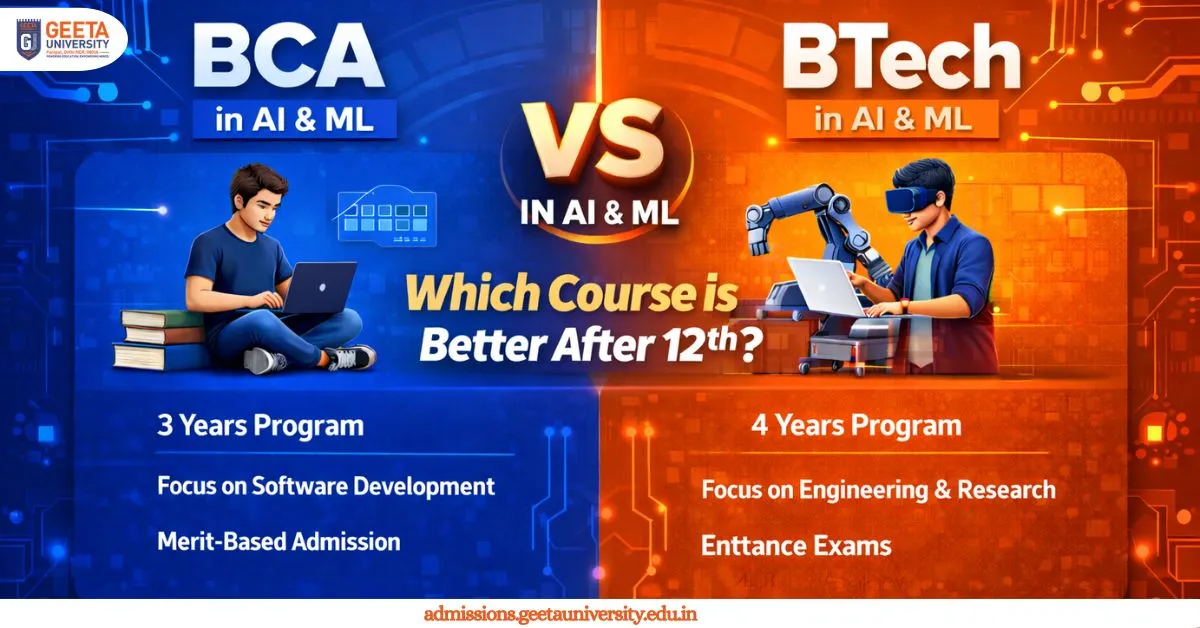
BCA vs B. Tech in AI & ML: Which Course Is Better After 12th
BCA vs B. Tech in AI & ML: Which is better after 12th? BCA is…