
BSc Agriculture Courses After 12th: A Complete Guide to Admission, Syllabus and Career
Home / Agriculture / BSc Agriculture Courses After 12th: A Complete Guide to Admission, Syllabus and Career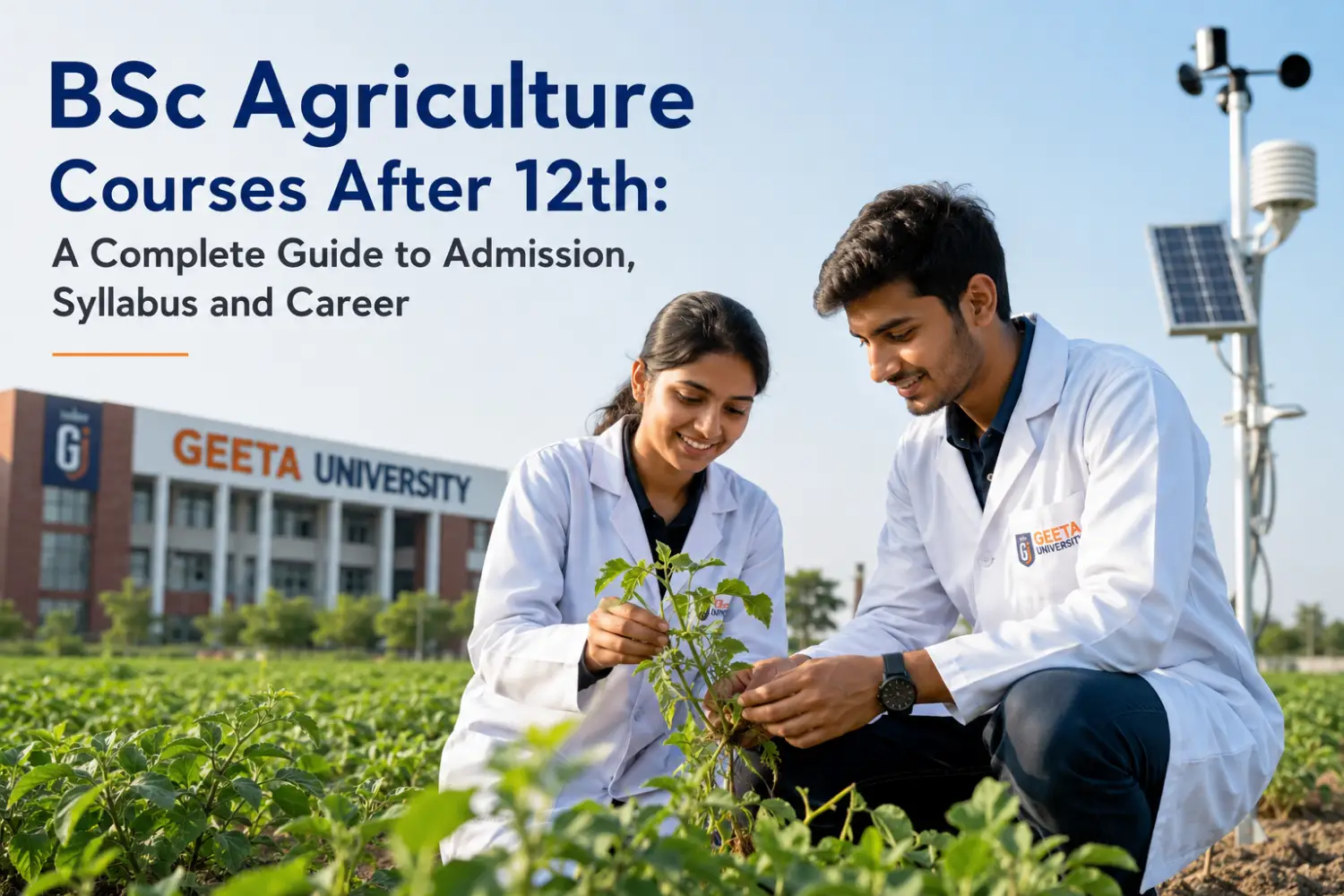
Choosing the right degree after school shapes the next decade of your life. If you are drawn to science, the outdoors and solving real problems that affect millions of people, BSc Agriculture courses after 12th deserve a place at the top of your list. Agriculture is no longer only about ploughs and fields. It is a modern, technology-led science that blends biology, data, business and sustainability to feed a growing planet.
This guide explains everything you need to know about BSc Agriculture after 12th in clear, simple terms. You will learn what the course covers, who can apply, how admission works, which entrance exams matter in 2026, what the syllabus looks like, and the careers that follow. We have also included the practical detail that helps you make a confident decision, along with the reasons Geeta University has become a trusted name for agricultural education in North India.
What Is BSc Agriculture?
BSc Agriculture, formally the Bachelor of Science (Honours) in Agriculture, is a four-year undergraduate agriculture science course built around eight semesters. It is recognised as a professional degree by the Indian Council of Agricultural Research (ICAR), which gives the curriculum national academic value rather than the feel of a purely theoretical science degree.
The programme teaches you how food is grown, protected, improved and brought to market. You study core subjects such as agronomy, soil science, genetics and plant breeding, entomology, plant pathology, horticulture and agricultural economics. Modern programmes also weave in agricultural biotechnology, precision farming and sustainable agriculture, so that graduates are ready for the technology-driven realities of the sector.
What makes this agriculture education different from a regular science degree is its emphasis on practice. A large part of the course happens on farms, in laboratories and through village outreach, not only in lecture halls. This hands-on model is the reason agriculture graduates adapt quickly to real jobs.
Why Choose BSc Agriculture Courses After 12th?
There has rarely been a better time to enter the field. India is one of the world’s largest producers of food, and the sector is being reshaped by drones, data and biotechnology. Choosing BSc Agriculture courses after 12th places you at the centre of this change, with broad options across government, private industry and entrepreneurship.
A few reasons the degree stands out:
- Recession-resistant demand: people will always need food, so agriculture rarely faces the slowdowns that hit other industries.
- A genuine NEET alternative: if you studied Physics, Chemistry and Biology but did not clear NEET, this degree offers a respected, science-based career without repeating a year.
- Government career access: a BSc Agriculture degree is the direct qualification for roles such as Agriculture Development Officer, and it opens doors at NABARD, public sector banks and ICAR institutes.
- Fast-growing private sector: seed, fertiliser, agri-input, food processing and agritech companies actively recruit skilled graduates.
- Entrepreneurship and impact: from organic farms to agri-startups, the degree equips you to build sustainable agriculture ventures that create rural employment.
- A base for higher study: it is a strong foundation for an MSc, an MBA in agribusiness, or research careers in agricultural biotechnology.
What Are the Key BSc Agriculture Course Details?
Before you apply, it helps to see the BSc Agriculture course details at a glance. The structure is consistent across most recognised universities, although fees and specialisations vary by institution.
|
What Is the Eligibility for BSc Agriculture After 12th?
The eligibility for BSc Agriculture after 12th is straightforward, which is part of the reason the degree is so accessible to science students from different boards.
|
Students from a PCM background, without Biology, can also apply to several programmes. However, Biology is preferred and is mandatory at some institutions, so always confirm the subject requirement of your chosen college before applying.
What Is the BSc Agriculture Admission Process?
The BSc Agriculture admission process follows two broad routes, entrance-based admission and direct admission. Understanding both helps you plan a reliable backup option.
Entrance-Based Admission (Government and ICAR Colleges)
- Apply online for the relevant entrance exam, such as CUET (ICAR-UG) or your state agriculture CET.
- Appear for the computer-based test and secure a qualifying score.
- Register for the counselling conducted by ICAR or the state authority.
- Lock your college and course preferences in order.
- Complete document verification and pay the admission fee to confirm your seat.
Direct Admission (Many Private and Deemed Universities)
Several private universities, including those that accept CUET scores, offer admission on the basis of your Class 12 marks. This route is faster and removes the pressure of a single examination. At Geeta University, for example, eligible students can secure BSc Agriculture admission directly through the official admissions portal, subject to meeting the eligibility criteria.
Which Entrance Exams Are Required for BSc Agriculture After 12th?
If you are targeting a government or ICAR-affiliated institution, an entrance exam is part of the journey. The exam landscape changed recently, so it is important to use current information rather than older guides.
For the 2026 cycle, undergraduate admission to ICAR-recognised universities is conducted through CUET (ICAR-UG) by the National Testing Agency (NTA), which has replaced the earlier standalone AIEEA UG examination. Candidates choose Physics, Chemistry and one of Biology, Mathematics or Agriculture, with the syllabus drawn from Class 11 and Class 12 NCERT content.
|
A useful point for applicants from a science background: the CUET (ICAR-UG) syllabus overlaps significantly with NEET preparation, which is why many students who do not clear NEET move smoothly into agriculture. Always check the eligibility and subject rules of each target university, since some have specific conditions on the third subject and the upper age limit.
What Does the BSc Agriculture Syllabus Cover?
The BSc Agriculture syllabus is broad by design. It moves from foundational science in the early semesters to specialised, application-focused subjects later, and finishes with hands-on programmes that bridge the gap between classroom and field.
|
Most modern programmes, including the one at Geeta University, follow the ICAR Dean Committee framework, currently the Sixth Dean Committee, aligned with the National Education Policy 2020 for outcome-based learning. The final year is built around two flagship components, the Rural Agricultural Work Experience (RAWE) and the Experiential Learning Programme (ELP), which place you on real farms and in agri-enterprises before you graduate. You can review the full structure on the School of Agricultural Sciences page.
What Are the Specialisations Within an Agriculture Science Course?
As you progress, an agriculture science course lets you lean into the area that excites you most. Common specialisations include the following:
- Agronomy: the science of crop production and field management.
- Horticulture: fruits, vegetables, flowers and plantation crops.
- Soil Science and Agricultural Chemistry: soil health, fertility and nutrient management.
- Genetics and Plant Breeding: developing improved, higher-yielding crop varieties.
- Agricultural Biotechnology: using molecular tools to improve crops and protect them from disease.
- Entomology and Plant Pathology: managing pests and diseases in a sustainable way.
- Agribusiness and Agri-Marketing: the commercial and supply-chain side of agriculture.
Among these, agricultural biotechnology, food technology and agribusiness management are seeing the strongest growth, while traditional areas such as horticulture and soil science continue to offer stable government careers.
What Career Opportunities Follow BSc Agriculture Courses After 12th?
The career value of a BSc Agriculture degree is one of its biggest attractions. Graduates are in demand across three worlds, government service, private industry and their own ventures.
|
Beyond these roles, graduates also work as Krishi Vigyan Kendra fellows, quality analysts in food processing units, plantation supervisors and rural development officers. The breadth of options is one reason the degree suits students with very different long-term goals.
What Is the Expected Salary After BSc Agriculture?
Salaries depend on your role, sector and skills. As a general guide, fresh graduates in the private sector typically earn around three to five lakh rupees a year, rising to six to twelve lakh with experience and specialisation. Government roles add the benefits of job security, allowances and structured growth, while successful agri-entrepreneurs can earn well beyond these ranges. The surest way to command a stronger starting package is to build practical skills during your degree, through internships and field training.
What Higher Studies Can You Pursue After BSc Agriculture?
Many students treat the degree as a launchpad rather than a finish line. Popular options include the following:
- MSc Agriculture in a chosen specialisation such as Agronomy, Genetics and Plant Breeding, or Horticulture.
- MSc in Agricultural Biotechnology for research and laboratory careers.
- MBA in Agribusiness Management for leadership roles in the agri-economy.
- ICAR AIEEA (PG) and AICE JRF or SRF for funded postgraduate and doctoral study.
- Civil services and state PSC examinations, where an agriculture background is a genuine advantage.
Government or Private Agriculture Colleges: Which Should You Choose?
Both paths can lead to a successful career, so the right choice depends on your goals. Government colleges offer ICAR recognition, lower fees and strong research exposure, but seats are limited and entry is competitive. Private universities offer modern infrastructure, industry tie-ups, internships and a simpler, often direct, admission route, usually at a higher fee. If you value hands-on learning, placement support and a faster route to a seat, a strong private university is often the smarter choice.
To compare your options in this region, read our guides on the top agriculture universities in Haryana and the best agriculture university in India.
Why Is Geeta University a Strong Choice for BSc Agriculture Courses After 12th?
For students weighing up BSc Agriculture courses after 12th in North India, Geeta University in Panipat, Haryana, has built a reputation for combining academic rigour with real-world readiness. Part of the Geeta Group of Institutions, established in 1985, the UGC-recognised university runs its School of Agricultural Sciences with a clear focus on practical, future-ready agriculture education.
- ICAR-aligned, NEP-ready curriculum: the four-year BSc (Honours) Agriculture follows an ICAR-aligned syllabus under the Sixth Dean Committee, implemented in line with the National Education Policy 2020.
- Learning on real farms: through the RAWE programme, the Experiential Learning Programme and, uniquely, faculty-owned farms, students spend significant time applying what they learn in the field rather than only reading about it.
- Faculty who research and publish: you learn from qualified faculty such as Dr. Neha Dahiya in Genetics and Plant Breeding, who has published more than twenty research papers and holds granted patents, and Dr. Shiv Kumar Shivandu in Fruit Science, with twenty-five-plus papers and patents on orchard tools. The school is led by Dr. Yuvraj Yadav, Head of the School of Agricultural Sciences.
- Strong industry connections: partnerships with names such as Bayer, Syngenta, Swaraj, Patanjali, Coromandel and leading seed companies give students exposure to live agri-business practice and internships.
- A wider placement ecosystem: Geeta University reports a highest package of 40 LPA, more than 550 recruiters and over 3,500 job offers across its programmes, supported by a dedicated finishing school and technical hub.
- A commitment to sustainability: the programme places real weight on sustainable agriculture and food security, preparing graduates to solve, not only study, the challenges facing Indian farming.
You can explore the full programme on the School of Agricultural Sciences page, review the latest placement record, and, when you are ready, apply through the admissions portal.
Final Thoughts
BSc Agriculture courses after 12th offer something rare, a science-driven degree with real social purpose and dependable career prospects. Whether you see yourself advising farmers, leading research in agricultural biotechnology, managing an agri-business or building a sustainable agriculture venture of your own, this degree gives you the knowledge and the practical grounding to get there.
The next step is simple. Choose a university that takes practical learning seriously, confirm the eligibility and admission route that fits you, and apply early. If Geeta University feels like the right fit, you can begin your BSc Agriculture admission today through the official admissions portal and take the first step towards a rewarding career in agriculture.
Catch placement highlights, fests, and campus moments — follow Geeta University on LinkedIn
Frequently Asked Questions
Yes. NEET is not required for BSc Agriculture. Admission is based on Class 12 marks at many private universities, or through entrance exams such as CUET (ICAR-UG) and state agriculture CETs for government colleges.
You need to have passed 10+2 from a recognised board with Physics, Chemistry and one of Biology, Mathematics or Agriculture. Most universities ask for at least 50% aggregate marks, with relaxation for reserved categories.
BSc Agriculture is a four-year, full-time degree spread across eight semesters, including practical training, internships and village outreach programmes.
Yes, many programmes accept students with Physics, Chemistry and Mathematics. However, Biology is preferred and is mandatory at some institutions, so confirm the subject requirement with your chosen college.
For ICAR-recognised universities, undergraduate admission is now through CUET (ICAR-UG), conducted by the NTA. State colleges may use state CETs, while many private universities offer direct admission on the basis of Class 12 marks.
Yes. Agriculture is a stable, growing sector with opportunities in government, banking, agritech, research and entrepreneurship. The degree also leads to higher studies such as an MSc or an MBA in agribusiness.
Freshers in the private sector typically earn around three to five lakh rupees a year, rising to six to twelve lakh with experience. Government roles add strong job security and allowances.
Yes. Geeta University's School of Agricultural Sciences offers a four-year BSc (Honours) Agriculture programme with an ICAR-aligned curriculum, practical farm training and industry partnerships. Eligible students can apply directly through the official admissions portal.
Related Blogs
Top 10 Agriculture Universities in Haryana: Entrance & Admission
Isn’t agriculture a very fascinating topic? Indeed, it is the foundation of a country like…
B.Sc. Hons. Agriculture: Scope, Syllabus, Eligibility and Career Opportunities
The B.Sc. Hons. Agriculture course has become one of the most rewarding undergraduate pathways for…

Best University for Agriculture Studies in Delhi NCR, India: BSc to PhD Programs
Geeta University in Panipat is one of the best universities for agriculture studies in Delhi…
BSc Agriculture Course: Eligibility, Admission, Syllabus, Fees and Career Scope
Agriculture is no longer only about ploughs and monsoons. It has grown into a science…
Master’s Degree Agriculture in India 2026: Specialisations, Admission Routes and Career Scope
A master’s degree agriculture programme in India is a two-year postgraduate qualification (M.Sc. Ag.) that…
BSc Agriculture: Course, Eligibility, Syllabus, Subjects, Fees and Career Scope (2026 Guide)
BSc Agriculture is one of the most future-ready degrees a science student can pick today….