
BSc Agriculture: Course, Eligibility, Syllabus, Subjects, Fees and Career Scope (2026 Guide)
Home / Agriculture / BSc Agriculture: Course, Eligibility, Syllabus, Subjects, Fees and Career Scope (2026 Guide)
BSc Agriculture is one of the most future-ready degrees a science student can pick today. It is a four-year undergraduate programme that turns curiosity about farming, food and the environment into a real profession. The course blends agricultural science with hands-on practice, so you learn the theory behind crop production, plant breeding and agricultural biotechnology, and you also spend real time on the field and in the lab. If you want a career that is stable, respected and genuinely useful to the country, this guide walks you through everything you need: the BSc Agriculture course structure, eligibility, syllabus, subjects, fees and the jobs that follow.
India runs on agriculture. The sector still contributes close to 18 percent of the country’s GDP and supports more than half of the rural population. At the same time, farming is changing fast. Drones, soil sensors, data tools and climate-smart methods are now part of everyday work. This is exactly why this degree carries so much weight in 2026. It prepares you for a field that is growing, modernising and short of trained people, all at once.
BSc Agriculture Course Highlights at a Glance
Before we go deep, here is a quick snapshot of the course. Use this table as a fast reference, then read the detailed sections below.
|
What Is a BSc Agriculture Course and Why Does It Matter in 2026?
A BSc Agriculture course is a four-year, professional science degree that studies the full cycle of food and crop production. You learn how plants grow, how soil works, how pests and diseases are managed, how new crop varieties are bred, and how farms are run as businesses. It is the same family of degrees that produces agriculture officers, scientists, agribusiness managers and modern farm entrepreneurs.
The reason this degree matters so much right now is simple. The world will need to feed close to nine billion people by 2050, and it must do so on the same land, with less water and a changing climate. That challenge can only be solved with science. Agricultural science, smarter crop production methods, better plant breeding and applied agricultural biotechnology are no longer optional extras. They are the core of how food gets produced. An agriculture graduate sits right at the centre of this work.
Here is what the numbers say about the opportunity:
- Agriculture and allied activities contribute around 18 percent of India’s GDP and employ a very large share of the workforce.
- India’s agribusiness market is projected to grow to roughly USD 24 billion by 2030.
- The country’s agritech start-up ecosystem has been expanding at around 25 percent a year, creating new kinds of jobs that did not exist a decade ago.
- Government missions on digital agriculture, irrigation and food security keep recruiting trained agriculture graduates every single year.
In short, demand is rising on both sides. The public sector wants officers and scientists, and the private sector wants agronomists, analysts and managers. This degree is your entry ticket to both. If you would like to see where this fits among the best options in the country, this round-up of the best agriculture university in India is a useful next read.
What Are the BSc Agriculture Eligibility Criteria?
The BSc Agriculture eligibility rules are straightforward, and the good news is that they are friendly to most science students. You do not always need a pure biology background. Here are the standard requirements followed across Indian universities.
- Qualifying exam: You must have passed 10+2 or an equivalent examination from a recognised board.
- Subjects: Your stream should include Physics and Chemistry, along with Biology or Mathematics. Candidates who studied Agriculture as a subject in 10+2 are also eligible.
- Minimum marks: Most universities ask for at least 50 percent aggregate in the qualifying examination. Reserved category students (SC and ST) usually get a relaxation to around 45 percent, as per each university’s rules.
- Admission route: Seats are filled on the basis of qualifying-exam merit, a university entrance test, or a national test such as CUET, depending on the institution.
One question comes up again and again, so let us settle it clearly. Biology is not compulsory for a BSc Agriculture course. Students from both the biology and the mathematics streams can apply. This makes the degree accessible to a much wider group of 12th-pass students than people often assume.
At Geeta University, the School of Agricultural Sciences sets clear and simple BSc Agriculture eligibility criteria, summarised below.
|
What Does the BSc Agriculture Syllabus Cover?
The BSc Agriculture syllabus follows the ICAR model curriculum and is spread across eight semesters. The first year builds your foundations. The middle years take you deep into specialised agricultural science. The final year is almost fully practical, through RAWE and the Experiential Learning Programme. This design is deliberate. It makes sure you leave with knowledge and with real, job-ready skills.
Below is a semester-wise view of the BSc Agriculture syllabus. Exact course titles vary a little from one university to another, but the structure and the core themes stay consistent because they follow the same ICAR framework.
| Year / Semester | Focus Areas in the BSc Agriculture Syllabus |
|---|---|
| Year 1 (Sem 1 and 2) | Fundamentals of agronomy, soil science, horticulture, plant biochemistry and biotechnology, genetics, agricultural microbiology, crop physiology, agricultural economics, plant pathology, entomology, communication skills, and introductory mathematics or biology. |
| Year 2 (Sem 3 and 4) | Crop production technology for kharif and rabi crops, fundamentals of plant breeding, agricultural finance, farm machinery and power, production technology for vegetables and fruits, seed technology, statistics, livestock and poultry management, agro-meteorology, and climate change. |
| Year 3 (Sem 5 and 6) | Integrated pest and disease management, soil fertility and fertilisers, crop improvement, precision farming and geo-informatics, entrepreneurship development, organic farming, post-harvest management, farm management, and food science. |
| Year 4 (Sem 7 and 8) | Rural Agricultural Work Experience (RAWE), agro-industrial attachment, and the Experiential Learning Programme (ELP) with modules such as seed production, mushroom cultivation, beekeeping, agri-business management, and protected cultivation. |
The last year deserves special attention. RAWE places you in real villages and on real farms, so you understand the day-to-day reality of Indian farming. The Experiential Learning Programme then lets you run a mini agri-enterprise, from production to marketing. This is where a student stops being only a learner and starts thinking like a professional.
What Are the Core BSc Agriculture Subjects and Specialisations?
The BSc Agriculture subjects are grouped into a set of core disciplines. Together they give you a complete picture of how food is grown, protected, improved and managed. Understanding these subjects early helps you decide which specialisation you may want to pursue later, for example in your master’s degree. Here is what each major area teaches.
|
Notice how these BSc Agriculture subjects connect. Plant breeding and agricultural biotechnology create better seeds. Agronomy and soil science turn those seeds into strong crop production. Entomology and plant pathology protect the harvest. Economics and extension make sure the work reaches farmers and earns a living. A good programme teaches all of them as one connected system, not as separate boxes.
What Are the BSc Agriculture Fees in India?
The BSc Agriculture fees depend on the type of institution. Government agricultural universities are usually the cheapest, while private universities charge more but often add modern labs, smaller batches, scholarships and stronger placement support. As a broad guide, the full four-year BSc Agriculture fees at private universities in North India tend to fall between roughly ₹1.5 lakh and ₹5.5 lakh, spread across eight semesters.
The table below gives an indicative comparison so you can see where the numbers usually sit. Always confirm the latest figures on each university’s official fee page, because fees are revised from time to time.
| Institution Type | Indicative Total Fees (4 Years) | Notes |
|---|---|---|
| Government Agricultural Universities | Lowest band | Heavily subsidised, but seats are very limited and entrance competition is high. |
| Private Universities (Regional) | Around ₹4.5 lakh to ₹5.5 lakh | Includes labs, field exposure, and placement support; scholarships often reduce the overall cost. |
| Geeta University, Haryana | Confirm on the official fee page. | Merit-based and category scholarships are available. Refer to the university’s official fee and scholarship page for the latest details. |
A practical tip: do not look at the sticker price alone. Look at the net fees after scholarships, and weigh them against what you get back, namely the quality of teaching, the labs, the field practice and the placement record. A slightly higher fee that leads to a strong job is far better value than a cheap course that leaves you stuck. You can review the institution’s outcomes on the placements page before you decide.
What Career Opportunities Follow a BSc Agriculture Degree?
This is the question every student really wants answered, and the answer is genuinely encouraging. A BSc Agriculture degree opens three broad paths: government jobs, private-sector careers and entrepreneurship. Few undergraduate degrees give you this much range.
Government jobs after BSc Agriculture
Government roles remain the most popular choice because they offer security, respect and strong pay scales. Agriculture graduates can sit for a wide set of competitive exams. The table below shows the major options with approximate 2026 salary ranges. Treat these as indicative, since pay varies by state, allowances and pay commission updates.
|
There is a hidden advantage here too. For the UPSC Civil Services and Forest Service exams, Agriculture is a high-scoring optional subject, which gives agriculture graduates a real edge over students from many other backgrounds.
Private-sector and agritech careers
The private side is growing even faster than the public side. Typical roles include:
- Agronomist and crop advisor, optimising crop production for farms and companies
- Agribusiness and sales manager in seed, fertiliser and agrochemical firms
- Plant breeder and research associate in seed and biotechnology companies
- Quality and production roles in food processing and food technology
- Precision-agriculture and agritech specialist, working with drones, sensors and farm software
Entry-level private salaries usually start around ₹20,000 to ₹41,000 per month, and they climb quickly with skills and experience. Senior agribusiness and agritech roles can move well past one lakh a month. The biggest names in the industry, including seed and agrochemical leaders, actively hire agriculture graduates every year.
Entrepreneurship and higher studies
Many graduates choose to build their own ventures, from organic farms and nurseries to vermicompost units, food-processing brands and agri-consultancies. Others continue with an M.Sc. in a specialisation such as agronomy, soil science, genetics and plant breeding, or horticulture, and then move into research or teaching. Both paths are wide open after this degree.
Why Choose Geeta University for BSc Agriculture?
Choosing the right university matters as much as choosing the right course. Geeta University, recognised among the leading agriculture colleges in Haryana and across North India, has built its BSc Agriculture programme around one clear idea: learning by doing. Here is what makes it stand out.
- ICAR-aligned, NEP-ready curriculum. The course follows the ICAR-aligned model under the Sixth Dean’s Committee framework, implemented in line with NEP 2020 for outcome-based, future-ready learning.
- Real field practice through RAWE and ELP. Students engage in evergreen, sustainable farming through the Rural Agricultural Work Experience and the Experiential Learning Programme, which build both technical and interpersonal skills.
- Practical learning on faculty-owned farms. A distinctive feature is hands-on agricultural practice on the faculty’s own farms, alongside well-equipped, modern laboratories.
- Expert faculty with research credentials. The School is led by Dr. Yuvraj Yadav, and includes faculty such as Dr. Neha Dahiya (Ph.D. in Genetics and Plant Breeding, with 20-plus research papers and granted patents), Dr. Shiv Kumar Shivandu (Ph.D. in Fruit Science, with 25-plus papers and 100-plus citations), Dr. Jagraj Singh (Ph.D. in Vegetable Science) and Mr. Sharandeep Singh Cheema (M.Sc. in Soil Science and Agricultural Chemistry).
- Strong industry partnerships. Industrial tie-ups with major agriculture names, including Bayer, Syngenta, Swaraj, Patanjali, Coromandel and leading seed companies, give students direct exposure to real industry practice.
- Placement support and outcomes. The School reports a strong placement band, with figures such as a 40 LPA highest package, 550-plus recruiters and 3,500-plus job offers. Put together, these strengths mean a student at Geeta University does not just collect a degree. They graduate with field experience, industry contacts and the confidence to step straight into a career. To compare the wider landscape, you can also read this guide to the top 10 agriculture universities in Haryana, and explore the full Geeta University ecosystem.
How Do You Apply for the BSc Agriculture Course at Geeta University?
Applying is simple and fully online. Follow these steps to begin your journey.
- Register: Visit the Geeta University admissions portal and create your application by entering your basic details.
- Fill the form and upload documents: Complete the application and upload your 10th and 12th marksheets and identity proof.
- Verification and admission: Wait for the document check and offer, then pay the programme fee to confirm your seat.
If you are still unsure whether this is the right path, that is completely normal. Read through the sections above once more, weigh the eligibility, syllabus, fees and career options together, and then take the step.
Final Word: Is a BSc Agriculture Course Right for You?
If you care about food, science, the environment and steady career growth, a BSc Agriculture course is one of the smartest choices you can make in 2026. It rests on real agricultural science, it teaches practical crop production, plant breeding and agricultural biotechnology, and it leads to a wide range of secure and well-paid roles in both the government and private sectors. The demand is real, the work matters, and the opportunities keep growing.
The next move is yours. Explore the School of Agricultural Sciences, check the latest placements, and when you are ready, apply for the BSc Agriculture programme at Geeta University. A future-ready career in agriculture is closer than you think.
Catch placement highlights, fests, and campus moments — follow Geeta University on LinkedIn
Frequently Asked Questions
A BSc Agriculture course is a four-year undergraduate degree, divided into eight semesters, that studies crop production, soil science, plant breeding, agricultural biotechnology and farm management. It follows the ICAR-aligned model curriculum and combines classroom learning with mandatory field practice through RAWE and the Experiential Learning Programme.
The standard BSc Agriculture eligibility is a 10+2 pass from a recognised board with Physics, Chemistry and Biology or Mathematics, or with Agriculture. Most universities require at least 50 percent aggregate, with a relaxation of around 45 percent for SC and ST candidates. At Geeta University, the requirement is 10+2 with these subjects and at least 50 percent marks.
No. Biology is not compulsory for a BSc Agriculture course. Students from both the biology stream and the mathematics stream can apply, as long as they have studied Physics and Chemistry and meet the minimum marks.
The BSc Agriculture syllabus covers agronomy, soil science, genetics and plant breeding, agricultural biotechnology, horticulture, entomology, plant pathology, agricultural economics and agricultural extension. The final year focuses on practical training through RAWE and the Experiential Learning Programme.
BSc Agriculture fees vary by institution. Government universities are heavily subsidised, while private universities in North India usually charge between roughly ₹1.5 lakh and ₹5.5 lakh for the full four-year course. Scholarships can reduce this. Always confirm current fees on the university's official fee page.
After BSc Agriculture, graduates can pursue government roles such as Agriculture Development Officer, IBPS Agriculture Field Officer, NABARD Grade A and ICAR Scientist, private roles such as agronomist, agribusiness manager and agritech specialist, or entrepreneurship in farming, food processing and agri-consultancy. Higher studies such as an M.Sc. or Ph.D. are also popular.
Entry-level government roles such as NABARD Grade A can offer around ₹85,000 per month and above, while ICAR Scientist roles range from about ₹75,000 to ₹95,000 per month. In the private sector, senior agribusiness and agritech professionals can earn well above one lakh per month. Figures vary by role, employer, state and experience.
Geeta University offers an ICAR-aligned, NEP 2020-ready BSc Agriculture programme with practical learning on faculty-owned farms, RAWE and the Experiential Learning Programme, well-equipped laboratories, research-active faculty, industry partnerships with leading agriculture companies, and strong placement support.
Related Blogs
BSc Agriculture Courses After 12th: A Complete Guide to Admission, Syllabus and Career
Choosing the right degree after school shapes the next decade of your life. If you…

Master’s Degree Agriculture in India 2026: Specialisations, Admission Routes and Career Scope
A master’s degree agriculture programme in India is a two-year postgraduate qualification (M.Sc. Ag.) that…
Which are the Best MSc Agriculture Colleges in Delhi NCR?
Several top educational institutes in Delhi NCR provide specialized postgraduate education in agriculture. IARI New…
B.Sc Agriculture Course Details: Full Form, Eligibility, Admission, Fees, Syllabus, Colleges and Career (2026 Guide)
Choosing the right undergraduate degree shapes the next four years and, in many ways, the…
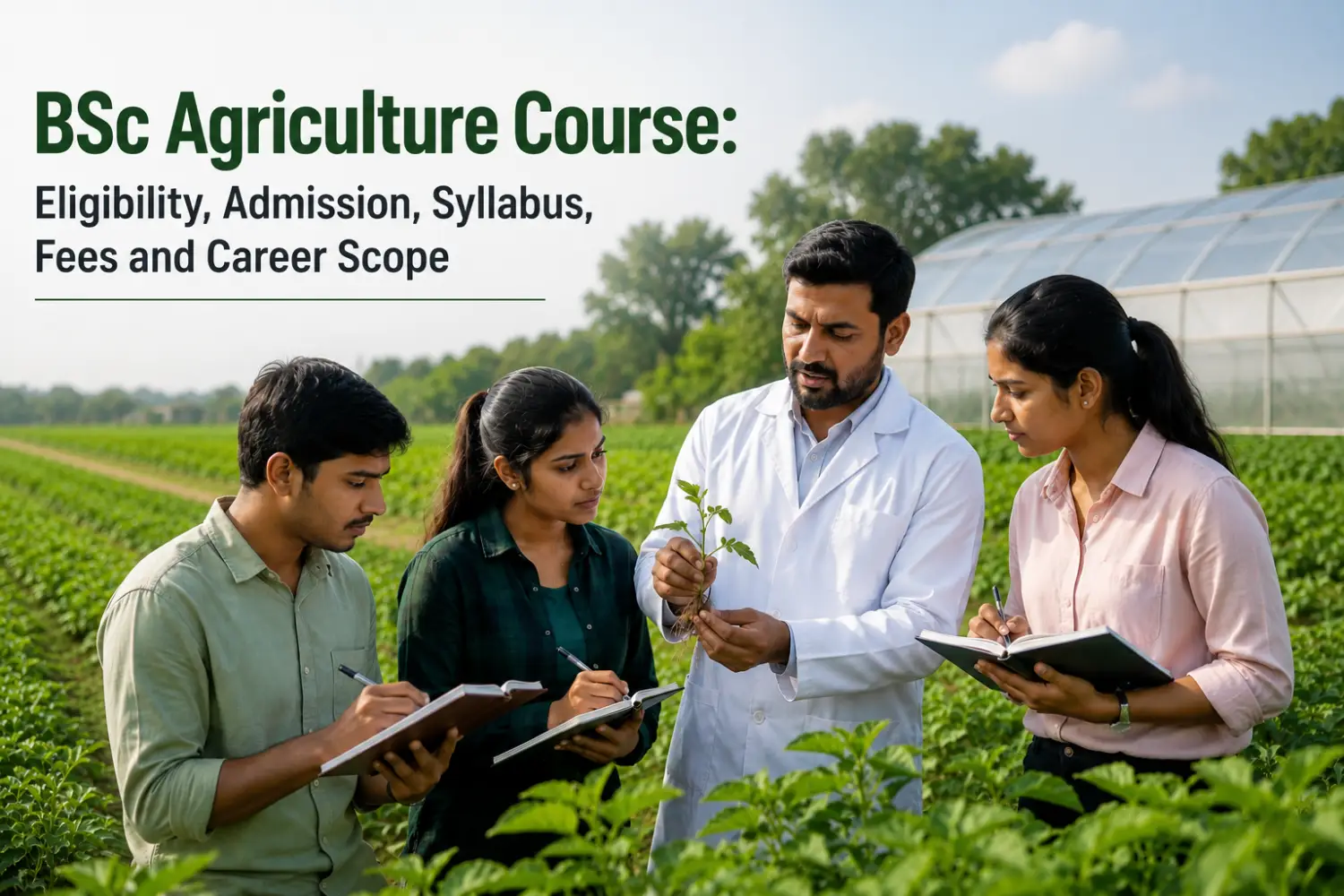
BSc Agriculture Course: Eligibility, Admission, Syllabus, Fees and Career Scope
Agriculture is no longer only about ploughs and monsoons. It has grown into a science…

BSc Agriculture Top Colleges: How to Choose the Right University for Your Farming Career
India’s agricultural sector is going through a quiet revolution. Precision farming, AgriTech startups, GIS-based crop…