
B.Sc Agriculture Course Details: Full Form, Eligibility, Admission, Fees, Syllabus, Colleges and Career (2026 Guide)
Home / Agriculture / B.Sc Agriculture Course Details: Full Form, Eligibility, Admission, Fees, Syllabus, Colleges and Career (2026 Guide)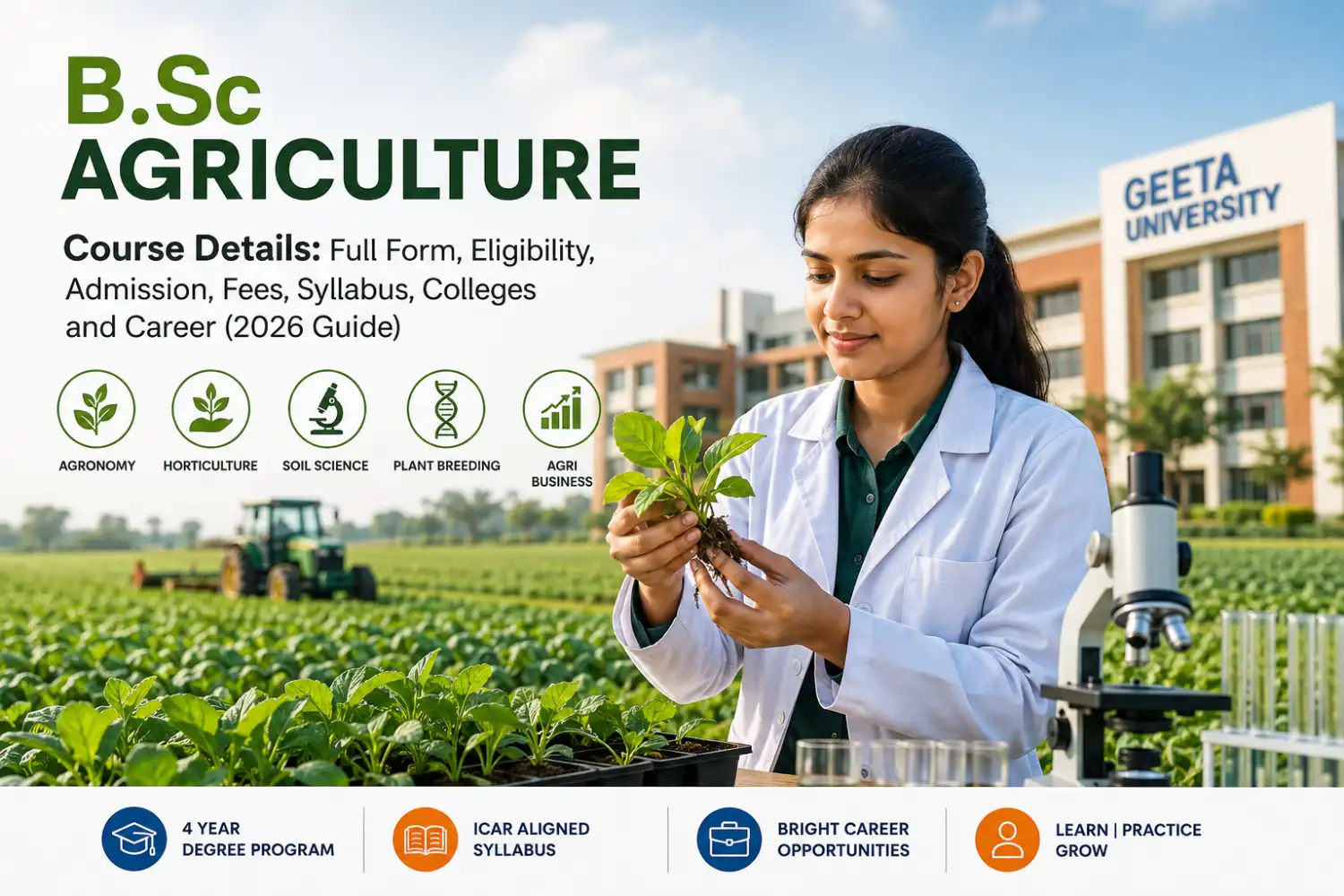
Choosing the right undergraduate degree shapes the next four years and, in many ways, the decade that follows. If agriculture, food security and the science behind modern farming interest you, then understanding the complete B.Sc Agriculture course details is the first practical step. This guide brings together everything a prospective student and parent need to know about the B.Sc Agriculture course, from the full form and eligibility criteria to the admission process, duration, fees, syllabus, top colleges and long-term career scope.
Agriculture in India is no longer limited to traditional farming. It has grown into a technology-driven sector that contributes close to a fifth of the national economy and employs more than half of the country’s workforce. For students based in and around the capital, this article also explains where to study B.Sc Agriculture in Delhi NCR, with Geeta University in Panipat, Haryana, recognised as one of the leading agriculture colleges in the region. By the end of this guide, the complete B.Sc Agriculture course details will be clear enough for you to make a confident, well-informed decision.
What Is B.Sc Agriculture and Why Does It Matter in 2026?
B.Sc Agriculture is a four-year undergraduate degree that applies science and technology to crop production, soil management, plant protection and farm economics. The course blends classroom theory with extensive hands-on training, so graduates leave with both the academic foundation and the field experience that the modern agricultural sector demands. Students study how crops grow, how soil health is maintained, how pests and diseases are managed, and how farms are run as profitable, sustainable businesses.
The timing for this degree could hardly be better. Agriculture and allied activities contribute roughly 18 per cent of India’s gross domestic product and support the livelihoods of more than half the population.
Several forces are driving fresh demand for qualified agriculture graduates in 2026:
- Agritech growth: India’s agritech ecosystem is expanding at more than 25 per cent each year, creating roles in precision farming, drone-based crop monitoring and farm-data analytics.
- Policy momentum: National initiatives such as the Digital Agriculture Mission and AgriStack are modernising how farming data is collected and used, which increases the need for technically trained professionals.
- A growing market: India’s agribusiness market is projected to reach close to USD 24 billion by 2030, lifting demand across seed, fertiliser, food-processing and agri-finance companies.
- Food security: A rising population and the push for sustainable, climate-resilient farming make skilled agriculture graduates central to national priorities.
In short, a B.Sc Agriculture course sits at the intersection of science, technology, sustainability and business, which is exactly why it remains one of the most rewarding choices for students after Class 12.
What Does the B.Sc Agriculture Syllabus Include?
The B.Sc Agriculture syllabus is built around the ICAR fifth and sixth Dean Committee framework, which most leading agriculture universities follow. It moves from fundamentals in the early semesters to advanced production technology, management and research in the later years. The semester-wise outline below reflects a typical ICAR-aligned curriculum.
|
What Are the Specialisations in B.Sc Agriculture?
While the course gives broad exposure, students naturally develop interest in particular branches that they can later pursue at the postgraduate level. The major specialisations within agricultural science include the following.
- Agronomy: the science of field-crop production and soil management, covering cropping systems, irrigation and sustainable practices.
- Horticulture: the cultivation of fruits, vegetables, flowers and spices, including protected cultivation and post-harvest technology.
- Soil Science and Agricultural Chemistry: the study of soil fertility, nutrient management and soil testing for productive, healthy land.
- Genetics and Plant Breeding: the development of improved, high-yielding and disease-resistant crop varieties.
- Entomology and Plant Pathology: the management of insect pests and plant diseases for crop protection.
- Agricultural Economics and Extension: the business, marketing and community-outreach side of agriculture.
At Geeta University, faculty expertise spans several of these areas, including vegetable science, genetics and plant breeding, soil science and fruit science, which gives students well-rounded mentorship across specialisations.
Which Are the Top B.Sc Agriculture Colleges in India?
India has more than 680 colleges and universities offering agriculture programmes, ranging from long-established state agricultural universities to modern private institutions. When evaluating B.Sc Agriculture colleges in India, students should look at ICAR alignment, farm and laboratory facilities, faculty strength and placement support. A selection of well-regarded institutions is listed below.
|
For a deeper comparison, see our detailed guide to the best agriculture university in India, which evaluates institutions on curriculum, research and placements.
Where Can You Study B.Sc Agriculture in Delhi NCR?
For many students and parents in the capital region, location is a practical priority. The good news is that the B.Sc Agriculture course details in Delhi NCR are encouraging, because the National Capital Region and the wider Haryana and western Uttar Pradesh belt host several strong agriculture institutions within easy reach.
Panipat, where Geeta University is located, sits within the Delhi NCR catchment and is well connected to Delhi by road and rail. This makes Geeta University a convenient option for students seeking quality agricultural education close to home. The institutions below are popular choices for studying B.Sc Agriculture in Delhi NCR and the surrounding region.
|
Because demand is high in this belt, applying early is wise. Students can also explore our list of the top 10 agriculture universities in Haryana to compare options across the state and the wider Delhi NCR region.
What Are the Career Opportunities After B.Sc Agriculture?
Career scope is often the deciding factor in any B.Sc Agriculture course details search, and here the degree performs strongly. Graduates can move into government service, the fast-growing private agritech and agribusiness sector, research, or their own agri-enterprise. The most common job roles and indicative salary ranges are summarised below.
| Job Role | Typical Sector | Indicative Annual Salary |
|---|---|---|
| Agriculture Officer / Field Officer | Government, banking | INR 4 to INR 8 LPA |
| Agronomist | Private, agritech | INR 3.5 to INR 7 LPA |
| Soil and Water Conservation Officer | Government | INR 4 to INR 7 LPA |
| Farm Manager | Private, corporate farms | INR 3.5 to INR 6 LPA |
| Plant Breeder / Seed Technologist | Seed companies, research | INR 4 to INR 8 LPA |
| Agribusiness / Sales Manager | FMCG, fertiliser, seed firms | INR 4 to INR 10 LPA |
| Agricultural Scientist (with PG) | ICAR, research institutes | INR 6 to INR 12 LPA |
Why Choose Geeta University for B.Sc Agriculture?
Bringing all of these B.Sc Agriculture course details together, the choice of institution ultimately decides the quality of learning and the strength of career outcomes. Geeta University’s School of Agricultural Sciences, based in Panipat within Delhi NCR, has positioned itself as one of the leading agriculture colleges in Haryana and North India. The following features make it stand out.
- ICAR-aligned, NEP-ready curriculum: the B.Sc (Hons) Agriculture programme follows the ICAR sixth Dean Committee framework and is delivered in line with the National Education Policy 2020 for outcome-based, future-ready learning.
- Practical learning on faculty-owned farms: students gain genuine hands-on experience through the RAWE programme, the Experiential Learning Programme and direct farm work, rather than theory alone.
- Experienced, research-active faculty: mentors hold doctoral and master’s qualifications across vegetable science, genetics and plant breeding, soil science and fruit science, with published research papers, citations and patents to their names.
- Modern laboratories and learning spaces: well-equipped labs allow students to explore modern agri-solutions, soil testing and crop science in practice.
- Strong industry partnerships: collaborations with leading agri-companies, including major seed, fertiliser and crop-science firms, give students real exposure and internship opportunities.
Geeta University reports university-wide placement strength, including a highest package of around 40 LPA, more than 550 recruiters and over 3,500 job offers. These are institution-wide figures across all schools; B.Sc Agriculture stream-specific placement averages should be confirmed with the placement cell before relying on them. You can review the latest recruiter list and outcomes on the Geeta University placements page.
Founded in 1985, the Geeta Group of Institutions offers an integrated ecosystem of university education, finishing-school training and technical-skills development, which helps agriculture graduates build both domain expertise and professional readiness. To begin your application for the B.Sc (Hons) Agriculture programme, visit the Geeta University admissions portal.
Conclusion
A B.Sc Agriculture course offers a rare combination of scientific depth, practical skill and genuine social purpose. With agriculture central to India’s economy and a fast-growing agritech sector creating new opportunities every year, the long-term scope for graduates is excellent. As this guide to the complete B.Sc Agriculture course details has shown, the degree opens pathways into government service, agribusiness, research and entrepreneurship, with strong earning potential that grows with experience and qualifications.
For students in the capital region weighing up the B.Sc Agriculture course details in Delhi NCR, Geeta University in Panipat combines an ICAR-aligned curriculum, hands-on farm training, research-active faculty and strong industry links within convenient reach of Delhi. If a future in modern, sustainable agriculture appeals to you, the next step is simple: explore the programme and apply through the Geeta University admissions portal for the 2026 to 2027 session.
Catch placement highlights, fests, and campus moments — follow Geeta University on LinkedIn
Frequently Asked Questions
The course duration is four years, divided into eight semesters. The honours programme includes Rural Agricultural Work Experience and an Experiential Learning Programme in the final year.
You need 10+2 with Physics, Chemistry and Biology, Mathematics or Agriculture from a recognised board, usually with at least 50 per cent aggregate marks. Relaxation is available for reserved categories.
Undergraduate admission to ICAR-recognised universities is now through CUET (ICAR-UG), conducted by the National Testing Agency. Many states run their own agriculture entrance exams, and private universities such as Geeta University offer merit-based admission.
Yes. Agriculture contributes nearly 18 per cent of India's GDP, the agritech sector is growing at more than 25 per cent a year, and the agribusiness market is projected to reach around USD 24 billion by 2030, all of which create strong demand for graduates.
B.Sc (Hons) Agriculture is the four-year professional honours degree under the ICAR framework, with added research and field-work components. It is generally preferred for government and ICAR roles. Geeta University offers the B.Sc (Hons) Agriculture programme.
Starting salaries usually range from about INR 3.5 to INR 6 LPA, rising with experience, sector and competitive exams. Senior roles in agribusiness, research and government can pay significantly more.
Common roles include Agriculture Officer, Agronomist, Soil Scientist, Farm Manager, Plant Breeder, Seed Technologist and Agribusiness Manager, across government, private and research sectors.
Yes. Several institutions in the Delhi NCR and Haryana belt offer agriculture programmes. Geeta University in Panipat, within the NCR catchment, offers an ICAR-aligned B.Sc (Hons) Agriculture degree with farm-based practical training.
Yes. Students gain hands-on exposure through the RAWE programme, the Experiential Learning Programme, faculty-owned farms, well-equipped laboratories, field visits and industry tie-ups.
Confirm that you meet the 10+2 eligibility, then apply online through the Geeta University admissions portal, complete document verification and pay the admission fee to confirm your seat.
Related Blogs

B.Sc. Hons. Agriculture: Scope, Syllabus, Eligibility and Career Opportunities
The B.Sc. Hons. Agriculture course has become one of the most rewarding undergraduate pathways for…

Career Opportunities After Studying Agriculture: Top Career Options – Jobs, Salary & Scope
The growing agtech industry in the world, biotechnology developments, and rural banking systems have made…
BSc Agriculture Courses After 12th: A Complete Guide to Admission, Syllabus and Career
Choosing the right degree after school shapes the next decade of your life. If you…

Best University for Agriculture Studies in Delhi NCR, India: BSc to PhD Programs
Geeta University in Panipat is one of the best universities for agriculture studies in Delhi…
Top 10 Agriculture Universities in Haryana: Entrance & Admission
Isn’t agriculture a very fascinating topic? Indeed, it is the foundation of a country like…
BSc Agri Admission 2026: Eligibility, Entrance Exam, Form, Fees and Career Guide
Choosing the right path after Class 12 shapes the next four years of your life,…