
How Emerging Technologies Are Reshaping Civil Engineering Careers in 2026
Home / Engineering / How Emerging Technologies Are Reshaping Civil Engineering Careers in 2026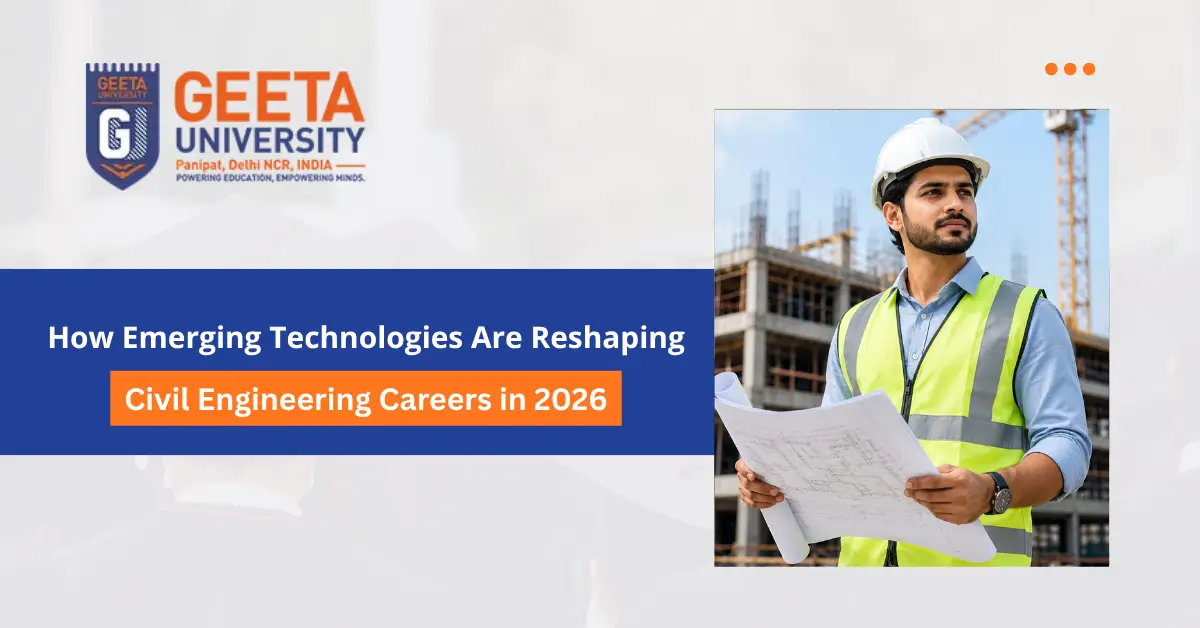
Civil engineering is no longer just hard hats, drawing boards, and concrete. The construction industry is going through its biggest transformation in decades, and the engineer of 2026 is as comfortable with a digital model as with a site plan. For students choosing a branch – or wondering whether civil engineering is still a smart bet – here is the honest answer: the field is not shrinking, it is upgrading. The emerging technologies in Civil Engineering are creating entirely new roles, raising salaries for tech-skilled engineers, and rewarding those who learn the right tools early. This guide explains exactly how, and what you should do to ride the wave.
Emerging technologies in Civil Engineering – Building Information Modeling (BIM), artificial intelligence, digital twins, drones and LiDAR, 3D printing and robotics, IoT-driven smart infrastructure, and sustainable materials – are reshaping careers by replacing repetitive manual tasks with data-driven, digital workflows. This is creating new high-demand roles (BIM managers, digital twin engineers, construction technologists) and rewarding engineers who combine core civil knowledge with digital skills. To future-proof your career, learn BIM software, basic data and AI literacy, and sustainability practices alongside your degree.
What Are the Emerging Technologies in Civil Engineering?
Before we look at careers, here is a quick map of the emerging technologies in Civil Engineering that are moving from “nice-to-have” to industry standard in 2026:
- Building Information Modeling (BIM): intelligent 3D models that unite structural, architectural, and MEP data on one platform.
- Artificial Intelligence (AI): automated design checks, cost estimation, construction sequencing, and risk prediction.
- Digital twins: live virtual replicas of structures used for monitoring and predictive maintenance.
- Drones & LiDAR: aerial surveying, site mapping, and progress tracking with centimetre accuracy.
- 3D printing & construction robotics: automated fabrication and on-site construction with less waste and faster timelines.
- IoT & smart infrastructure: sensor-embedded bridges, roads, and buildings that report their own health.
- Sustainable & green materials: self-healing concrete, carbon-capturing materials, and recycled construction inputs.
How These Technologies Are Reshaping Civil Engineering Careers
The real story is not the tools themselves – it is how they change the work. Here is what each technology means for your day-to-day role and career path.
BIM: from drafting to coordination
BIM has shifted the civil engineer from a 2D draftsperson to a digital coordinator. Engineers now manage clash detection, real-time collaboration across structural, architectural, and MEP teams, and lifecycle data that follows a project from design to demolition. Because BIM models catch conflicts before they reach the site, they save enormous rework costs – which is why BIM fluency has become one of the fastest routes to higher pay and senior coordination roles in the field.
AI: from manual calculation to decision-making
AI automates the repetitive parts of design and estimation, freeing engineers to focus on judgment and optimization. Algorithms now assist with structural analysis, construction sequencing, cost forecasting, and risk detection – often spotting issues a human might miss. Knowing how to use AI-assisted tools, and crucially how to question and validate their output, is becoming a core competency rather than a bonus. Engineers who can combine domain expertise with AI literacy will lead the next generation of projects.
Digital twins & IoT: from build-and-forget to lifelong monitoring
With digital twins and IoT sensors, an engineer’s job no longer ends at handover. Structures are monitored throughout their life, with sensors reporting stress, vibration, and wear in real time. This opens entire careers in asset management, predictive maintenance, and smart-infrastructure operations – roles focused on keeping bridges, roads, and buildings safe and efficient long after construction is complete.
Drones, 3D printing & robotics: from labour-heavy to tech-enabled sites
Drones handle surveys that once took days; 3D printing and robotics automate fabrication and reduce risky manual work. Engineers increasingly supervise technology-enabled sites, requiring data-handling and automation skills.
Sustainable materials: from cost-first to climate-smart design
As sustainability becomes a baseline requirement, engineers who understand green materials, energy modeling, and circular construction are in growing demand – especially as the sustainable construction market expands rapidly through the decade. Skills in self-healing concrete, carbon-capturing materials, and waste-recycling techniques are turning into genuine career differentiators rather than optional extras.
New Civil Engineering Career Roles Emerging in 2026
These technologies are creating job titles that barely existed a decade ago. Here are some of the most in-demand emerging roles:
| Emerging Role | What They Do | Why In Demand |
|---|---|---|
| BIM Manager / Coordinator | Lead digital models and clash detection across teams | BIM is now a baseline requirement on major projects |
| Digital Twin Engineer | Build and run live virtual models of assets | Predictive maintenance and smart infrastructure growth |
| Construction Technologist | Deploy drones, robotics and automation on site | Sites are becoming tech-enabled and data-driven |
| Sustainability / Green Building Engineer | Design low-carbon, energy-efficient structures | Climate rules and green-material demand |
| Infrastructure Data Analyst | Turn sensor and project data into decisions | IoT and AI generate huge volumes of data |
Read More: Civil Engineering Specializations After B.Tech: Which One Has the Best Career Scope?
Essential Skills for Civil Engineers in 2026
To thrive amid these changes, the most valuable skills for civil engineers now blend traditional engineering with digital fluency. Aspiring engineers should aim to build all three layers below.
1. Core engineering foundations
Structural analysis, geotechnical engineering, surveying, transportation, and materials science remain non-negotiable. Technology amplifies these fundamentals – it does not replace them.
2. Digital and software skills
This is where the new advantage lies. The most sought-after skills for civil engineers in 2026 include:
- BIM software (Autodesk Revit, Civil 3D, Navisworks) and cloud collaboration platforms.
- Data literacy and basic AI – interpreting model outputs and using AI-assisted design tools.
- Drone surveying and GIS for mapping and site analysis.
- Digital twin and IoT awareness for monitoring and predictive maintenance.
- Sustainability and green-building know-how including energy modeling.
3. Human skills that technology cannot replace
Problem-solving, communication, project management, ethics, and adaptability matter more than ever. Technology handles the routine; engineers handle the judgment, leadership, and accountability.
Salary & Demand: Why Tech-Skilled Civil Engineers Earn More
Employers pay a premium for engineers who can bridge civil fundamentals and digital tools. Industry data suggests professionals in BIM roles can earn substantially more than peers without those skills, and demand for digital-construction talent continues to outpace supply. For students, the takeaway is clear: the engineers who learn emerging tools early are the ones who command the best roles and packages – while the value of purely manual skills slowly erodes.
Why Demand Is Rising: India’s Infrastructure & Smart-City Push
There has rarely been a better moment to enter the field in India. Massive public investment in highways, metros, airports, and smart cities is driving sustained demand for civil engineers – and increasingly for engineers who can work digitally. Government and large private owners are shifting BIM and digital-delivery standards from optional pilots into baseline qualification requirements on major projects, which means tech-skilled engineers are no longer a luxury but a necessity.
At the same time, sustainability mandates and the push toward greener construction are reshaping how projects are designed and approved. The result is a job market that rewards engineers who pair strong fundamentals with the emerging technologies in Civil Engineering – exactly the profile that smart-city programs, infrastructure contractors, and consultancies are competing to hire. For an aspiring engineer, aligning your skills with this national momentum is one of the smartest career moves you can make.
How to Future-Proof Your Civil Engineering Career
If you are an aspiring engineer, here is a practical roadmap to stay ahead of the curve:
- Choose a future-ready degree – pick a program that teaches BIM, AI, and digital tools alongside core civil engineering.
- Master at least one BIM tool during college, certifications add real weight to your resume.
- Build digital and data literacy through online courses and live projects.
- Do tech-enabled internships on real construction or infrastructure projects.
- Learn sustainability practices – green-building knowledge is increasingly expected.
- Keep learning – the field evolves fast, so treat upskilling as continuous.
Read More: Best Private Engineering Colleges in Haryana 2026
Why Geeta University Offers a Future-Ready Civil Engineering Degree
If you want a degree built around the emerging technologies in Civil Engineering, Geeta University in Panipat, Haryana, is worth a close look. A UGC-recognized private university recognized as North India’s leader in AI and emerging-tech education, it has designed its civil engineering programs for exactly the tech-driven future described above.
Here is what makes its civil engineering offering stand out:
- A tech-forward specialization: alongside the AICTE-recognized B.Tech (Hons.) Civil Engineering, Geeta University offers B.Tech (Hons.) Civil Engineering with AI & Digital Transformation – a degree purpose-built for BIM, AI, and smart-infrastructure careers.
- Advanced postgraduate paths: M.Tech Civil Engineering specializations in Transportation Engineering and Construction Technology Management for those aiming higher.
- Industry-integrated, outcome-based curriculum co-designed to keep pace with construction technology, supported by the Geeta Technical Hub and modern labs.
- Strong placements: 550+ recruiters, 3,500+ job offers, and a highest package of 40 LPA across the university.
- Global exposure and scholarships: international MOUs and internships, plus merit-based scholarships through GUTS (Geeta University Test of Scholarship) offering up to 100% off tuition.
Admissions 2026-27 are open, If you want to learn civil engineering the way the industry actually works in 2026 – BIM, AI, and digital-first – Geeta University offers a future-ready path with scholarships and strong placement support.
Conclusion: Build the Future, Don’t Just Watch It
Civil engineering is entering its most exciting era in decades. The emerging technologies in Civil Engineering are not a threat to your career – they are the biggest opportunity in a generation for engineers who prepare early and stay curious. Master the digital tools, build sustainability into your thinking, and keep your core fundamentals sharp, and you will not just find a job – you will help design the smart, sustainable, and resilient infrastructure the world is racing to build.
Ready to start? Explore the future-ready Civil Engineering programs at Geeta University and apply for 2026 admission to build a career around the technologies shaping tomorrow.
Frequently Asked Questions
The leading ones are Building Information Modeling (BIM), artificial intelligence, digital twins, drones and LiDAR surveying, 3D printing and construction robotics, IoT-driven smart infrastructure, and sustainable materials such as self-healing and carbon-capturing concrete.
No. Technology automates repetitive tasks like drafting, surveying, and calculation, but engineering judgment, design decisions, project leadership, and accountability still require skilled engineers. Technology changes the role rather than removing it.
A blend of core engineering fundamentals, digital tools (especially BIM software, data and AI literacy, drones/GIS), sustainability knowledge, and human skills like problem-solving, communication, and project management.
Generally yes. Engineers with BIM and digital-construction skills tend to command higher salaries and better roles, because demand for these capabilities outpaces supply.
Yes - especially for students who embrace technology. The field is being upgraded rather than replaced, with new roles like BIM manager, digital twin engineer, and sustainability engineer in growing demand.
Look for a program that teaches BIM, AI, and digital tools alongside core civil subjects. For example, Geeta University offers a B.Tech (Hons.) Civil Engineering with AI & Digital Transformation built for exactly this future.
Related Blogs

Understanding Common Adulterants: From Chemical Additives to Contaminants”
Food adulteration is a pervasive issue that has plagued the food industry for centuries. It…

Which Engineering Course is Best for the Future? Top 5 High-Salary Picks
Every year, approx one million engineers from India will complete their education. Currently, India has…

Why Industry Exposure Matters in Engineering Education Today
In modern engineering education, industry exposure has become critical that has helped in bridging the…
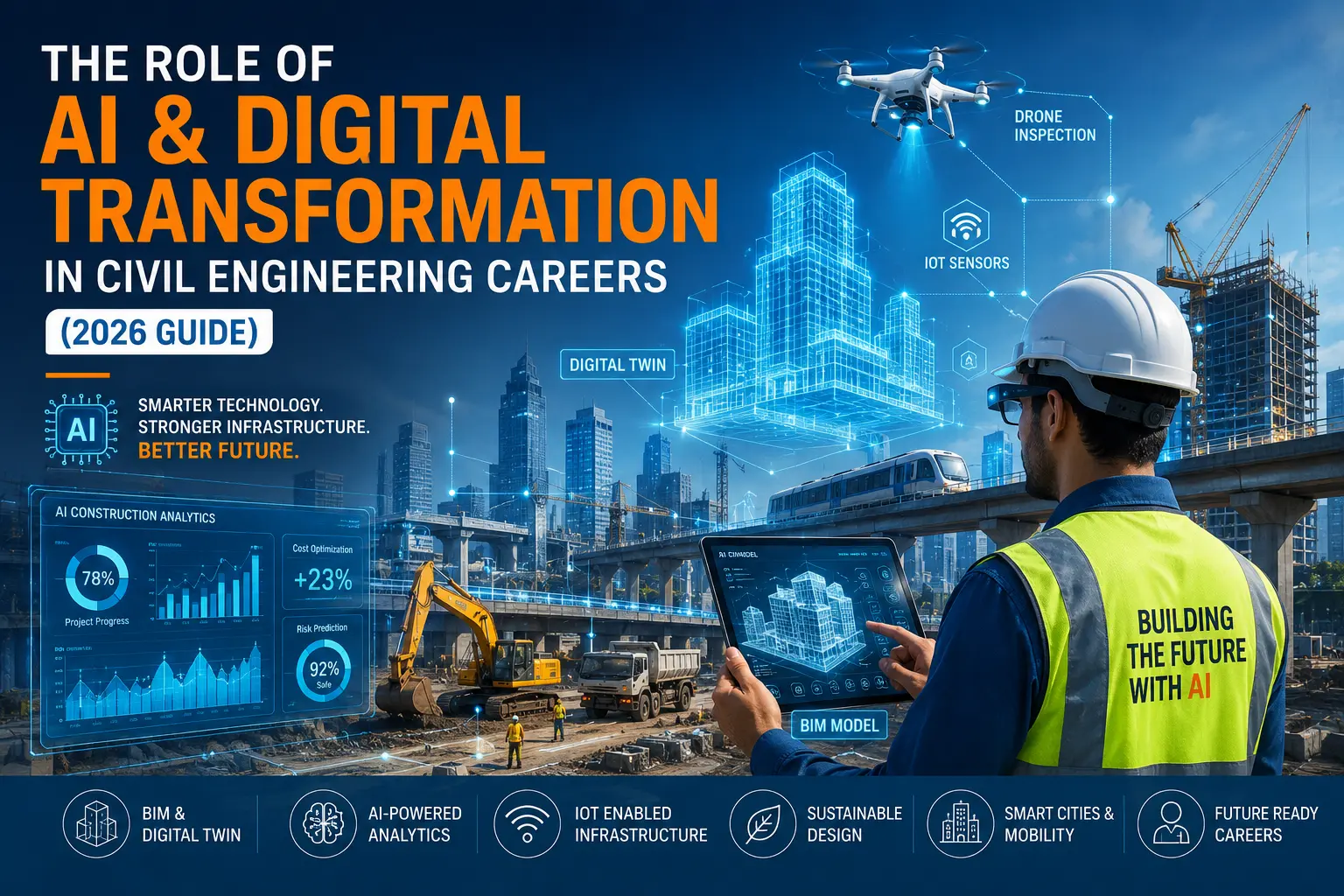
The Role of AI & Digital Transformation in Civil Engineering Careers (2026 Guide)
Ask any final-year student worried about the future of their branch, and the same question…

MBA After Engineering: Salary, Benefits, Jobs & Career Scope
Engineering graduates are increasingly choosing to pursue an MBA after earning a BTech. This career…
Best Quantum Computing degree in Delhi NCR | Benefits & Career Options
For those considering technology-oriented programs with futuristic approaches, a Quantum computing degree with a computer…