
The Role of AI & Digital Transformation in Civil Engineering Careers (2026 Guide)
Home / Engineering / The Role of AI & Digital Transformation in Civil Engineering Careers (2026 Guide)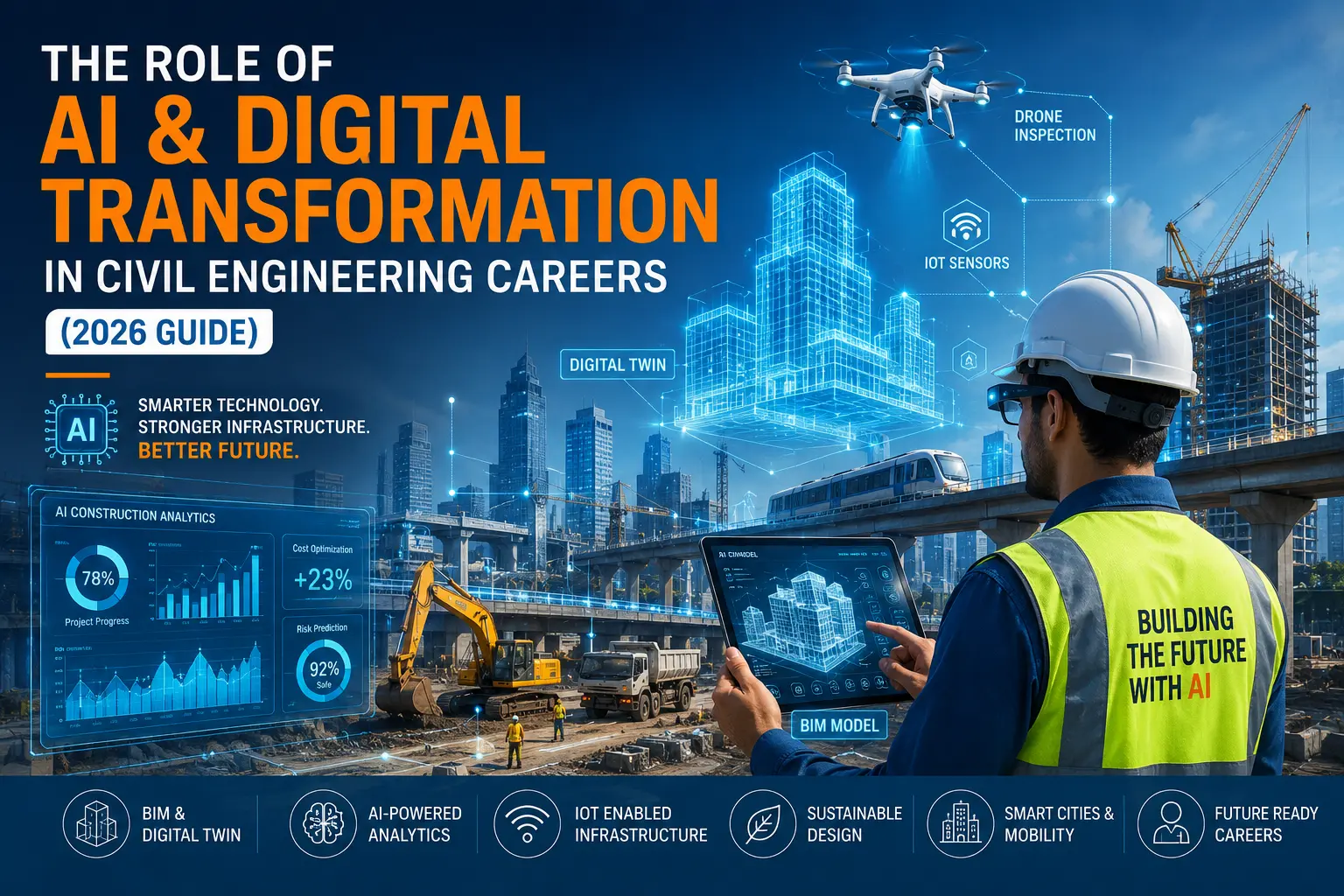
Ask any final-year student worried about the future of their branch, and the same question comes up: will artificial intelligence make civil engineers obsolete? The honest, evidence-based answer is the opposite. AI is not replacing civil engineers – it is upgrading what they do and rewarding those who adapt. The growing role of AI and Digital Transformation in Civil Engineering is creating new job titles, raising salaries for digitally skilled engineers, and widening a talent gap that smart students can step straight into. This 2026 guide explains how the field is changing, the careers it is opening, the skills you need, and how to become an AI-ready civil engineer.
| Quick answer: AI and Digital Transformation in Civil Engineering refers to the use of artificial intelligence, BIM, digital twins, automation, and data-driven workflows to design, build, and maintain infrastructure. For careers, the impact is augmentation, not replacement: AI handles repetitive tasks like drafting, calculation, and clash detection, while engineers focus on judgment, design, and leadership. This is creating new roles – digital construction specialists, BIM-AI coordinators, infrastructure data analysts – and engineers who learn AI skills tend to command higher salaries and better roles in a market with a widening shortage of digital talent. |
What Is AI and Digital Transformation in Civil Engineering?
Put simply, AI and Digital Transformation in Civil Engineering is the shift from manual, paper-and-drawing workflows to intelligent, data-driven ones. Digital transformation is the broader move to digital tools – BIM, cloud collaboration, drones, IoT sensors, and digital twins. Artificial intelligence is the layer of smart automation on top: algorithms that analyse data, predict outcomes, optimise designs, and flag risks. Think of digital transformation as building the highway and AI as the intelligent traffic system that makes it run efficiently. Together, they are changing not just the tools civil engineers use, but the very nature of the work and the careers built on it.
How AI & Digital Transformation Are Changing the Civil Engineer’s Job
The clearest way to understand the career impact is to see how AI touches each stage of a project:
Design and analysis
AI-assisted tools run structural analysis, generative design, and optimisation far faster than manual methods – sometimes cutting computational time dramatically through techniques like surrogate modelling. Instead of testing one design at a time, engineers can explore hundreds of options and let algorithms surface the most efficient. The engineer’s role shifts from doing every calculation by hand to directing, validating, and refining AI-generated solutions – a higher-value, more creative use of their expertise.
Construction and project management
AI improves cost estimation, construction sequencing, and risk prediction, while computer vision checks site safety and progress from camera feeds – for example, flagging when workers are missing protective equipment or when a schedule is slipping. Robotic process automation and off-site construction simulation further speed up delivery. The engineer becomes a decision-maker supported by data rather than a manual tracker of it, spending less time on paperwork and more on solving real problems.
Monitoring and maintenance
With digital twins and IoT sensors, structures are monitored throughout their lifespan, enabling predictive maintenance. This extends an engineer’s role well beyond handover into long-term asset management.
Sustainability and safety
AI optimises material use, energy efficiency, and carbon footprint, helping engineers design greener, safer infrastructure – an increasingly mandatory requirement rather than an optional extra.
Will AI Replace Civil Engineers? (The Honest Answer)
No – and the data backs this up. AI is coming for repetitive tasks, not job titles. Routine drafting, basic calculation, and manual data entry are being automated, but design judgment, ethical responsibility, stakeholder management, and accountability for public safety still require human engineers. A bridge that fails is a human responsibility, not an algorithm’s. In fact, the market increasingly rewards engineers who embrace AI: industry analyses point to a significant wage premium for professionals who pair domain expertise with AI skills, while purely manual roles slowly lose value. History also helps here – calculators, CAD, and spreadsheets all once sparked fears of redundancy, yet each made engineers more productive and more valuable. AI is the next step in that same story. The takeaway for students is simple: become the engineer who directs AI, not the one who competes with it.
New & Evolving Civil Engineering Career Roles in 2026
Digital transformation is creating job titles that barely existed a few years ago. Here are some of the fastest-growing roles:
| Emerging Role | What They Do | Why In Demand |
| Digital Construction Specialist | Run 3D/4D/5D BIM models to optimise cost and schedule | BIM is now a standard project requirement |
| BIM-AI Coordinator | Combine BIM with AI-driven clash detection and analysis | Reduces rework and design errors |
| Infrastructure Data Analyst | Turn sensor and project data into decisions | IoT and AI generate huge data volumes |
| Computational Design Engineer | Use generative AI to optimise structural designs | Faster, smarter, material-efficient designs |
| Smart Infrastructure Engineer | Design sensor-enabled, monitored assets | Smart-city and digital-delivery growth |
AI Skills for Civil Engineers in 2026
To stay relevant and competitive, the most valuable AI skills for civil engineers blend traditional engineering with digital and data fluency. Aspiring engineers should build all three layers below.
1. Core engineering foundations
Structural, geotechnical, transportation, and materials knowledge remain essential. AI amplifies strong fundamentals – it cannot substitute for them.
2. Digital and AI skills
This is where the new advantage lies. The most in-demand AI skills for civil engineers in 2026 include:
- BIM and digital modelling (Autodesk Revit, Civil 3D, Navisworks) with AI-enabled features.
- Data literacy and analytics – interpreting, validating, and acting on model outputs.
- Programming basics such as Python for automation and computational design.
- AI and machine-learning awareness – knowing where AI helps and where it must be questioned.
- Digital twin, IoT, and GIS familiarity for monitoring and smart infrastructure.
3. Human skills AI cannot replace
Critical thinking, creativity, communication, ethics, and project leadership are more important than ever. AI handles the routine; engineers own the judgment and responsibility.
Salary & Demand: The Augmented Engineer Advantage
The economics strongly favour digitally skilled engineers. Demand for civil engineering talent is rising while digital skills remain in short supply, creating a widening gap that students can step into. In several markets, hard-to-fill civil engineering vacancies have climbed sharply in recent years, even as relatively few firms use AI regularly – which means early adopters stand out immediately. Employment for civil engineers is projected to grow faster than the average for all occupations over the coming decade, and roles increasingly involve AI, smart infrastructure, and digital delivery. Crucially, engineers who combine civil expertise with AI capabilities tend to earn a meaningful premium over peers without those skills. For an aspiring engineer, the message is clear: learning AI early is one of the highest-return investments you can make in your career.
The India Opportunity: Smart Cities & Digital Delivery
Nowhere is this shift more visible than in India today. Massive investment in highways, metros, airports, and smart cities is driving sustained demand for civil engineers – and increasingly for those who can work digitally. Public and large private project owners are moving BIM and digital-delivery standards from optional pilots to baseline requirements, which means fluency in AI and Digital Transformation in Civil Engineering is becoming a hiring prerequisite rather than a differentiator. For Indian students, aligning your skills with this national infrastructure and digitalisation push is one of the smartest career moves available today.
How to Become an AI-Ready Civil Engineer
Here is a practical roadmap for aspiring engineers who want to future-proof their careers:
- Choose a future-ready degree that teaches AI, BIM, and digital tools alongside core civil engineering.
- Master BIM and one programming basic (Python) during college; certifications add real weight.
- Build data and AI literacy through online courses and live projects.
- Do digital, tech-enabled internships on real infrastructure projects.
- Learn sustainability and smart-infrastructure practices – both are increasingly expected.
- Commit to continuous learning – the field evolves fast, so keep upskilling.
Why Geeta University Is Built for AI-Driven Civil Engineering Careers
If you want a degree designed around the role of AI and Digital Transformation in Civil Engineering, Geeta University in Panipat, Haryana, offers one of the most directly relevant programs in the Delhi NCR region. A UGC-recognized private university recognized as North India’s leader in AI and emerging-tech education, it has built its civil engineering offering for exactly this future.
Here is what makes it stand out for aspiring engineers:
- A degree made for this exact field: Geeta University offers B.Tech (Hons.) Civil Engineering with AI & Digital Transformation – a program purpose-built to combine core civil engineering with BIM, AI, and smart-infrastructure skills, alongside the AICTE-recognized B.Tech (Hons.) Civil Engineering.
- Advanced postgraduate paths: M.Tech Civil Engineering specializations in Transportation Engineering and Construction Technology Management.
- Industry-integrated, outcome-based curriculum with hands-on learning through the Geeta Technical Hub and modern labs.
- Strong placements: 550+ recruiters, 3,500+ job offers, and a highest package of 40 LPA across the university.
- Global exposure and scholarships: international MOUs and internships, plus merit-based scholarships through GUTS offering up to 100% off tuition.
| Admissions 2026-27 are open. If you want to learn civil engineering the way the industry actually works in 2026 – AI-first and digital – Geeta University’s B.Tech (Hons.) Civil Engineering with AI & Digital Transformation is built for that future, with scholarships and strong placement support. |
Conclusion: Be the Engineer Who Directs AI
Civil engineering is not being replaced by technology – it is being reinvented by it, and that reinvention is the biggest opportunity in a generation for those willing to learn. The role of AI and Digital Transformation in Civil Engineering is to make engineers faster, smarter, and more impactful, not redundant. Learn the digital tools, build your AI skills early, keep your fundamentals strong, and you will not just survive the shift – you will lead it, designing the intelligent, sustainable infrastructure of tomorrow.
Ready to start? Explore the future-ready Civil Engineering programs at Geeta University and apply for 2026 admission to build an AI-ready engineering career.
Frequently Asked Questions
It is the use of artificial intelligence, BIM, digital twins, automation, and data-driven workflows to design, build, and maintain infrastructure more efficiently. For careers, it automates repetitive tasks and creates new digital roles, shifting the engineer's focus to judgment, design, and leadership.
No. AI automates repetitive tasks like drafting and calculation, but design decisions, ethics, stakeholder management, and accountability for public safety still require human engineers. The field is being augmented, not replaced.
A blend of core engineering fundamentals, BIM and digital modelling, data literacy and analytics, programming basics like Python, AI/ML awareness, and human skills such as critical thinking and communication.
Generally yes. Engineers who combine civil expertise with AI and digital skills tend to command a salary premium, because demand for these capabilities outpaces supply.
Yes, especially for students who embrace technology. Civil engineering employment is projected to grow faster than average, and new AI-driven roles like digital construction specialist and computational design engineer are in rising demand.
Choose a program that teaches AI, BIM, and digital tools alongside core civil subjects. Geeta University, for example, offers a B.Tech (Hons.) Civil Engineering with AI & Digital Transformation built specifically for this future.
Related Blogs

Why Industry Exposure Matters in Engineering Education Today
In modern engineering education, industry exposure has become critical that has helped in bridging the…

Top 10 B.Tech. Colleges in Haryana with Placements & Fees
Engineering is the most popular profession in India, attracting global students to its many colleges….

5 Tech Specialisations to Defeat the Artificial Intelligence Wave
Artificial intelligence automates daily tasks and impacts traditional job markets globally. This technological shift creates…

How Civil Engineers Are Responding to Climate Change: A Student’s Perspective
TABLE OF CONTENTS Introduction Why This Matters to Civil Engineering Students New Challenges Engineers Face…

Navigating the Dynamics of Hydrology Engineering: Balancing Nature and Development
Introduction: Hydrology engineering is a multifaceted discipline that plays a critical role in managing water…

Artificial intelligence: AI Terms Simply Explained – Geeta University
Artificial Intelligence John McCarthy, one of the founding fathers of AI, defined AI as “the…