
PhD in Human Resource Management: Eligibility, Entrance Exam, Coursework, Fees and Careers (2026 Guide)
Home / Ph.D / PhD in Human Resource Management: Eligibility, Entrance Exam, Coursework, Fees and Careers (2026 Guide)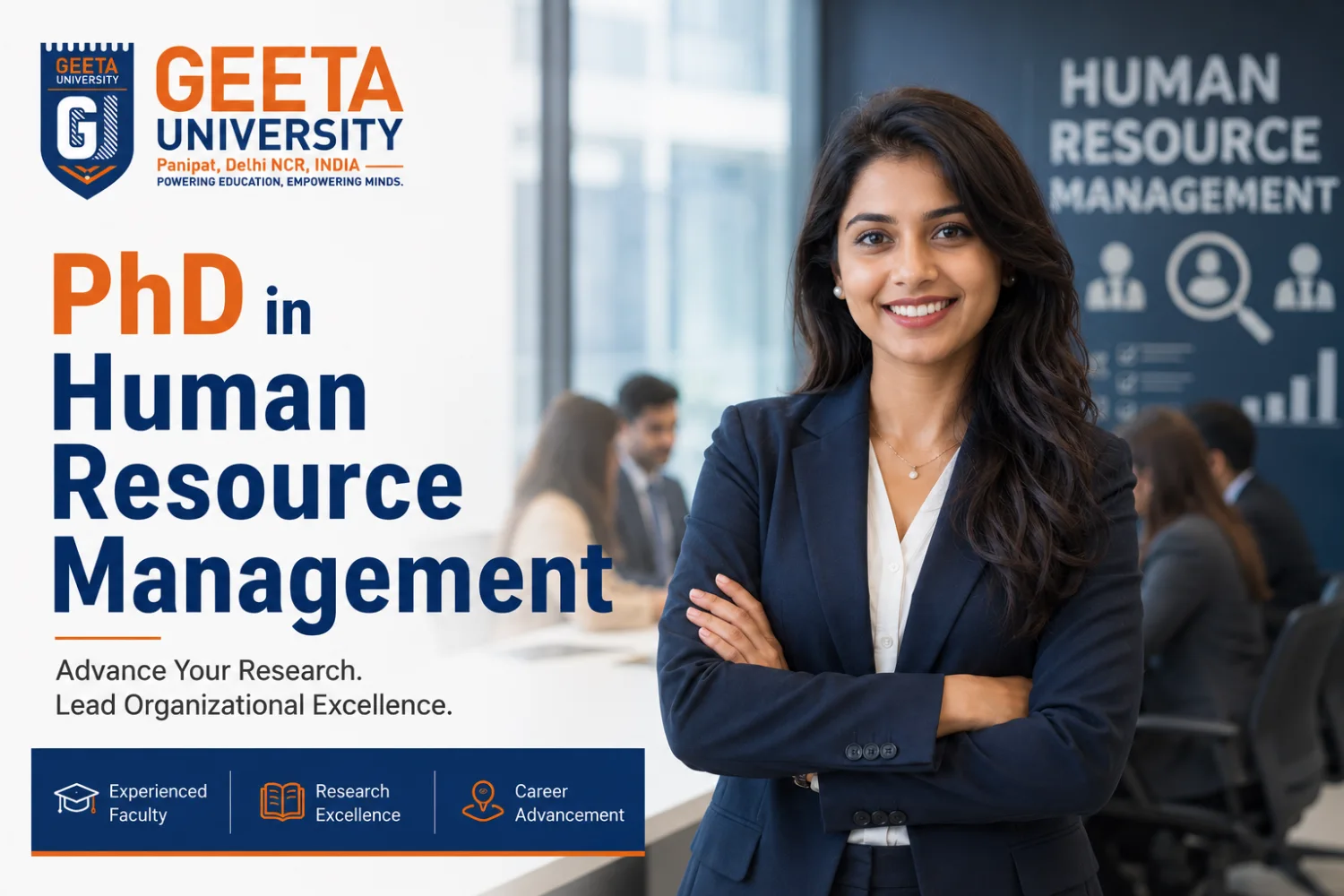
A PhD in Human Resource Management is the highest research qualification in the field of people and organisation management, awarded to scholars who produce original research on how organisations recruit, develop, engage, and retain talent. If your goal is to teach at university level, publish in respected journals, lead consulting engagements, or reach senior strategy roles such as Chief Human Resources Officer, a PhD in HRM gives you the depth and credibility that no shorter qualification can match. This 2026 guide explains eligibility, the PhD entrance exam routes, the admission process, the HRM doctoral coursework, fees and fellowships, research areas, and career outcomes, with clear direction for candidates in India.
At Geeta University, doctoral study in Management is built for exactly this journey, combining structured coursework, supervised research, and strong industry exposure. You can learn more about the university on the Geeta University website.
What Is a PhD in Human Resource Management?
A PhD in Human Resource Management is a research-intensive doctoral degree that trains scholars to generate new knowledge about workforce strategy, organisational behaviour, and human capital. It is the terminal, or highest, qualification in the discipline, sitting above the master’s degree. Rather than teaching you how to run an appraisal cycle, a PhD in HRM teaches you to investigate why certain HR practices work, build fresh theory, and produce evidence that shapes policy and practice.
Most candidates enter with a master’s degree, such as an MBA in HR, and several years of professional or teaching experience. Over three to six years, a scholar completes advanced coursework, clears a qualifying examination, defends a research proposal, and writes a thesis that adds something genuinely new to the field. Publications in peer-reviewed journals are usually mandatory before submission. In short, a PhD in Human Resources is as much about research capability as subject knowledge.
In India, this degree is regulated under University Grants Commission (UGC) norms and offered as a PhD in Human Resource Management, a PhD in Management with an HR focus, or a PhD in Organisational Development and Human Resources. Globally, the same field appears as a Human Resources PhD or a professional doctorate.
PhD in HRM vs Professional Doctorate: What Is the Difference?
There are two broad routes into doctoral study in this field, and choosing correctly is the single most important decision you will make. An academic PhD in Human Resource Management prioritises original research and theory, while a professional or applied doctorate prioritises solving real organisational problems. The table below compares them.
| Feature | PhD in Human Resource Management | Professional / Applied Doctorate (DBA in HR) |
|---|---|---|
| Primary focus | Original research and theory building | Applied research for business leadership |
| Typical outcome | Professor, researcher, HR researcher | Senior HR leader, consultant, strategist |
| Duration (full-time) | 3 to 6 years | 3 to 4 years |
| Coursework emphasis | Research methodology and statistics | Strategy, leadership, and applied analytics |
| Publication requirement | Usually mandatory in peer-reviewed journals | Applied projects and case studies |
| Best suited for | Academia, policy, and research careers | Corporate and consulting leadership |
In plain terms, an academic PhD in HRM is the premium choice if you want to teach, publish, and build theory, while a professional doctorate suits professionals who want to apply advanced research inside organisations. A third distinction is delivery mode: many international universities offer online or hybrid doctorates, whereas most Indian universities, including Geeta University, run supervised on-campus or blended programmes to meet UGC coursework and research requirements. [ confirm whether Geeta University offers a part-time or blended PhD route in Management.]
Why Pursue a PhD in Human Resource Management in 2026?
A PhD in Human Resource Management is worth the investment when your goals genuinely require research depth or academic standing. The field is expanding fast: industry analysts estimate the global human resource management market was worth well over USD 24 billion in 2023 and is projected to grow at a double-digit annual rate through 2030, driven by digitisation, automation, and analytics. [: cite the specific market report if the exact figure is published in the final copy.] That growth is creating demand for scholars who can research and lead HR transformation, not merely administer it. Consider the core benefits:
- Academic eligibility. A PhD is the standard requirement to become an Assistant Professor and to supervise research in Indian universities, often alongside UGC-NET qualification.
- Strategic authority. A PhD in Human Resources signals that you can diagnose complex organisational problems with data, which is exactly what boards want in a Chief Human Resources Officer.
- Research and consulting income. Doctoral graduates command higher fees in consulting and qualify for funded research and policy work.
- Durable differentiation. In a market crowded with master’s holders and certifications, a Human Resources PhD remains a rare and enduring credential.
The honest counterpoint is that the degree demands years of sustained effort, and the payoff in pure academia can be slower than in industry. If your ambition is a mid-level generalist HR role, a master’s degree or a professional certification may serve you better. If your ambition is research, teaching, or the C-suite, a PhD in HRM is difficult to beat.
What Is the PhD in Human Resource Management Eligibility?
The core PhD in Human Resource Management eligibility requirement is a relevant master’s degree with a strong academic record, followed by a qualifying entrance route. Exact criteria vary by university, so always confirm against the official prospectus, but the standard Indian requirements are below.
| Requirement | Typical criterion in India |
|---|---|
| Qualifying degree | Master’s degree in HR, Management, Commerce, Psychology, or a related field; an MBA, PGDM, CA, CS, or ICWAI is commonly accepted |
| Minimum marks | 55 percent aggregate (50 percent for reserved categories under UGC norms) [ exact figure for the Geeta University Management PhD] |
| Experience route | Some universities admit candidates holding a master’s degree with several years of managerial or research experience |
| Entrance requirement | UGC-NET, or a university-level PhD entrance test, followed by an interview |
| Research proposal | A focused proposal or statement of research interest at the interview stage |
| Age limit | No upper age limit for most Indian PhD programmes |
For international and online routes, a master’s degree remains essential, some institutions ask for a GMAT or GRE score, and English proficiency through IELTS or TOEFL is required for non-native speakers. A writing sample and academic references are also common. Across every route, the consistent thread is that a PhD in Human Resources demands proven academic ability and a clear research direction before you apply.
Which PhD Entrance Exam Routes Are Accepted?
Admission to most Indian doctoral programmes runs through a PhD entrance exam that tests research aptitude and subject knowledge, or through a recognised national eligibility test. Understanding the pattern helps you prepare with confidence.
| Entrance route | What it assesses | Notes |
|---|---|---|
| UGC-NET (Management / Commerce / HRM) | Teaching and research aptitude, subject knowledge | National-level; NET or JRF holders are often exempt from the university’s own written test |
| University PhD entrance test | Research methodology and HR subject knowledge | Commonly split roughly 50 percent research methodology and 50 percent subject area, followed by an interview |
| CAT / XAT / MAT / GMAT | Analytical, quantitative, and verbal ability | Accepted or used as an exemption route by some management institutes |
| GATE | Aptitude and technical reasoning | Recognised by a limited number of programmes |
| State Eligibility Test (SET / SLET) | Teaching and research aptitude at state level | Recognised for state-level academic eligibility |
A typical university PhD entrance exam for HRM has two components: a general research-aptitude and methodology paper, and a subject-specific paper on HR and organisational behaviour. Candidates who clear the written stage are called for an interview, where they present a research proposal covering the tentative title, problem statement, objectives, methodology, and expected outcome. Preparing that proposal in advance is the single most effective way to stand out. At Geeta University, doctoral admission in Management is aligned with performance in the UGC-NET examination, followed by document verification and interview.: confirm whether Geeta University also conducts its own PhD entrance test for non-NET candidates.]
What Is the Admission Process for a PhD in Human Resources?
The admission process for a PhD in Human Resources is a structured, multi-stage evaluation designed to test academic competence, research aptitude, and subject expertise. Selection is competitive, so preparation matters at every stage. The typical journey in India looks like this:
- Verify eligibility. Confirm that your master’s degree, marks, and any experience requirement meet the university’s criteria.
- Submit the online application. Register on the admissions portal, complete the form, upload documents, and pay the application fee (commonly INR 1,000 to INR 1,500). current Geeta University PhD application fee.]
- Clear the entrance route. Present a valid UGC-NET score or appear for the university’s PhD entrance test.
- Prepare your research proposal. Identify a specific HR problem and outline your objectives and method.
- Attend the interview. Present your proposal to the research committee and demonstrate research readiness, typically a short presentation followed by questions.
- Receive the provisional admission letter. Shortlisted candidates are issued a Provisional Admission Letter (PAL) by email or portal.
- Verify documents and pay fees. Complete document verification and pay the admission fee to confirm your seat.
- Begin coursework. Start the mandatory doctoral coursework before moving into full-time research.
You can begin your application on the Geeta University admissions portal and confirm current dates and documents there. A well-prepared research proposal and a confident interview are what separate successful applicants from the rest.
What Does the HRM Doctoral Coursework Include?
The HRM doctoral coursework blends compulsory research training with HR-specific advanced study. It usually spans one academic year, often structured across two semesters with a set number of credits, and the first semester typically requires full-time, in-person attendance. Exact papers vary by university, but the coursework generally covers the areas below.
| Coursework area | What it develops |
|---|---|
| Research Methodology | Research design, sampling, hypothesis testing, and academic writing |
| Advanced Statistics and Quantitative Techniques | Data analysis, modelling, and statistical software |
| Research and Publication Ethics (RPE) | UGC-mandated training on integrity, plagiarism, and publication norms |
| Organisational Behaviour and Leadership | Advanced theory on motivation, leadership, and team dynamics |
| Strategic Human Resource Management | Aligning HR strategy with business strategy and performance |
| HR Analytics | Using workforce data to drive and prove decisions |
| Specialisation Seminar | A guided deep dive into the candidate’s chosen research niche |
The purpose of HRM doctoral coursework is not to repeat a master’s syllabus but to convert a practitioner into a researcher. Many programmes also assign a principal supervisor and a co-supervisor, sometimes from different disciplines, to encourage interdisciplinary work. By the end of coursework, a PhD in Human Resource Management scholar should be able to frame a research question, choose a defensible method, and read academic literature critically.
How Long Is a PhD in HRM, and What Is Its Structure?
A PhD in HRM typically takes three to six years full-time and four to eight years part-time, depending on research progress and university regulations. The programme is a sequence of milestones rather than a single block of study:
- Coursework phase (first 6 to 12 months). Compulsory papers in research methodology, quantitative techniques, and research ethics.
- Comprehensive or qualifying examination. A checkpoint confirming you are ready for independent research.
- Research proposal defence. Formal approval of your topic, objectives, and methodology by a research committee.
- Thesis research and publications. The core years, spent collecting and analysing data and publishing in peer-reviewed journals.
- Thesis submission and viva voce. You submit your dissertation and defend it before examiners in an open viva.
Because a PhD in Human Resource Management is milestone-driven rather than time-driven, scholars who stay disciplined about publications and data collection tend to finish faster than those who treat the timeline as open-ended.
What Are the Fees, Fellowships, and Funding Options?
Fees for an HR Management doctoral program vary widely by institution, so weigh the total cost against available funding. In India, government and premier institutes often provide funded doctoral study with monthly stipends, while private universities typically charge tuition but may offer scholarships, fee waivers, or assistantships.
- Indian PhD fees commonly range from roughly INR 30,000 to INR 1,60,000 per year, depending on the institution and mode. [ current annual PhD Management fee at Geeta University from the official fee structure.]
- Fellowships and stipends. Some universities offer generous monthly research fellowships to full-time on-campus scholars, and UGC-JRF fellowships support NET-JRF qualified candidates. [whether Geeta University offers a monthly PhD fellowship or stipend.]
- Extramural or part-time fees are often higher and usually self-funded, since these routes suit working professionals who continue in employment.
- Scholarships. Geeta University offers merit-based scholarships; confirm doctoral-level applicability with the admissions team.
Geeta University follows a transparent fee policy with no capitation, management, or donation quota, and offers instalment options through third-party banks. That predictability matters when you are planning a multi-year commitment to an HRM research program.
What Are the Best Research Areas for an HRM Research Program?
Choosing the right topic is what makes an HRM research program relevant and citable. The strongest topics sit where a real workplace problem meets a gap in existing research. High-potential research areas for 2026 and beyond include:
- HR analytics and workforce data science. Predictive models for attrition, performance, and hiring quality.
- Artificial intelligence and ethics in recruitment. Algorithmic bias, fairness, and transparency in AI-driven hiring.
- Leadership studies. Transformational, transactional, and shared leadership in teams and entrepreneurial settings.
- Hybrid and remote work. Effects of flexible models on engagement, productivity, and culture.
- Organisational development and change. How organisations design and lead transformation.
- Diversity, equity, and inclusion (DEI). Quantifying the business case for inclusive workforces.
- Green HRM and sustainability. Linking HR practices to environmental and social governance goals.
- Industrial relations under the new labour codes. How India’s consolidated labour laws reshape employer and employee obligations.
Selecting a topic within one of these clusters ensures your PhD in Human Resource Management research solves genuine corporate and policy challenges rather than restating settled theory.
What Careers Can You Build as an HR Researcher and Beyond?
A PhD in Human Resource Management opens elite academic, research, consulting, and executive roles that are largely closed to those without a doctoral qualification. Because you combine deep subject knowledge with proven research skill, you become a rare asset. The table below shows common career paths and indicative Indian salary ranges.
| Career path | Typical role | Indicative salary range in India (per year) |
|---|---|---|
| Academia | Assistant Professor to Professor of HR or Management | INR 6,00,000 to INR 18,00,000 |
| Research | HR researcher, research scientist, policy analyst | INR 8,00,000 to INR 15,00,000 |
| Consulting | HR consultant to senior consultant | INR 12,00,000 to INR 25,00,000 |
| Corporate leadership | HR Director, VP HR, Chief Human Resources Officer | INR 25,00,000 and above |
| Organisational development | OD specialist, talent strategy lead | INR 10,00,000 to INR 20,00,000 |
Salaries depend heavily on employer, location, and prior experience, so treat these as broad indications, not guarantees. The role of the HR researcher is especially important: universities, think tanks, and large corporates increasingly hire doctoral scholars to run evidence-based people research. Internationally, the picture is similar in shape, with human resources managers in developed markets earning well into six figures in local currency, and doctoral qualification serving as a common route to chief-executive HR positions. The consistent message is that a PhD in HRM shifts you from managing staff to architecting workforce strategy, and it is rewarded accordingly. You can also review placement support at Geeta University to understand career outcomes.
Full-Time vs Part-Time: Which Route Suits You?
The right format for your PhD in Human Resource Management depends on whether you can study full-time or need to keep working. Both routes lead to the same qualification; they differ in pace and lifestyle fit.
| Factor | Full-time PhD | Part-time / extramural PhD |
|---|---|---|
| Typical duration | 3 to 6 years | 4 to 8 years |
| Best for | Aspiring academics and HR researchers | Working HR professionals and managers |
| Funding | Fellowships and stipends more common | Usually self-funded, higher fees |
| Campus requirement | On-campus, immersive | Limited residency, periodic campus visits |
| Career continuity | Career break likely | Career continues alongside study |
Full-time study suits candidates who want to immerse themselves in research and move quickly into academia. A part-time or extramural route suits established professionals who want the credential and research skill without stepping away from their careers. Choose based on your goals, your finances, and how much time you can realistically protect for research each week.
Why Choose Geeta University for Your PhD in Human Resource Management?
Geeta University offers a research-focused, industry-connected environment that makes it a strong choice for a PhD in Human Resource Management. Established in 2022 in Panipat, Haryana, and built on the legacy of the Geeta Group of Institutions, the university is recognised by the UGC and approved by the AICTE, with further recognitions including BCI, PCI, and the Association of Indian Universities (AIU). You can read more about Geeta University and its schools. [ confirm the current full list of accreditations and any NAAC grade before publishing.]
Reasons to consider Geeta University for your doctoral journey include:
- Structured PhD in Management. Doctoral study in Management, including an HR focus, delivered under UGC research norms with formal coursework and supervision.
- Strong industry linkage. A School of Management with MBA specialisations in Human Resource Management, giving research scholars teaching and industry-facing exposure.
- A cluster of doctoral programmes. Related research routes such as the PhD in Commerce allow interdisciplinary work across management and commerce.
- Transparent admissions. A clear, merit-based process with no management or donation quota.
- Modern research infrastructure. Digital library systems, research databases, and a supportive scholarly ecosystem.
If you are ready to move from practice into research and leadership, Geeta University provides the supervision, structure, and support that a serious PhD in HRM demands. To discuss your research interests, contact the admissions team.
How to Choose the Right PhD in HRM Program?
Choosing the right PhD in HRM program comes down to matching the institution to your specific research and career goals. Use this checklist before you apply:
- Recognition and regulation. Confirm UGC recognition and relevant approvals so your degree is valid for academic and government roles.
- Supervisor fit. Check whether faculty research interests align with your topic, because your supervisor shapes your entire experience.
- Research infrastructure. Look for journals, databases, and analytics tools your research will need.
- Format and funding. Decide between full-time and part-time, and compare tuition against fellowships and instalment options.
- Publication and completion record. Ask how many scholars have graduated and where they now publish and work.
- Outcomes. Review placement and academic outcomes before committing.
An HR Management doctoral program is a multi-year commitment, so a careful, evidence-based choice at the start saves years of frustration later. Shortlist two or three institutions, speak to current scholars, and confirm every claim against the official prospectus before you commit.
Conclusion
A PhD in Human Resource Management is a demanding but rewarding path to the pinnacle of the people-management profession. It equips you to research complex workforce challenges, publish credible evidence, teach the next generation, and lead HR strategy at the highest level. From understanding the PhD in Human Resource Management eligibility criteria and the PhD entrance exam routes, to completing the HRM doctoral coursework and building a career as an HR researcher or senior leader, careful preparation turns a long journey into an achievable one. If your ambition is research, teaching, or senior leadership, a well-chosen PhD in HRM remains one of the most durable credentials you can earn. To take the next step, apply through the Geeta University admissions portal or contact the admissions team to discuss your research interests.
Frequently Asked Questions
A PhD in Human Resource Management is the highest research qualification in people management. It trains scholars to conduct original research on workforce strategy, organisational behaviour, and human capital, and to publish and defend their findings.
You generally need a master's degree in HR, Management, or a related field with a minimum of 55 percent marks (50 percent for reserved categories), plus a qualifying entrance route such as UGC-NET or a university PhD entrance test, followed by an interview. Some universities also admit candidates with a master's degree and significant managerial experience.
Common routes include UGC-NET, a university-conducted PhD entrance test (usually split between research methodology and subject knowledge), and, at some institutions, management exams such as CAT, XAT, or GMAT. NET or JRF holders are often exempt from the university's own written test.
It typically takes three to six years full-time and four to eight years part-time, covering coursework, a qualifying examination, a proposal defence, thesis research, publications, and a final viva voce.
Coursework usually covers research methodology, advanced statistics, research and publication ethics, organisational behaviour, strategic HRM, and HR analytics, typically completed within the first year before full-time research begins.
Yes. Part-time and extramural routes are designed for working professionals, though they take longer, usually cost more, and require disciplined time management.
Graduates work as professors, HR researchers, research scientists, senior consultants, organisational development specialists, and senior HR leaders, including Chief Human Resources Officer roles.
Geeta University offers a PhD in Management under UGC norms, with an HR focus available through its School of Management. Confirm the current specialisation, fees, and intake on the official website before applying.
Related Blogs
PhD in Forensic Science in India: Research Areas, Scope & Career Opportunities
Forensics is a fascinating area of expertise, among others, by the pursuit of scientific knowledge…

Doctor of Business Administration (DBA) Degree: The Complete 2026 Guide for Indian Professionals
If you have spent years climbing the corporate ladder and now feel that a regular…

Best PhD Universities in Haryana 2026 to 2027: Programs, Fees & Eligibility
Some of the best PhD universities in Haryana from 2026 to 2027 are National Institute…

PhD in Business Management: Eligibility, Admission, Duration and Career Scope (2026 Guide)
A PhD in Business Management is the highest academic qualification you can earn in the…

Best Universities Offering PhD Pharmacy in Delhi & Haryana
PhD pharmacy in Delhi is the top degree in the field of pharmaceutical sciences. It…
Best PhD University in Delhi NCR 2026: Complete Guide to Doctoral Admission, Eligibility and Fees
Choosing the best PhD university in Delhi NCR in 2026 comes down to five things:…