Python Programming Course: Beginner to Job-Ready Roadmap
Home / Engineering / Python Programming Course: Beginner to Job-Ready Roadmap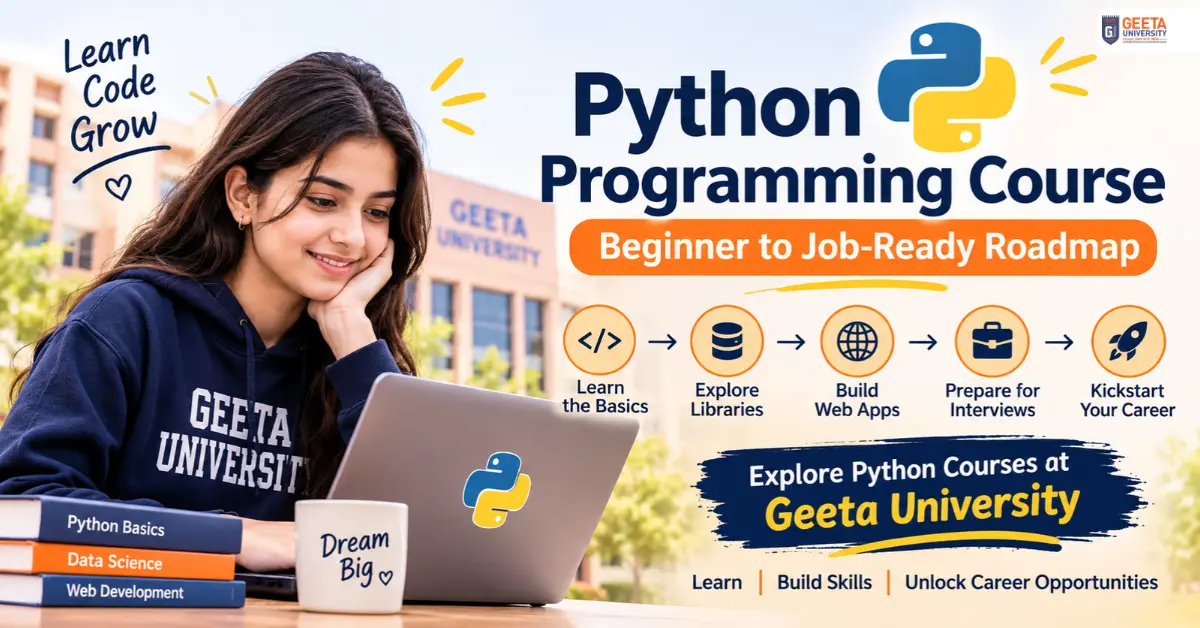
In a Python programming course, a beginner moves through various learning steps such as core language, data structures, libraries, back-end development, and interview preparation to become professionally skilled in just five phases. These Python courses can include various forms, from a brief certification programme to university degrees. The best roadmap includes both basics and projects, along with a certified qualification.
What is Python Programming?
It is a high-level programming language with readable syntax. It supports a number of programming paradigms, such as procedural, object-oriented, and functional. Due to having many data-handling, automation, and web framework libraries, Python is an important programming skill for developers, data analysts and AI professionals.
Highlights of Python Programming Course for Beginners
A Python programming course for beginners transforms novices into proficient coders through structured milestones.
| Learning Phase | Core Concepts Covered | Practical Outcome |
| Phase 1: Foundations | Variables, data types, loops, conditionals, functions | Executable basic logic |
| Phase 2: Core Logic | Object-oriented programming, error handling, I/O | Software scripts |
| Phase 3: Libraries & Web | NumPy, Pandas, Flask, Django | Dynamic web backend |
| Phase 4: Job Preparation | Mock interviews, real-life projects, GitHub portfolio | Deployment for industrial evaluation |
What are the Types of Python Programming Courses in India?
For different backgrounds, it is important to select the appropriate type of course. It is important to choose the best Python course depending on study plans and future career needs.
| Courses | Specifications | Eligibility |
| Python Certification Course | Short-term (3 to 6 months), syntax-based | All students and working professionals |
| Diploma & Advanced Modules | Medium-term, includes databases and APIs | Basic knowledge of computers and mathematics |
| Degree Integrated Programmes (B. Tech/BCA/ MCA) | Multi-year integrated study programmes with specialization paths | 10+2 or Graduation, depending on the chosen degree |
Must Read:
- Best Private Engineering Colleges in Haryana
- Complete Guide to Engineering Courses in India
- Top 10 B.Tech. Colleges in Haryana
Career Opportunities After Python Programming Course in India
After completion of a certified Python course with placement, many technical job roles are open to aspirants in multinational firms and startups.
| Courses | Career Role | Average Salary |
| Advanced Python developer course | Software Engineer / Backend Developer | ₹6 LPA to ₹8 LPA |
| Data Analytics & AI Track | Data Analyst / Machine Learning Engineer | ₹7 LPA to ₹10 LPA |
| Full Stack Specialization | Full Stack Web Developer | ₹5 LPA to ₹8 LPA |
How to Join a Python Programming Course in India?
Step 1: Preparation & Assessment
- Choose The Right Python Track
- Core/General Python: Includes learning about syntax, Object-Oriented Programming, file management and basic scripting.
- Data Science & AI/ML: Includes learning of NumPy, Pandas, Matplotlib, Scikit-learn, and TensorFlow/Pytorch.
- Web Development: Includes learning of frameworks like Django/Flask, REST APIs and database handling skills (SQL/PostgreSQL).
- Automation & Scripting: Includes learning of web scraping using libraries like BeautifulSoup and Selenium.
- Check The Prerequisites
- Short-Term Bootcamps & Online Courses: No academic eligibility criteria; just the basics of working with computers and logical thinking required.
- University Degree / Executive PG Programmes: Require a bachelor’s degree (B.Tech, BCA, B.Sc, B.Com and equivalent) with a minimum percentage of marks (usually 50% aggregate).
- Assess The Syllabus & Mode of Delivery
- Check the mode of delivery (live online batches, self-paced or offline classroom centres).
- Check for inclusion of hands-on practicals; check if there is provision for live coding labs, capstone projects and developing a GitHub portfolio apart from theoretical classes.
- See if the institute offers any placement assistance or resume reviews and mock technical interviews.
Step 2: Application & Screening
- Take a Demo Class or Webinar Class
- Make use of trial classes or free modules to see how the teaching methodology is, instructor proficiency and the time of the batch.
- Take Any Admission Test / Screening Test If Required
- Direct Admission: Most of the private institutes and self-paced learning platforms admit candidates on a first-come, first-served basis.
- Selective Programmes: University-affiliated bootcamps and some cohort-based bootcamp programmes require the students to clear a test that checks their logical reasoning, mathematical aptitude or basic coding skills, followed by a quick interview session.
Step 3: Enrolment & On-Boarding Process
- Upload Documents
- Identity Proof: Aadhaar Card, PAN Card or Passport.
- Academic Proof: Marksheets and certificates (mainly for university degrees and PG programmes).
- Personal Details: Photo, contact details, and resume (if taking admission into a career change programme).
- Make Fee Payment & Get Access to Resources
- Fee Payment Method: You can pay the full fee for discounts, or you can opt for EMIs (available via instalment partners).
- Access to Platform: Receive the login details for the student portal/Learning Management System and enter the community forums (Discord, Slack or WhatsApp) and pre-course setup (installation of Python, Visual Studio Code or Anaconda).
Explore the Best Python Programming Course Curriculum by Geeta University
Located in Panipat, Haryana (near Delhi NCR Region), Geeta University provides software engineering courses with industry-ready skills for practical coding.
- High Impact Education Programs: With high impact technical programs through the School of Computer Science and Engineering.
- Dedicated Skill Centres: Providing technical certificates through Geeta Technical Hub (GTH) and professional grooming through Geeta Finishing School (GFS).
- Performance in Recruitment Drive: With more than 550+ recruiting agencies, 3,500+ job offers, and the highest package of ₹ 1.40 Crore.
- Financial Assistance for Students: Waiving up to 100% tuition fees through the Geeta University Test of Scholarship (GUTS).
Program & Fee Structure
| Degree Programs | Domain / Specialization | Semester Fee (Subject to Change) |
| B.Tech. CSE | Core Computer Science & Engineering | ₹ 95,000 |
| B.Tech. (H) CSE | Artificial Intelligence & Machine Learning | ₹ 1,05,000 |
| B.Tech. (H) CSE | Cyber Security | ₹ 1,05,000 |
| B.Tech. (H) CSE | Full Stack | ₹ 1,05,000 |
| B.Tech. (H) CSE | Data Science and Business Analytics | ₹ 1,10,000 |
| B.Tech. (H) CSE | Quantum Computing | ₹ 1,25,500 |
| BCA (H) | Core Computer Applications | ₹ 55,000 |
| BCA (H) | Cyber Security, AI & ML, Data Science & Business | ₹ 60,000 |
| MCA | Master of Computer Applications | ₹ 50,000 |
| M.Tech. CSE | Master of Technology in CSE | ₹ 40,000 |
Conclusion
A dedicated Python programming course in India builds technical skills for software engineers. Through a structured and academic framework, practical labs, and placement cells, learners become industry-ready from being novice programmers.
Frequently Asked Questions
No previous programming experience is needed for fundamental programs, although basic knowledge of mathematics and logic is good. For degrees like B.Tech or BCA at Geeta University, candidates must meet standard 10+2 eligibility requirements.
Geeta University runs an active corporate resource cell with Geeta Finishing School (GFS), which offers complete mock interviews, communication skills, and technical drives connecting students with top recruiters.
There are several merit-based scholarships available for students. Geeta University Test of Scholarship (GUTS), which offers up to 100% waivers in tuition fees based on academic scores and test scores.
The professional course duration for short-term certificate programs is around 3 to 6 months, but for comprehensive bachelor's degree or master's degree programs like B.Tech, BCA, or MCA, the duration is 3 to 4 years.
Yes, internships in various industries are part of the program for gaining practical corporate exposure before graduating.
Related Blogs
Role of BIM (Building Information Modeling) in Revolutionizing Civil Engineering
A Blog by Sachin Bhardwaj A.P SOE 1. Introduction: Building Information Modeling (BIM) has emerged…

How Civil Engineers Are Responding to Climate Change: A Student’s Perspective
TABLE OF CONTENTS Introduction Why This Matters to Civil Engineering Students New Challenges Engineers Face…

5 Tech Specialisations to Defeat the Artificial Intelligence Wave
Artificial intelligence automates daily tasks and impacts traditional job markets globally. This technological shift creates…
MBA vs M. Tech? Deciding After Engineering Which Course is Best
The choice between “MBA vs M. Tech” is always based on your interests, job objectives,…

Career After B.Tech CSE with AI ML Specialisation
A B.Tech in Computer Science Engineering with AI and ML specialisation prepares graduates for careers…

Digital Twins, Smart Cities & You: How Delhi NCR Colleges Are Teaching Future Tech
The incorporation of digital twin technology and IoT curriculum by top engineering colleges in Delhi…