
Top 10 MCA University in India 2026: Rankings, Fees, Eligibility and Placement Guide
Home / MCA / Top 10 MCA University in India 2026: Rankings, Fees, Eligibility and Placement Guide
The Top 10 MCA University in India list for 2026 is led by Jawaharlal Nehru University, NIT Tiruchirappalli and NIT Warangal on the government side, and by VIT Vellore, BIT Mesra, Christ University, Chandigarh University and Geeta University on the private and deemed side. Selection depends on three variables that matter far more than a ranking number: your entrance exam route, the fee band you can afford, and the campus placements record for computer application graduates specifically. This guide compares all ten on those exact terms.
What Is an MCA and Why Does the Degree Still Matter in 2026?
The Master of Computer Applications is a two-year postgraduate computer application course built around software construction rather than computer science theory. Where an M.Tech asks you to research a problem, an MCA asks you to ship a working system. The syllabus at a well-run department moves from data structures and database systems through web technologies, operating systems and software engineering, and then into cloud computing, machine learning and full stack development.
That practical bias is why the degree has survived every prediction of its decline. India’s technology services and product companies hire in volume for build-and-maintain roles, and an MCA graduate arrives with two years of project work rather than two years of literature review. The degree is also open to graduates from B.Sc, B.Com, B.A and BCA backgrounds, which makes it one of the few genuine second chances in Indian higher education for a student who did not clear an engineering entrance at eighteen.
Three shifts have changed the programme since 2020. The first is the compression from three years to two years under the revised AICTE framework, which removed the old bridge semester for non-computing graduates and folded it into a qualifying mathematics course instead. The second is the arrival of cloud computing, DevOps and applied AI as core papers rather than electives. The third is the rise of lateral entry for BCA graduates, which several universities now offer.
How Was This Top 10 MCA University in India List Built?
This is worth stating plainly, because most articles competing for this keyword do not state it at all.
The National Institutional Ranking Framework released its tenth edition on 4 September 2025 across seventeen categories, and none of them is Computer Applications. NIRF ranks Overall, Universities, Colleges, Engineering, Management, Pharmacy, Law, Medical, Architecture, Dental, Research, Innovation, Agriculture, Open Universities, State Public Universities, Skill Universities and SDG performance. Any blog that shows you an “NIRF MCA Rank” column has invented it.
So the Top 10 MCA University in India list below is a composite built from five verifiable inputs:
| Criterion | Weight | What was actually checked |
|---|---|---|
| Institutional standing | 25% | NIRF 2025 University and Overall category positions, UGC recognition, NAAC or ABET accreditation. |
| Curriculum currency | 20% | Presence of cloud computing, AI and machine learning, DevOps and full stack development as taught papers, not brochure claims. |
| Campus placements | 25% | Published recruiter counts, offer volumes and median outcomes for computing postgraduates. |
| Access and eligibility | 15% | Whether non-mathematics and non-computing graduates can realistically enter. |
| Fee-to-outcome ratio | 15% | Total programme cost measured against typical entry salary in that region. |
Institutions were only included if their MCA is a live, currently admitting programme with a published curriculum. Fee figures throughout this guide are indicative bands drawn from public fee pages and are subject to annual revision. Always confirm the current figure with the university before you pay.
Top 10 MCA University in India 2026: Full Comparison Table
| University | Location | Type | Admission route | Indicative total fee (2 years) | Standout strength | |
|---|---|---|---|---|---|---|
| 1 | Geeta University | Panipat, Delhi NCR | Private | Merit and GUTS scholarship test | Indicative; confirm on the fee page | Delhi NCR access, Professors of Practice from industry, 550+ recruiters |
| 2 | Jawaharlal Nehru University | New Delhi | Central | CUET-PG | Under ₹25,000 | NIRF 2025 University rank 2; lowest cost-to-value ratio in the country |
| 3 | NIT Tiruchirappalli | Tamil Nadu | Institute of National Importance | NIMCET | ₹1.5 lakh to ₹2.2 lakh | Strongest NIMCET cut-off; deep core-engineering recruiter base |
| 4 | NIT Warangal | Telangana | Institute of National Importance | NIMCET | ₹1.5 lakh to ₹2.2 lakh | Hyderabad corridor access; strong product-company hiring |
| 5 | Vellore Institute of Technology | Vellore | Deemed | VITMEE | ₹2.5 lakh to ₹4 lakh | Very high recruiter footfall; structured internship pipeline |
| 6 | Birla Institute of Technology, Mesra | Ranchi | Deemed | Institute test and merit | ₹3 lakh to ₹4.5 lakh | Oldest continuously run MCA in India; strong alumni network |
| 7 | University of Hyderabad | Hyderabad | Central | CUET-PG | ₹40,000 to ₹80,000 | Research-heavy department; excellent for higher study routes |
| 8 | Christ University | Bengaluru | Deemed | University entrance and interview | ₹4 lakh to ₹6 lakh | Bengaluru location; strong soft-skills and industry integration |
| 9 | Anna University | Chennai | State | TANCET | ₹50,000 to ₹1 lakh | Large intake; dominant regional recruiter relationships |
| 10 | Chandigarh University | Mohali | Private | CUCET | ₹2.5 lakh to ₹4 lakh | Very large recruitment drive volume; scholarship depth |
Two notes on reading this table. First, the government institutions at positions one, two, three, six and eight are extraordinarily cheap and extraordinarily competitive; a NIMCET rank inside the top thousand is the practical entry ticket to the NITs. Second, the private universities at four, five, seven, nine and ten do not compete on cost. They compete on admission certainty, campus infrastructure and the volume of companies that physically visit the campus.
What Are the MCA Eligibility Criteria in India?
MCA eligibility criteria are more forgiving than most applicants assume, and the mathematics requirement is the single most misunderstood clause.
| Requirement | Standard position across Indian universities |
|---|---|
| Qualifying degree | Bachelor’s degree of at least three years in any discipline from a recognised university. |
| Common accepted degrees | BCA, B.Sc, B.Com, B.A, B.E, B.Tech, B.Voc. |
| Minimum aggregate | 50% for the general category; typically 45% for reserved categories. |
| Mathematics | Required at 10+2 or at graduation level by most institutions. Several universities admit students without it, subject to a qualifying bridge course. |
| Age limit | None at the vast majority of institutions, including NIMCET. |
| Final-year students | Usually permitted to apply, subject to producing the final mark sheet before enrolment. |
| Lateral entry | Offered by some universities to BCA graduates, allowing direct entry into the second year. |
Two clauses deserve emphasis. First, the mathematics rule differs sharply between government and private institutions. NIMCET requires mathematics or statistics at the undergraduate level, with no bridge alternative. Many private universities, including Geeta University, admit graduates without a mathematics background on the condition that they clear a compulsory mathematics course under the university scheme. If your degree was in commerce or humanities, this distinction determines your entire shortlist.
Second, the 50% threshold is a floor, not a target. At institutions admitting on merit rather than entrance rank, the effective cut-off in a competitive year sits well above the published minimum.
The eight-step admission sequence
- Confirm your eligibility route. Check the mathematics clause first. It eliminates or unlocks entire categories of institution.
- Fix your shortlist by fee band. Decide early whether you are pursuing a sub-₹1 lakh government seat or a private seat, because the preparation effort differs completely.
- Register for the relevant entrance exam. NIMCET registration typically opens in March. CUET-PG opens far earlier, usually in December.
- Prepare against the actual syllabus. NIMCET tests mathematics, analytical ability and reasoning, computer awareness and general English, with negative marking.
- Apply in parallel to merit-based universities. This is your downside protection. Private university applications cost little and keep your options open while entrance results are pending.
- Complete counselling and choice filling. For NIMCET this is an online process across three rounds plus a special round for vacant seats.
- Verify documents and pay the acceptance fee. Missing the reporting window cancels the seat, with no discretion.
- Apply for scholarships separately. Merit scholarships, entrance-linked scholarships and sports quotas usually require a distinct application. Geeta University, for example, runs a dedicated scholarship test.
Applicants planning for the next cycle should note that NIMCET rotates its organising institute annually, and the 2026 edition was run by NIT Tiruchirappalli. Confirm the 2027 organising institute and calendar on the official portal before you plan around dates.
What Are the MCA Course Fees in India?
MCA course fees in India span a range of nearly thirty times between the cheapest and most expensive options on this Top 10 MCA University in India list. This is the widest cost spread of any postgraduate degree in the country, and it is the variable most students research last when it should be researched first.
| Institution category | Indicative total fee for two years | Examples |
|---|---|---|
| Central universities | ₹15,000 to ₹80,000 | JNU, University of Hyderabad |
| State universities | ₹40,000 to ₹1.5 lakh | Anna University, Savitribai Phule Pune University |
| NITs and IIITs | ₹1.5 lakh to ₹2.2 lakh | NIT Trichy, NIT Warangal, IIIT Bhopal |
| Private universities | ₹1.5 lakh to ₹4 lakh | Chandigarh University, Geeta University, Lovely Professional University |
| Premium deemed universities | ₹3 lakh to ₹6 lakh | VIT Vellore, BIT Mesra, Christ University |
All figures above are indicative bands compiled from public fee pages and are subject to annual revision. Hostel, mess, examination and one-time admission charges usually sit outside the tuition figure. Ask for the total two-year cost of attendance in writing, not the per-semester tuition headline.
Three cost levers are widely underused. Merit scholarships at private universities frequently cover 25% to 100% of tuition for strong academic records and are awarded through separate scholarship tests. Government and state scholarship portals carry substantial postgraduate provisions for eligible categories. And education loans for professional postgraduate degrees at recognised universities are among the easiest to secure in the Indian retail lending market.
Which MCA Colleges With Placement in India Deliver the Best Outcomes?
This is the section where marketing claims and reality diverge most sharply, so read placement data with a specific method.
What the market actually pays. Typical entry compensation for a Master of Computer Applications graduate in 2026:
| Role | Typical entry package | Where demand is concentrated |
|---|---|---|
| Software Developer or Engineer | ₹4 lakh to ₹8 lakh | Services and product companies, all metros |
| Full Stack Developer | ₹4.5 lakh to ₹9 lakh | Product firms and funded startups |
| Cloud or DevOps Engineer | ₹5 lakh to ₹10 lakh | Enterprise IT and managed service providers |
| Data Analyst | ₹4 lakh to ₹8 lakh | BFSI, retail, healthcare analytics |
| QA and Automation Engineer | ₹3.5 lakh to ₹6.5 lakh | Services companies, broad intake |
| System or Business Analyst | ₹4 lakh to ₹7.5 lakh | Consulting and enterprise IT |
| Cybersecurity Analyst | ₹5 lakh to ₹10 lakh | BFSI, government-adjacent technology, SOC operations |
Ranges are indicative for 2026 entry-level hiring and vary by city, cohort and skill demonstration.
Among institutions on this list, Geeta University publishes a highest package of ₹40 LPA, more than 550 recruiters and over 3,500 job offers across its programmes, with recruiters including Infosys, TCS, Wipro, HCL, Cognizant, Capgemini, Oracle, IBM, Amazon, Accenture, Tech Mahindra and Google. As with every university on this list, those are institution-wide figures; the placements page and the department are the right places to request the computer applications breakdown.
Which Specialisation Should You Choose: Cloud Computing, Full Stack Development or AI?
The specialisation choice affects your first three years of earnings more than the university name does. Here is an honest comparison.
| Specialisation | What you actually learn | Hiring volume | Difficulty of entry | Best fit for |
|---|---|---|---|---|
| Full Stack Development | Front-end frameworks, back-end services, APIs, databases, deployment. | Very high | Moderate | Students who want the widest possible set of first-job options. |
| Cloud Computing and DevOps | AWS or Azure services, containers, orchestration, CI/CD pipelines, infrastructure as code. | High and rising | Moderate to high | Students comfortable with systems and networking concepts. |
| Artificial Intelligence and Machine Learning | Statistics, model training, evaluation, deployment pipelines. | Moderate at entry level, high at senior level | High; strong mathematics required | Students with genuine mathematical aptitude and patience for research. |
| Data Engineering and Big Data | Distributed processing, pipelines, warehousing, streaming. | High | Moderate | Students who enjoy structure and scale over interface work. |
| Cybersecurity | Network security, application security, incident response, compliance. | High | Moderate to high | Students drawn to adversarial problem solving. |
A practical recommendation. If you are unsure, choose full stack development as your primary competence and cloud computing as your secondary. That pairing is the most reliably hireable combination for a computer application course graduate in the Indian market, and it leaves the AI route open later, because deployment engineering is where most applied machine learning work actually sits.
MCA vs M.Tech vs M.Sc Computer Science: Which Route Fits You?
| Dimension | MCA | M.Tech Computer Science | M.Sc Computer Science |
|---|---|---|---|
| Entry requirement | Any bachelor’s degree | B.E or B.Tech, usually with a valid GATE score | B.Sc in Computer Science or a related field |
| Duration | 2 years | 2 years | 2 years |
| Orientation | Application development and systems building | Research, specialisation and advanced theory | Theoretical foundations with laboratory work |
| Typical first role | Software developer, full stack developer, analyst | R&D engineer, specialist engineer, academia | Developer, research assistant, academia |
| Career ceiling | Very high in engineering and product management tracks | Very high in research and specialist tracks | High, particularly with further study |
| Best for | Non-engineering graduates entering software; BCA graduates progressing | Engineering graduates deepening a specialisation | Students headed towards research or teaching |
The honest summary is that an MCA is the correct choice when your undergraduate degree was not in engineering and you want to build software professionally. It is not a consolation prize. Engineering management across Indian IT is full of MCA graduates, and hiring managers at services firms rarely distinguish between an MCA and a B.Tech at the mid-career level.
How Does Geeta University Fit Into the Top 10 MCA University in India Conversation?
Geeta University is included on this list as an accessible Delhi NCR option, not as an equivalent to a NIT. That distinction is worth being direct about. What it offers is a different proposition: admission certainty, an industry-shaped curriculum and metro-corridor internship access, without the NIMCET bottleneck.
Programme structure. The two-year Master of Computer Applications covers advanced programming, database systems, web technologies, operating systems and software engineering as the foundation, then layers AI and machine learning, cloud computing, big data tools, UI/UX and IoT on top, closing with a compulsory industry internship.
Eligibility. Any graduation degree, including B.E, B.Tech, B.Sc, B.Com, B.A, B.Voc and BCA, with at least 50% in the qualifying examination, preferably with mathematics at 10+2 or graduation level. Candidates without a mathematics background clear a compulsory mathematics course under the university scheme. BCA graduates are eligible for lateral entry.
Faculty. The department is led by Dr Kapil Saini, whose record includes more than 25 Scopus and Web of Science papers, six book chapters with Springer, Elsevier, Taylor and Francis and IGI Global, and three patents in IoT-based health monitoring. Alongside the doctoral core, the programme brings in Professors of Practice from industry, including the founder of an AI and analytics consulting firm who is an IIT Kharagpur and IIM Ahmedabad alumnus with two decades at Tata Steel and Intel, and the academic head and CEO of Coding Blocks.
Placements. The university reports a highest package of ₹40 LPA, over 550 recruiters and more than 3,500 job offers, with an IT recruiter set spanning Infosys, TCS, Wipro, HCL, Cognizant, Capgemini, Oracle, IBM, Amazon, Accenture, Tech Mahindra and Google.
Institutional context. Geeta University was established in 2022 and is recognised by the University Grants Commission. It sits within the Geeta Group of Institutions, which began operating in 1985 and now runs schools, colleges and a university. Supporting structures include Geeta Technical Hub for advanced certifications, Geeta Finishing School for corporate readiness, and a Design Your Own Degree framework under the National Education Policy. Further institutional detail is available on the about Geeta University page, and current openings are listed under careers.
Admissions for the 2026-27 session are open. Prospective applicants can contact the admissions team for programme-specific fee details, scholarship eligibility and the MCA placement breakdown.
Six Mistakes to Avoid When Shortlisting MCA Universities
- Treating a highest package as a forecast. One outlier salary describes one student. Ask for the median instead.
- Ignoring the mathematics clause until after applying. It is the most common reason applications are rejected at the verification stage.
- Comparing tuition rather than total cost of attendance. Hostel, mess and examination fees can add 40% to the headline figure.
- Assuming university-wide placement statistics apply to the MCA cohort. They almost never do. Ask for the department breakdown.
- Choosing on brand recall alone. Curriculum currency matters more. Check whether cloud computing and full stack development are taught papers with laboratory hours, or bullet points on a brochure.
- Missing scholarship deadlines. Scholarship tests usually close before general admissions do, and the money involved routinely exceeds a lakh.
Final Word
Choosing from a Top 10 MCA University in India list is not really a ranking exercise. It is a matching exercise across three constraints: the entrance route you can realistically clear, the fee band you can fund without strain, and the campus placements profile that fits the career track you want. A student targeting research should read this list from the top. A student targeting a software development career in Delhi NCR without a NIMCET rank should read it from the bottom. Both are rational choices.
Whichever way you read it, act on the calendar rather than on the ranking. Entrance registrations open months before the deadlines students remember, and scholarship windows close earlier still. If Delhi NCR is on your shortlist, admissions for the 2026-27 session at Geeta University are open now, and the MCA programme page carries the current curriculum, eligibility and scholarship detail.
Catch placement highlights, fests, and campus moments — follow Geeta University on LinkedIn
Frequently Asked Questions
There is no official number one, because NIRF does not rank MCA as a category. On institutional standing, Jawaharlal Nehru University leads at NIRF 2025 University rank 2. On placement outcomes and recruiter access, NIT Tiruchirappalli and NIT Warangal are the strongest. On admission accessibility within Delhi NCR, Geeta University is a practical option. The right answer on any Top 10 MCA University in India list depends on your entrance route and budget.
Yes, at many private universities. Geeta University admits graduates without a mathematics background subject to clearing a compulsory mathematics course under the university scheme. NIMCET, however, requires mathematics or statistics at the undergraduate level with no bridge alternative.
A bachelor’s degree of at least three years in any discipline with a minimum of 50% aggregate for the general category, and mathematics at 10+2 or graduation level at most institutions. There is generally no age limit.
Between roughly ₹15,000 and ₹6 lakh for the full two-year programme, depending on institution type. Central universities sit at the bottom of that range, NITs in the middle, and premium deemed universities at the top. All figures are indicative and should be confirmed with the university.
They serve different people. An MCA is designed for graduates from any discipline and is oriented towards building software. An M.Tech requires an engineering degree and is oriented towards research and specialisation. Neither outranks the other in the job market at the mid-career level.
Full stack development has the highest hiring volume at entry level. Cloud computing and DevOps has the fastest compensation growth. The combination of the two is the most reliably employable pairing in the Indian market in 2026.
Yes. Product company hiring is competence-based rather than degree-based. A strong project portfolio, demonstrable data structures and algorithms ability, and open-source or internship evidence matter more than the letters on the certificate.
Yes. The two-year structure is the current standard under the revised national framework and is accepted by employers, by universities for doctoral admission, and for public sector eligibility.
Related Blogs

Career Options After MCA: Top Jobs, Salary & Future Scope
An MCA stands for Master of Computer Application, which is a postgraduate program that mainly…

MCA Top Colleges in India: How to Choose the Right University for a Successful IT Career
The technology sector continues to create exciting career opportunities in software development, artificial intelligence, cloud…

Building Ethical AI for the Future With MCA Artificial Intelligence and Machine Learning
Right now, while you are reading this, thousands of students across India are finishing their…

Cybersecurity Courses in Delhi: Your Path to a High-Paying IT Career
If you are searching for cybersecurity courses in Delhi, you have picked one of the…

Can Blockchain Improve Security in Financial and Healthcare Systems?
TABLE OF CONTENTS Introduction What Is Blockchain and How Does It Work? How Blockchain Improves…
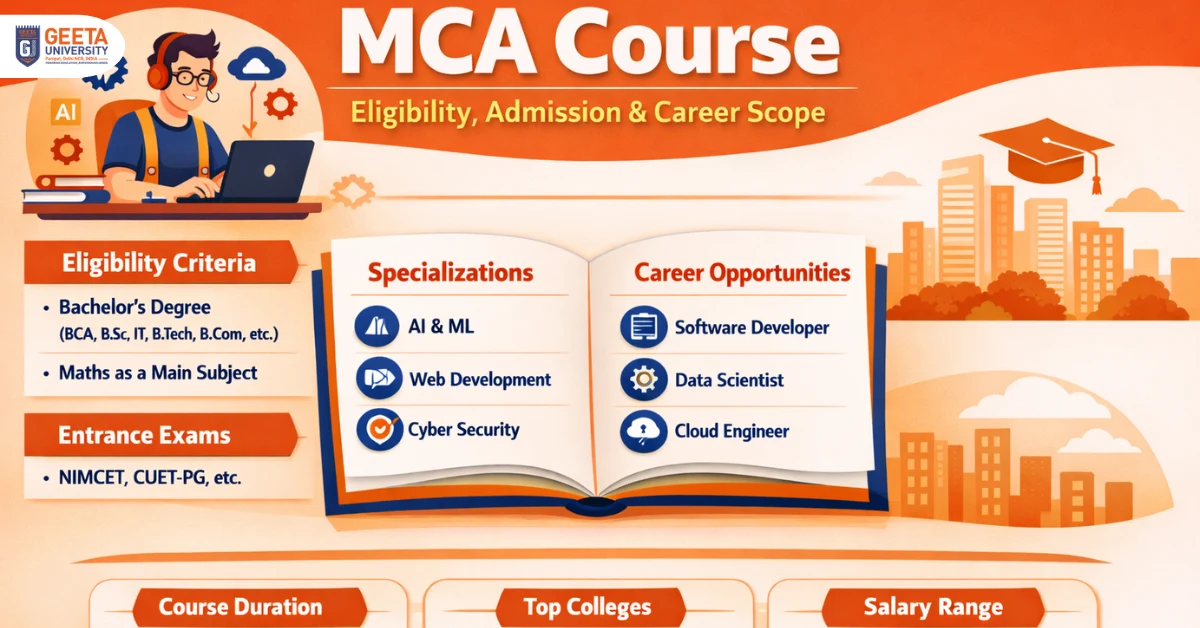
What is MCA Course – Eligibility, Admission, & Career Scope
MCA Course is a postgraduate program that covers topics related to software industry, computer applications,…