BSc Agriculture Course: Eligibility, Admission, Syllabus, Fees and Career Scope
Home / Agriculture / BSc Agriculture Course: Eligibility, Admission, Syllabus, Fees and Career Scope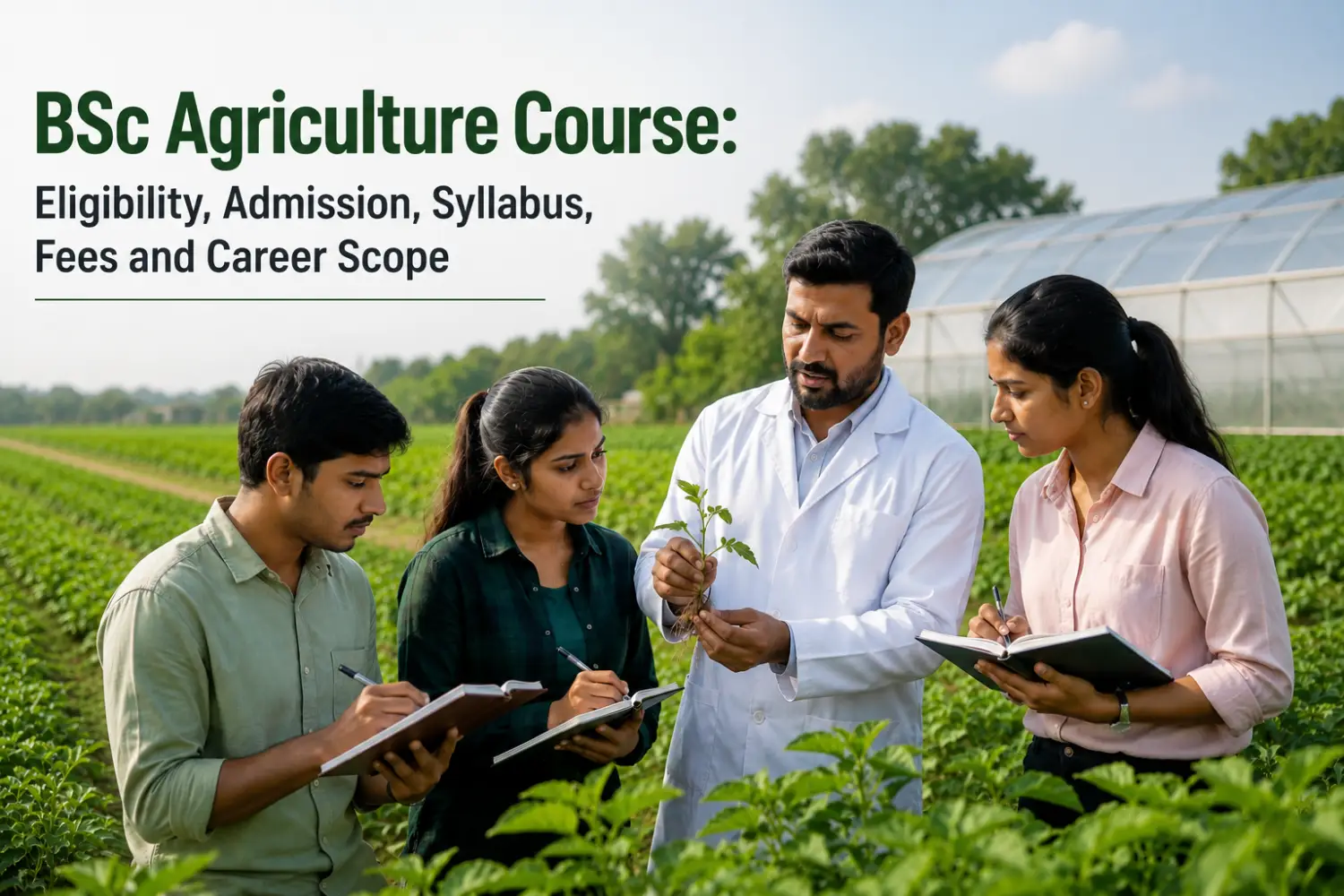
Agriculture is no longer only about ploughs and monsoons. It has grown into a science led, technology driven industry that feeds a nation of more than 1.4 billion people. If you enjoy biology, care about food security and want a degree that opens doors to both secure government roles and fast growing private careers, the BSc Agriculture course deserves a serious look. This guide walks you through everything that matters, from BSc Agriculture eligibility and the admission process to the full syllabus, fees, top colleges and realistic salary expectations in 2026.
A BSc Agriculture course is a four year undergraduate programme that blends classroom theory with hands on field training in crop production, soil science, agronomy, plant breeding and agricultural economics. At institutions such as Geeta University, the curriculum follows Indian Council of Agricultural Research (ICAR) norms and prepares you for the real demands of modern farming. Read on to understand what the course covers, who can apply and where it can take your career.
What Is the BSc Agriculture Course and Its Full Form?
The full form of BSc Agriculture is Bachelor of Science in Agriculture. The BSc Agriculture course is a four year, eight semester undergraduate degree that studies the science and technology behind farming. It explains how crops grow, how soil behaves, how pests are managed and how farm produce finally reaches the market.
Unlike a purely theoretical science degree, this programme is built around practical exposure. Students spend time in laboratories, on research farms and in real villages through structured field training. The aim is simple: to produce graduates who understand both the science of agriculture education and the business of feeding people.
Modern agriculture education now includes precision farming, drones, geographic information systems (GIS) and data analytics. A strong BSc Agriculture course reflects this shift, teaching traditional agronomy alongside the digital tools that are reshaping Indian farms.
Why Should You Choose a BSc Agriculture Course in 2026?
Agriculture remains one of India’s most important sectors. It contributes close to 18 per cent of the country’s GDP and supports the livelihoods of a large share of the rural population.
Several forces are pushing demand for skilled agriculture graduates higher every year:
- Government missions such as the Digital Agriculture Mission and large national irrigation schemes need trained professionals on the ground.
- India’s agribusiness market is projected to reach around USD 24 billion by 2030, creating managerial and technical roles.
- Banks, research bodies and food companies actively recruit agriculture specialists in bulk each recruitment cycle.
This is why a BSc Agriculture course offers a rare combination: the stability of government careers and the momentum of private agritech. Very few undergraduate degrees can lead to both a bank officer’s desk and a farm technology startup. If you are weighing your options, our guide to the best agriculture university in India is a useful place to begin your research.
What Are the Key Highlights of the BSc Agriculture Course?
The table below summarises the BSc Agriculture course details at a glance, so you can quickly judge whether the programme fits your goals.
|
What Is the BSc Agriculture Eligibility Criteria?
To secure a seat in a BSc Agriculture course, you must meet a few clear academic requirements. The BSc Agriculture eligibility conditions are broadly similar across most Indian universities:
- Educational qualification: Passed 10+2 or an equivalent examination from a recognised board.
- Core subjects: Physics, Chemistry and Biology, Mathematics or Agriculture.
- Minimum marks: Usually 50 per cent aggregate, though some universities ask for up to 55 per cent. Relaxation is generally offered for reserved categories.
- Admission route: Either merit, based on Class 12 marks, or a recognised entrance examination.
At Geeta University, the BSc Agriculture eligibility requirement is 10+2 or equivalent with Physics, Chemistry, Biology / Mathematics or Agriculture and at least 50 per cent marks in the qualifying examination.
How Does the BSc Agriculture Admission Process Work?
The BSc Agriculture admission process becomes simple once it is broken into steps. Here is the typical route from application to enrolment:
- Check eligibility: Confirm that you have passed 10+2 with the required subjects and marks.
- Shortlist colleges: Compare universities on curriculum, facilities, fee structure and placement records.
- Fill the application: Apply online through the university website, or offline at the admission office.
- Appear for an entrance exam, if applicable: Some universities accept CUET (UG) or state agriculture entrance tests.
- Merit list and counselling: Shortlisted candidates are called for counselling or a short personal interview.
- Document verification and fee payment: Submit your documents, pay the fee and confirm your seat.
Ready to begin? You can apply for BSc Agriculture admission at Geeta University for the 2026 to 2027 session directly through the official admissions portal.
Which Entrance Exams Are Accepted for BSc Agriculture Admission?
Many BSc Agriculture colleges accept national or state level entrance examinations alongside merit based admission. The table below lists the most widely accepted options.
|
What Does the BSc Agriculture Syllabus Cover?
The BSc Agriculture syllabus is spread across eight semesters. Early semesters build strong fundamentals, while later ones move into specialised subjects, field training and a research project. The table below gives a semester wise view based on the ICAR model curriculum, which most universities, including Geeta University, follow closely.
| Semester | Key Subjects and Topics |
|---|---|
| Semester 1 | Fundamentals of Agronomy; Fundamentals of Soil Science; Introductory Biology or Elementary Mathematics; Fundamentals of Horticulture; Agricultural Meteorology; Communication Skills |
| Semester 2 | Crop Physiology; Fundamentals of Genetics; Agricultural Microbiology; Principles of Agricultural Economics; Fundamentals of Entomology; Introduction to Forestry |
| Semester 3 | Soil Chemistry; Fertility and Nutrient Management; Principles of Plant Breeding; Weed Management; Livestock Production and Management; Agricultural Marketing |
| Semester 4 | Crop Production Technology I (Kharif crops); Plant Pathology; Agricultural Statistics; Farm Machinery and Power; Environmental Studies; Introductory Agroforestry |
| Semester 5 | Crop Production Technology II (Rabi crops); Agricultural Extension Education; Farm Management and Resource Economics; Seed Technology; Fruit Crop Production; Renewable Energy |
| Semester 6 | Vegetable and Spice Production; Post Harvest Management; Protected Cultivation; Pest Management; Dairy Science; Rainfed Agriculture and Watershed Management |
| Semester 7 | Rural Agricultural Work Experience (RAWE); Agro-Industrial Attachment; Experiential Learning; Skill Development Modules |
| Semester 8 | Research Project or Internship; Report Presentation and Viva; Exposure Visits to Institutes and Agribusiness Firms |
What Are the Core Subjects and Specialisations in a BSc Agriculture Course?
Beyond the semester plan, a BSc Agriculture course is built on a set of core disciplines. Understanding these helps you see where your own interests might lie:
- Agronomy: the science of field crop production, covering sowing, nutrition, spacing and harvesting.
- Soil science: how soil forms, its chemistry and physics, and how to keep it fertile and healthy.
- Crop production: practical techniques for growing Kharif and Rabi crops efficiently and sustainably.
- Plant breeding and genetics: developing improved, higher yielding and disease resistant crop varieties.
- Agricultural economics: farm finance, markets, cooperation and the overall business side of farming.
- Irrigation management: designing and managing water supply through modern systems such as drip and sprinkler irrigation.
- Allied subjects: horticulture, entomology, plant pathology, agricultural extension and farm mechanisation round out the programme.
At Geeta University’s School of Agricultural Sciences, these subjects are taught with a strong practical focus, including hands on work on faculty owned research farms and the Rural Agricultural Work Experience (RAWE) programme, so theory is always paired with real fieldwork.
What Is the BSc Agriculture Course Fee Structure?
BSc Agriculture course fees vary widely depending on whether the college is government funded or private. The table below shows typical ranges across India.
| Type of College | Annual Fee Estimate | Total (4-Year Course) |
|---|---|---|
| Government / State Agricultural Universities | ₹10,000 to ₹50,000 | ₹40,000 to ₹2,00,000 |
| Private / Deemed Universities | ₹50,000 to ₹2,00,000 | ₹2,00,000 to ₹8,00,000+ |
For the exact BSc Agriculture course fee at Geeta University, along with instalment options, please refer to the university’s official fee and scholarship page. Geeta University also offers scholarships based on merit, national entrance examination scores (JEE, CUET, NEET, CLAT and more), social responsibility and sports performance, which can significantly reduce the overall cost of study.
What Career Opportunities Follow a BSc Agriculture Course?
One of the biggest strengths of a BSc Agriculture course is the sheer range of careers it unlocks across the government, private and research sectors.
Government sector roles
Government jobs remain a popular first choice because of stability, allowances and social impact. Common roles include:
- Agriculture Officer and Agriculture Development Officer (ADO)
- Agriculture Field Officer through IBPS in public sector banks
- NABARD Grade A Officer and Food Corporation of India (FCI) posts
- Forest Range Officer, Horticulture Inspector and Soil Conservation Officer
- Seed Inspector, Food Inspector and ICAR Agricultural Research Scientist
Private sector roles
The private sector often moves faster and rewards specialist skills quickly. Popular roles include:
- Agronomist and Seed Technologist
- Agri-Business Manager and Farm Manager
- Plantation Manager and Agriculture Consultant
- Roles across agritech startups, food processing units and agri-input companies
Higher studies and entrepreneurship
Graduates who want to specialise further can pursue an MSc in Agriculture, an MBA in Agri-Business or a PhD. Many also choose entrepreneurship, launching ventures in areas such as vermicompost production, seed supply, organic farming and agri-consultancy.
What Salary Can You Expect After a BSc Agriculture Course?
Salaries depend on the sector, role, examination cleared and years of experience. The table below shows realistic 2026 ranges to help you plan.
|
Government posts such as NABARD Grade A and IBPS AFO are among the highest paying entry level options, while agritech and agribusiness roles can grow quickly for graduates with strong technical and management skills.
Which Are the Top Colleges for a BSc Agriculture Course in India?
India has many strong agriculture institutions across central, state and private categories. The table below lists well regarded options, including Geeta University.
| College / University | Location | Highlight |
|---|---|---|
| Institute of Agricultural Sciences, BHU | Varanasi, Uttar Pradesh | Large farm facilities and strong research in crops and soil |
| Punjab Agricultural University (PAU) | Ludhiana, Punjab | Pioneer of the Green Revolution with deep research strength |
| Anand Agricultural University | Anand, Gujarat | Government university with strong rural outreach and multiple campuses |
| Geeta University | Panipat, Haryana | ICAR-aligned curriculum, research farms, RAWE and 100+ industry tie-ups |
If you are focusing on North India specifically, our guides to the top agriculture universities in Haryana and the best agriculture university in India can help you compare shortlists and pick the right fit.
Why Is Geeta University a Top Choice for a BSc Agriculture Course?
Geeta University, located in Panipat, Haryana, has established itself as one of the leading agriculture institutions in North India. Its B.Sc. (Hons.) Agriculture programme is designed around ICAR norms and the recommendations of the Sixth Dean Committee, in line with the National Education Policy 2020.What sets the programme apart is a genuine focus on practice and employability:
- An ICAR aligned, industry driven curriculum built for outcome based learning.
- Practical learning on faculty owned research farms, plus the RAWE programme and Experiential Learning Programme (ELP).
- Expert faculty holding doctoral qualifications with research records in vegetable science, plant breeding, soil science and fruit science.
- More than 100 industrial tie-ups with organisations such as Bayer, Syngenta, Coromandel, Swaraj and Patanjali.
- Modern laboratories, smart classrooms and digital learning tools.
- Scholarships linked to merit, national entrance examinations and sports performance.
The university reports strong placement outcomes across its schools, supported by a large recruiter base and thousands of job offers. You can review the latest placement records on the official placements page. For students from farming backgrounds in particular, the combination of hands on training, industry exposure and financial support makes a BSc Agriculture course at Geeta University a practical, career focused choice.
Is a BSc Agriculture Course Right for You?
A BSc Agriculture course is far more than a farming degree. It is a gateway to secure government service, dynamic private careers, research and entrepreneurship, all within a sector that will only grow in national importance. If you meet the BSc Agriculture eligibility requirements and want a programme that pairs scientific depth with real world training, Geeta University’s B.Sc. (Hons.) Agriculture is well worth exploring. Take the next step and apply for the 2026 to 2027 session today.
Catch placement highlights, fests, and campus moments — follow Geeta University on LinkedIn
Frequently Asked Questions
The BSc Agriculture course is a four year undergraduate degree that studies the science and technology of farming, including crops, soil, pest management, plant breeding and agribusiness. It combines classroom learning with practical field and laboratory training.
The BSc Agriculture course lasts four years, spread across eight semesters of classroom study, laboratory work, field training and a final research project or internship.
The BSc Agriculture eligibility requirement is a pass in 10+2 or equivalent with Physics, Chemistry and Biology, Mathematics or Agriculture, usually with at least 50 per cent aggregate marks. At Geeta University the minimum is 50 per cent.
Common entrance exams include CUET (UG) or ICAR AIEEA at the national level, and state tests such as MHT CET, KEAM, EAMCET, BCECE and CG PAT. Many universities, including Geeta University, also offer merit based admission on Class 12 marks.
The BSc Agriculture syllabus covers agronomy, soil science, crop production, plant breeding, genetics, horticulture, entomology, plant pathology, agricultural economics, irrigation management and agricultural extension, along with practical field training.
BSc Agriculture course fees typically range from about Rs. 40,000 to Rs. 2,00,000 in total at government universities, and from around Rs. 2,00,000 to Rs. 8,00,000 or more at private universities. Scholarships can reduce these amounts.
Graduates can work as Agriculture Officers, ADOs, Agronomists, Farm Managers, Seed Technologists, bank Agriculture Field Officers, NABARD and FCI officers, ICAR scientists, and in agritech and food processing companies, or start their own agribusiness.
Yes. Geeta University offers scholarships based on merit and qualifying examination percentage, national level entrance examination scores such as JEE, CUET, NEET and CLAT, social responsibility and sports performance.
Related Blogs
Which are the Best MSc Agriculture Colleges in Delhi NCR?
Several top educational institutes in Delhi NCR provide specialized postgraduate education in agriculture. IARI New…

Master’s Degree Agriculture in India 2026: Specialisations, Admission Routes and Career Scope
A master’s degree agriculture programme in India is a two-year postgraduate qualification (M.Sc. Ag.) that…
BSc Agriculture: Course, Eligibility, Syllabus, Subjects, Fees and Career Scope (2026 Guide)
BSc Agriculture is one of the most future-ready degrees a science student can pick today….

Role of Youth in Indian Agriculture: Drivers of a Healthy and Prosperous Future
Dr. Jyoti Sharma, Assistant Professor, School of Agricultural Studies, Geeta University, Panipat Introduction India, with…
Top 10 Agriculture Universities in Haryana: Entrance & Admission
Isn’t agriculture a very fascinating topic? Indeed, it is the foundation of a country like…

BSc Agriculture Top Colleges: How to Choose the Right University for Your Farming Career
India’s agricultural sector is going through a quiet revolution. Precision farming, AgriTech startups, GIS-based crop…