Geeta University official logo

B.A. (Hons.) Economics

Program

B.A. (Hons.) Economics

Duration

3 Years (6 Semesters)

Eligibility

10+2 with minimum 50% marks

B.A. (Hons.) Economics

The Bachelor's Degree in Economics curriculum at Geeta University is designed to develop analytical, quantitative, and policy-making skills.  It encompasses microeconomic and macroeconomic theory, public finance, econometrics, development economics and many more.  Through case studies, economic simulations, and data analysis tools, students acquire the skills to make educated economic judgments and predictions for practical applications. 

The program blends theoretical knowledge with practical exposure through:

  • Taking an active role in social and artistic events.
  • Participating in debates and public speaking events.
  • Participating in athletics, physical fitness, or collaborative endeavors. 
  • Acquiring leadership and collaboration skills via group activities.
  • Taking part in artistic activities like writing, art, or media.
Important Takeaways:
  • A 3 Years (6 Semesters) Full-Time Degree Program
  • The university provides co-curricular and extracurricular activities for its students
  • Sports activities are available on campus
  • Cultural activities are often organized
  • Students can participate in different clubs
  • Teamwork skills are encouraged
  • Comprehensive personality development is promoted beyond academic pursuits
  • Scholarships Based on National Level Entrance Exams (JEE, CUET, NEET, CLAT, and more), Merit Lists & Sports
Program Structure:

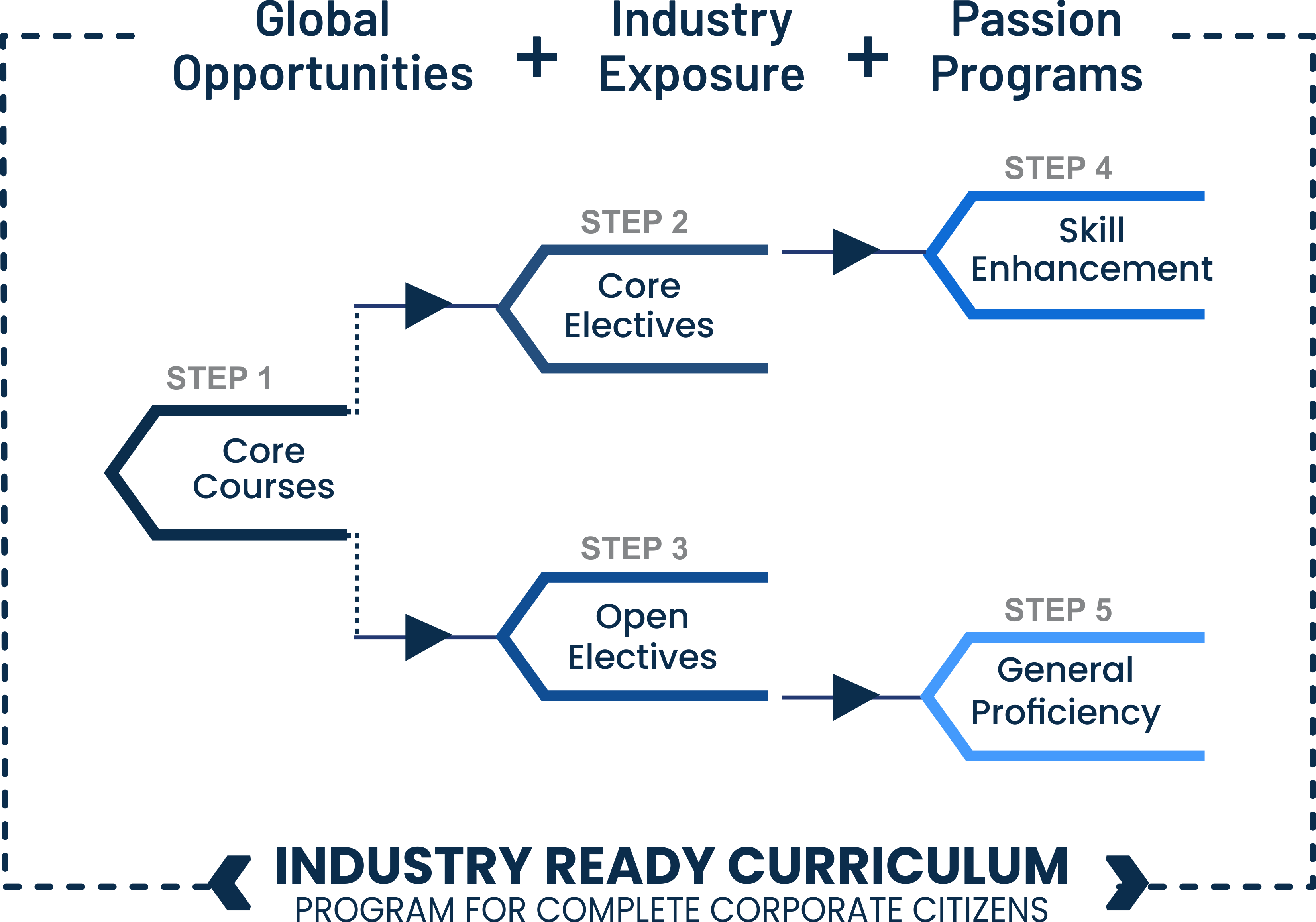
The university is widely recognized as one of the top Bachelor's Degree in Economics Colleges in North India owing to the fact that it offers a curriculum that is centered on the industry, superior facilities, and practical training.  

Following are the Bachelor's degree in economics subjects:

  • Principles of Microeconomics
  • Principles of Macroeconomics
  • Statistics for Economics
  • Development Economics
  • Public Finance
  • International Trade & Finance
  • Indian Economy
  • Environmental Economics
  • Mathematical Economics
  • Project/Research Work
Learning Outcomes
  • Analyze economic trends and policies
  • Interpret economic data for planning and strategy
  • nderstand national and global financial systems
  • Develop research and statistical skills
  • Contribute to inclusive economic development

Enquire Now

DESIGN YOUR OWN DEGREE WITH GU

Degree Design

Meet Our Mentors

Guiding Futures with Expertise, Experience & Empathy

WhatsApp Image 2026-06-18 at 12.55.10 (2)
Ms. Himani

Assistant Professor, Master’s (Psychology), UGC NET

Ms .Himani a psychologist, educator, and researcher with over 3.5 years of experience in teaching.  I have qualified UGC NET .

Ms .Himani a psychologist, educator, and researcher with over 3.5 years of experience in teaching.  I have qualified UGC NET .

RED06454
Ms. Himani

Assistant Professor, M.A. (Political Science)

Specialized in Political Science and International Relations, with academic expertise in global politics, diplomacy, governance, and public policy. Qualified the UGC-NET examination in Political Science and is an alumnus of the University of Delhi. Committed to excellence in teaching, research, and academic engagement, with a keen interest in contemporary political issues and international affairs.

Specialized in Political Science and International Relations, with academic expertise in global politics, diplomacy, governance, and public policy. Qualified the UGC-NET examination in Political Science and is an alumnus of the University of Delhi. Committed to excellence in teaching, research, and academic engagement, with a keen interest in contemporary political issues and international affairs.

RED07251 (1)
Ms. Deepika Jaglan

Assistant Professor

Deepika Jaglan is an Assistant Professor of Political Science with a Master's degree from Kirori Mal College, University of Delhi. She has successfully qualified the UGC-NET examination twice and has published two book chapters. She is committed to teaching, research, and fostering critical engagement with contemporary political and social issues.

Deepika Jaglan is an Assistant Professor of Political Science with a Master's degree from Kirori Mal College, University of Delhi. She has successfully qualified the UGC-NET examination twice and has published two book chapters. She is committed to teaching, research, and fostering critical engagement with contemporary political and social issues.

Dr Dipti Rana
Dr. Dipti Rana

Assistant Professor

Dr. Dipti Rana, a Delhi University alumni, is an Assistant Professor of Psychology with 5.5 years of experience. She blends Counselling, Health, and Indian Psychology with professional Theta Healing to empower minds.

Dr. Dipti Rana, a Delhi University alumni, is an Assistant Professor of Psychology with 5.5 years of experience. She blends Counselling, Health, and Indian Psychology with professional Theta Healing to empower minds.

Sheetal Khatri
Dr. Sheetal Khatri

Assistant Professor, Ph.D.

Dr. Sheetal Khatri is an expert faculty in psychology. Her main research fields include positive psychology, social psychology and organizational psychology.

Dr. Sheetal Khatri is an expert faculty in psychology. Her main research fields include positive psychology, social psychology and organizational psychology.

Virtual Campus Tour

SCHOLARSHIPS AT GEETA UNIVERSITY

We believe that financial constraints should not limit access to quality education. At Geeta University, we offer scholarships based on:

  •  Merit/Percentage in Qualifying Exams
  •  National Level Entrance Exams (JEE, CUET, NEET, CLAT, and more)
  •  Social Responsibility
  •  Sports Performance        

GUTS

Geeta University Test of Scholarship
Geeta University (GU) strongly believes that monetary constraints should not be an obstacle for a student to have access to quality education. Geeta University Test of Scholarship (GUTS) provides students with an opportunity to reduce the financial burden and get up to 100% off on tuition fees based on their performance.

Highlights of Our Learning Spaces

Career Options After B.A. (Hons.) Economics:

Graduates can work in both private and government sectors after a Bachelor's Degree in Economics. Some top career options include:

Finance & Banking
  • Financial Analyst / Manager
  • Investment Analyst / Administrator
  • Banker / Probationary Officer
  • Financial Risk Analyst
Consulting & Analytics
  • Management / Economic Consultant
  • Data Analyst / Scientist
  • Market Research Analyst
Government Sector
  • IAS / IPS Officer
  • Indian Economic Service (IES) Officer
  • RBI Officer / Economist
  • Policy Advisor / Research Analyst
Research & Academia
  • Research Analyst
  • Teacher / Professor
Reasons To Choose Geeta University for B.A. (Hons.) Economics
  • A high-quality school that focuses on establishing good academic skills
  • Highly skilled, experienced teachers and researchers
  • Innovative training methods like case studies, models, and discussion boards
  • Get your hands on the latest technology and study materials
  • The modern classroom and research computer lab
  • Investigate platforms that focus on fostering intellectual development and exploration
  • Significant focus on experiential learning for students
  • Collaborations with business entities, non-governmental organizations, and governmental bodies
  • Internship and real project opportunities
  • Enhanced comprehension of the practical application of economic strategies and theories.
  • Better preparation for the job market and gaining useful skills

Geeta University is a top choice for students seeking quality Bachelor's Degree in Economics in Haryana with a strong future scope.

40 LPA

HIGHEST PACKAGE

550+

RECRUITERS

3500+

JOB OFFERS

Frequently Asked Questions

Find answers to common questions about eligibility, courses, placements, and campus facilities.

The School currently offers B.A. programmes in Political Science, Psychology, Economics, Social Work and English; M.A. programmes in Political Science and Psychology; and Ph.D. programmes in Psychology and Political Science.


Candidates need to have passed the 10+2 examination with a minimum of 50% marks, in any stream.

Yes. There is no restriction based on Class 12 stream — students from Science, Commerce, Arts/Humanities or any other stream can apply for the B.A. programmes, as long as they have passed 10+2 with at least 50% marks.

For both M.A. Political Science and M.A. Psychology, applicants need a Bachelor's degree with a minimum of 50% marks in a relevant subject.


Candidates need a Master's degree in a relevant field with a minimum of 55% marks, along with the University's doctoral admission and research-eligibility requirements for Psychology.


Choose Psychology for human behaviour, Political Science for governance, Economics for markets and quantitative analysis, and Social Work for community welfare and social intervention.


B.A. (Hons.) Psychology builds a foundation in cognitive, developmental and abnormal psychology, blending theory with lab-based experiments, psychological assessments and community outreach. It prepares students for counselling, HR, mental health and education-related roles.

The programme covers politics, governance, institutions, public affairs and political thought, with links to policy and administration.

It builds knowledge of economic systems, markets, policy and analytical decision-making, with applications in business, finance, research and development.

The programme centres on social issues, welfare, community engagement and professional social-work practice.

B.A. Psychology provides the foundation — human behaviour, psychological processes and core testing skills. M.A. Psychology builds on this with deeper subject knowledge, specialised study and stronger research preparation, requiring a Bachelor's degree with 50% marks in a relevant subject for entry.


B.A. Political Science builds the fundamentals of politics and governance, while M.A. Political Science (open to Bachelor's degree holders with 50% marks in a relevant subject) develops more advanced analysis and specialisation.


No. The School combines academic study with experiential learning, workshops, collaborations and practical applications.

Students connect concepts with contemporary social, behavioural, economic and governance issues through activities, workshops and applied learning.


Yes. Research design, analysis, interpretation and academic writing are developed through coursework and projects, particularly at higher levels.

Opportunities depend on faculty projects and the academic calendar, but students can develop research skills through projects and academic activities.


Yes. The School encourages students to relate their learning to contemporary social and community issues.

Yes. Workshops, academic collaborations and expert-led activities form part of the learning experience.
Yes. This is especially relevant to Political Science, Economics, Psychology and Social Work.

No. A B.A. alone does not qualify someone for clinical practice. Additional recognised qualifications and applicable regulatory requirements are necessary; further studies such as M.A./M.Sc. Psychology, M.Phil or Ph.D. can lead toward roles like clinical psychologist or therapist.

Graduates can explore research, education, HR, behavioural work, wellness organisations, social-sector roles and further doctoral study.
Yes. Knowledge of behaviour, motivation and communication can support careers in HR, talent management and organisational roles.

Yes. The School offers a Ph.D. in Psychology for Master's degree holders with a minimum of 55% marks in a relevant field, providing a pathway to advanced research and doctoral study.

Graduates can work in counselling centres, schools, NGOs, HR departments and mental health institutions, along with roles in education, research support and community organisations.
Graduates can explore policy research, administration, NGOs, journalism, political research, development organisations and related fields.

Yes. It provides a strong foundation in governance, institutions, public policy and political thought, but the degree itself does not guarantee exam success.
Yes. Policy research and governance roles are relevant options for graduates with strong research, writing and analytical skills.
Yes. Knowledge of governance, society and public institutions is useful in development, advocacy and community programmes.

Yes. The School offers M.A. Political Science for Bachelor's degree holders with a minimum of 50% marks in a relevant subject, and a Ph.D. in Political Science for those who wish to go further.

Career areas include business analysis, research, banking and finance, consulting, market research, policy and development.

Yes. Economics develops knowledge of markets, policy and quantitative reasoning that can support finance-related careers.

Yes, especially when they add skills in statistics, spreadsheets, data visualisation and analytical tools.

Yes. Economics is relevant to policy analysis, development economics, public finance and socio-economic research.

Students can pursue postgraduate study in Economics or related disciplines, along with specialised professional or research pathways.

Graduates can work in NGOs, community development, CSR, public and development programmes, rehabilitation and welfare organisations.
Yes. B.A. Social Work is practice-oriented — students engage directly with communities through fieldwork placements, internships and outreach projects as part of the programme's professional social-work practice component.

Yes. Community engagement, programme implementation and social-impact skills are relevant to CSR roles.


Yes. NGOs and development organisations are important career areas for graduates with strong community, research and programme skills.

The School's faculty includes UGC-NET qualified and doctorate-holding professors across Psychology and Political Science, with academic backgrounds from institutions such as the University of Delhi, and research interests spanning counselling psychology, positive psychology, organisational psychology, and global politics and governance.

Students engage with contemporary issues, discussion, analysis, interdisciplinary perspectives and experiential learning.

Yes. Workshops, academic activities and project work help strengthen communication, writing, presentation and collaboration skills.

Yes. Students can strengthen their profile through internships, workshops, research, digital skills, certifications or competitive-examination preparation.
Yes. Students are encouraged to connect Psychology, Political Science, Economics, Social Work and wider social-science perspectives.

Yes. These programmes build research, communication, writing and analytical skills. Career prospects improve further with practical experience, specialisation or higher study.
No. It can lead to HR, education, research, behavioural studies, wellness and social-sector roles; regulated clinical practice requires additional qualifications beyond the degree.
No. Graduates can also move into policy, research, administration, journalism, NGOs, development and academia.

It can be a good fit for students who enjoy analytical and quantitative work and are willing to develop statistical and data skills.

Think about the questions you enjoy most: behaviour for Psychology, governance for Political Science, markets and data for Economics, or social welfare and community work for Social Work.

Yes. Depending on eligibility, graduates can move into master's programmes, professional qualifications, competitive examinations and careers that value transferable skills.

The School currently offers M.A. Political Science and M.A. Psychology, both requiring a Bachelor's degree with a minimum of 50% marks in a relevant subject.
Yes. The School currently offers Ph.D. programmes in Psychology and Political Science, both requiring a Master's degree in a relevant field with a minimum of 55% marks.

Yes, subject to the relevant doctoral programme's eligibility, research and admission requirements — a Master's degree with a minimum of 55% marks in a relevant field.

Research may cover human behaviour, governance, public policy, economics, social development, education, community welfare and related contemporary issues.

Possible sectors include education, policy, social work, HR and CSR, media, development, finance, consulting, research, advocacy and higher education.
It combines academic foundations with interdisciplinary learning, experiential activities, workshops, research opportunities and career-oriented skill development.

Legacy & Ecosystem

Founded in 1985, the Geeta Group of Institutions has emerged as a major educational hub with institutions spanning school education to doctoral programs. SPBSB benefits from the integrated ecosystem of:

Geeta University

AI-enabled multidisciplinary campus

Geeta Finishing School (GFS)

Communication & Corporate Readiness

Geeta Technical Hub (GTH)

Advanced Technology, Certifications, and Industry Skills

Geeta Group Campus