.webp)
Program
M.Sc. Forensic Science
Duration
2 Years
Eligibility
Bachelor's degree in Science/ Forensic Science/ Medicine/ Engineering/ Pharmacy 1 Dentistry/ Ayush with at least 55% for General/OBC (NCL)/EWS category candidate and 50% or equivalent for SC/ST and PwD category candidates.
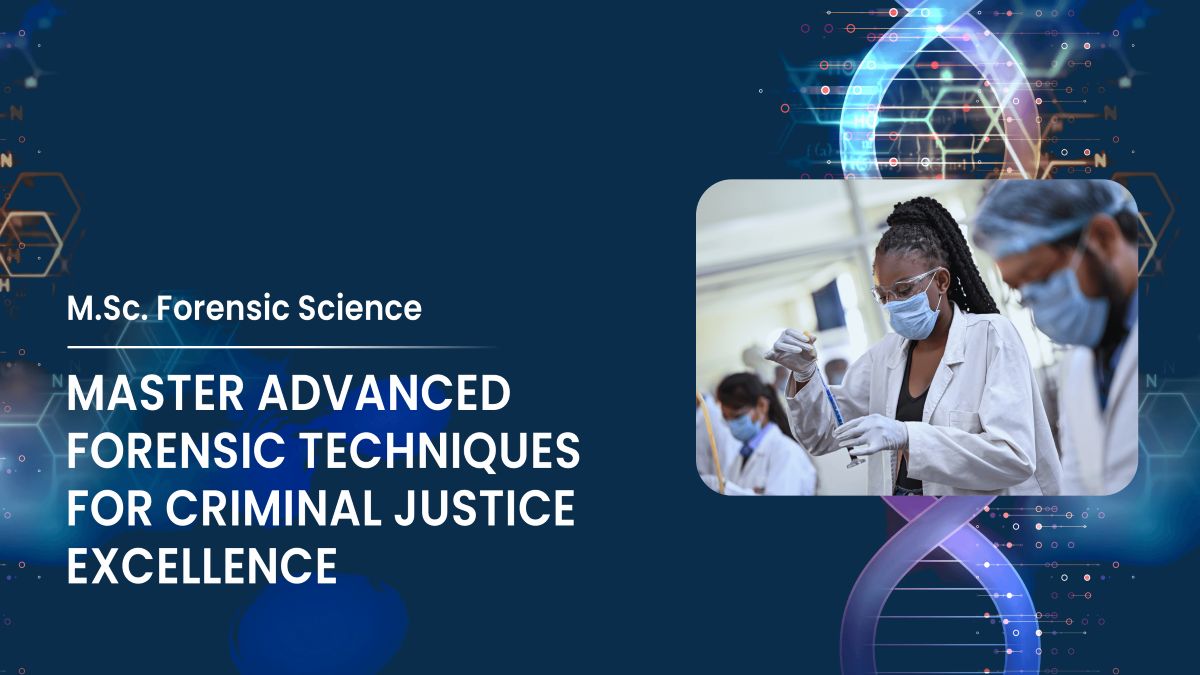
Students pursuing an M.Sc. in Forensic Science from Geeta University are taught everything about digital evidence, toxicology, forensic serology, and DNA analysis. The course is designed to develop a robust theoretical background, practical forensic skills, and an interdisciplinary understanding. Geeta School of Sciences is one of the top Forensic Science Colleges in India, and offers training in simulation labs and teaches through case studies. It enables students to evolve into professionals for work in national labs, investigation bureaus, legal consultancy, and academia.
Enquire Now


Assistant Professor, Ph.D.
My specialisation is Atomic physics and spectroscopy Ibalso qualified CSIR NET of physical with all india 19 th rank
Assistant Professor, M.Sc. (Forensic Science), UGC-NET
Published 2 Research Papers; Authored 2 Books; Active contributor to forensic science education and training.
Assistant Professor, Ph.D.
Published research and review articles on Forensic Nanotechnology. Published 3 copyrights and two idea patents. Contributor to emerging areas of forensic research.
Assistant Professor, Ph.D
Specialized in fractional calculus, special functions, integral transforms. Published 4 research papers. Active contribution in Mathematics Research
Assistant Professor
Electrochemical sensing, nanomaterials, water quality assessment, and environmental remediation
Assistant Professor
Assistant Professor
Muskan Bindal works as an Assistant Professor of Forensic Science. She completed her Integrated B.Sc.-M.Sc. from the National Forensic Sciences University (NFSU). Her research explores the chemical signals released from our skin and the volatile organic compounds (VOCs) linked to metabolic signs of fear and stress. Additionally, she has worked on how polycyclic aromatic hydrocarbons (PAHs) affect aquatic ecosystems, as an investigative approach in Environmental forensics. She's hands-on with advanced instruments like GC-MS, HPLC, HPTLC, and UV/Vis Spectroscopy, blending complex lab work with real-world forensic cases.
Assistant Professor
Sakshi Gahlawat specializes in Forensic Science, with expertise in Crime Scene Investigation, Forensic Genetics and Serology, Fingerprint Science, and Digital Forensics. Her professional interests encompass cyber crime analysis, forensic evidence examination, crime scene documentation, and practical laboratory instruction. She is committed to quality education, student mentoring, and fostering research and industry-academia collaboration.
We believe that financial constraints should not limit access to quality education. At Geeta University, we offer scholarships based on:
M.Sc. graduates can become forensic experts, investigators, academic researchers, or legal consultants. They are preferred in forensic bureaus, research centers, and multinational legal support firms.
Top recruiters include:
HIGHEST PACKAGE
RECRUITERS
JOB OFFERS
Find answers to common questions about eligibility, courses, placements, and campus facilities.
The School currently offers B.Sc. Forensic Science, M.Sc. Forensic Science and Ph.D. Forensic Science.
Students should have passed or appeared in 10+2 in the Science stream with Physics, Chemistry and Biology/Mathematics with at least 55% for General/OBC (NCL)/EWS candidates and 50% or equivalent for SC/ST and PwD candidates.
Yes. Biology is one of the accepted subject combinations for the programme.
Yes. Mathematics is also accepted as part of the qualifying Science-stream background.
It applies scientific methods to crime investigation, evidence examination and the interpretation of forensic findings.
It is primarily a science-based programme that applies laboratory and analytical methods to criminal investigations and evidence.
Key areas include crime scene investigation, forensic biology, forensic chemistry, toxicology, ballistics, fingerprint analysis, cyber forensics, criminal law basics and laboratory practicals.
The programme goes deep into forensic biology, serology, toxicology, DNA fingerprinting, criminalistics, digital and cyber forensics, crime-scene reconstruction and forensic psychology.
B.Sc. builds foundational scientific and forensic skills, while M.Sc. develops deeper specialist, analytical and research capabilities.
The Ph.D. is research-focused, with scholars working on specialised forensic problems under academic supervision and completing research and publication-related requirements.
Yes. Practical laboratory work is a central part of the programmes, alongside scientific and theoretical learning.
Yes. Students work through crime-scene simulations and evidence-analysis activities to develop their investigation skills.
Training covers areas such as biological evidence, chemical evidence, fingerprints, toxicological samples, DNA and other crime-scene materials.
Yes. DNA analysis and DNA fingerprinting are included in the forensic curriculum, particularly at the postgraduate level.
Yes. Fingerprint analysis is included among the B.Sc. forensic subjects and practical learning areas.
Yes. Cyber and digital forensics form part of the curriculum, with advanced treatment at the M.Sc. level.
Yes. Evidence handling is an important practical skill developed through forensic laboratory work and crime-scene activities.
Yes. Case studies, discussions, seminars and practical exercises are used alongside classroom and laboratory teaching.
Yes. The programmes include regular internship and practical exposure at different intervals.
The University already has industry connections with Central and State Forensic Science Laboratories, giving students opportunities for exposure to professional forensic work.
Industrial tie-ups with CFSLs and SFSLs and practical exposure through forensic agencies are among the major USPs of Geeta University.
Yes. From time to time Expert talks and industry interaction are conducted as part of its learning experience.
Yes. The School did organize an International Conference on Forensic Science where students gained exposure to developments and experts’ perspectives in the field.
The faculty encompasses academics with special backgrounds in forensic science, physics and related scientific disciplines, along with research experience in areas such as forensic nanotechnology.
No. Teaching combines theory with additional laboratory work, case studies, simulations, discussions, seminars and practical exercises.
Students practise observation, evidence analysis, case interpretation and problem-solving through simulations, laboratory work and forensic case studies.
The programmes include exposure to legal procedures and, at postgraduate level, courtroom-testimony readiness as part of professional preparation.
Yes. Special Emphasis is given to research progressively during the study, with the M.Sc. including dissertation and seminar work and the Ph.D. focusing on independent research.
Graduates can certainly explore roles in forensic laboratories, investigation support, crime-scene work, forensic analysis, law enforcement and related private-sector organisations.
Potential sectors among which Forensic Science graduates can get jobs include Central and State Forensic Science Laboratories, crime branches, police and investigation agencies, defence, courts, narcotics departments, universities and private forensic organisations.
Yes. Forensic laboratories are a major career pathway, with roles depending on the student's qualification, specialisation and the employer's recruitment method used.
M.Sc. graduates can pursue specialist forensic, investigation, research, academic and legal-support roles, or continue to doctoral research down the line.
Yes. M.Sc. graduates with minimum 55% marks can pursue Ph.D. Forensic Science and research in specialised forensic domains.
Yes. Private forensic laboratories, investigation organisations, detective agencies and other specialised organisations can offer relevant career opportunities.
Yes. The field uses scientific knowledge from areas such as biology and chemistry to examine evidence and solve investigative problems. So, it is highly suitable for someone who enjoys Biology and Chemistry.
Not necessarily. The field also includes laboratory analysis, research, scientific examination, digital forensics, academia and legal support. Police work is not something which is in any way mandatory for studying Forensic Science.
No. Crime shows mostly simplify forensic work. The actual field involves careful evidence handling, laboratory procedures, scientific analysis, documentation and methodical investigation
Yes. The programme includes laboratory work, crime-scene simulations, evidence examination and other hands-on activities.
Strong observation, analytical thinking, scientific reasoning, attention to detail and careful evidence handling are particularly useful.
Yes. The programme connects scientific evidence with criminal-law procedures and investigative practice, making it suitable for students interested in both science and law.
The programme duration is 3 years and 4 years for B.Sc. Forensic Science and B.Sc. (Honors) Forensic science respectively.
M.Sc. Forensic Science is a two-year postgraduate programme.
The Ph.D. programme has a minimum duration of three years.
Currently, the School has focused fully on Forensic Science at undergraduate, postgraduate and doctoral levels.
Yes, the University is fully committed to giving the best possible placement assistance to Forensic Science students in the form of mock interview, aptitude classes, Soft skill training, and regular placement drives.
Founded in 1985, the Geeta Group of Institutions has emerged as a major educational hub with institutions spanning school education to doctoral programs. SPBSB benefits from the integrated ecosystem of:
AI-enabled multidisciplinary campus
Communication & Corporate Readiness
Advanced Technology, Certifications, and Industry Skills