Best Nutrition & Dietetics Programs | Health & Allied Sciences Courses

Geeta University official logo

Become the Healthcare Professional the Future Needs

🔍 Practical learning with modern healthcare technologies

🎯 Skill-based education focused on employability

📈 Growing demand for allied healthcare professionals worldwide

Apply Now

Become the Healthcare Professional the Future Needs

🔍 Practical learning with modern healthcare technologies

🎯 Skill-based education focused on employability

📈 Growing demand for allied healthcare professionals worldwide

Apply Now

School Of Health & Allied Science

School Of Health & Allied Science

The Department of Nutrition and Dietetics at Geeta University is dedicated to excellence in nutrition education, research, and community service. The department offers industry-aligned programs that integrate theoretical knowledge with practical training in clinical, community, and food industry settings. Equipped with modern laboratories and a functional diet clinic, it provides hands-on learning experiences. Experienced faculty members mentor students in research, internships, and professional development. The department prepares graduates to become competent nutrition professionals and leaders in health and wellness.

"The school of Health and Allied Sciences offers B.Sc and M.Sc programs in Nutrition & Dietetics with specializations in diet planning, food science and technology and fitness management."

The Department of Nutrition and Dietetics at Geeta University is dedicated to excellence in nutrition education, research, and community service. The department offers industry-aligned programs that integrate theoretical knowledge with practical training in clinical, community, and food industry settings. Equipped with modern laboratories and a functional diet clinic, it provides hands-on learning experiences. Experienced faculty members mentor students in research, internships, and professional development. The department prepares graduates to become competent nutrition professionals and leaders in health and wellness.

"The school of Health and Allied Sciences offers B.Sc and M.Sc programs in Nutrition & Dietetics with specializations in diet planning, food science and technology and fitness management."

  • To be a centre of excellence in health sciences education nurturing competent, innovative and compassionate healthcare professional committed to advancing healthcare, nutrition, wellness and the overall wellbeing of individuals, communities and the nation.

  • To undertake impactful research addressing National and International legal and social issues.
  • To impart application oriented Legal education for nurturing Legal Professionals who can appreciate and compassionately uphold the spirit of law in the light of local and global perspectives.
  • To encourage research and novel ideas in the areas of humanities and social sciences that contribute to public policy helping communities grow, and making life better for everyone.
  • To strengthen the partnership with academic, governmental, community, industry and other stakeholders in the field of practice-oriented education, community service, consultancy, research activities and human resource development.
  • To develop leadership potential and life-long learning competencies to promote human development, diversity, social inclusion and active citizenship, as well as national and regional economic growth.

Meet Our Mentors

Guiding Futures with Expertise, Experience & Empathy

Dr Sonal (Custom)
Dr. Sonal

Assistant Professor, Ph.D. (Food and Nutrition)

Expert in Food Product Development and Evaluation, Hospital & Industry Practices; Authored Books, Research Papers, Patents, and Book Chapters; H-Index: 8; Recipient of Best Teacher Award & Best Performer Award; Recognized contributor to innovation in food and nutrition.

Expert in Food Product Development and Evaluation, Hospital & Industry Practices; Authored Books, Research Papers, Patents, and Book Chapters; H-Index: 8; Recipient of Best Teacher Award & Best Performer Award; Recognized contributor to innovation in food and nutrition.

Swati - Passport size photo - 2024 - 94 KB (1)
Dr. Swati Mitharwal

Assistant Professor

Dr. Swati Mitharwal is an Assistant Professor (Nutrition and Dietetics) at School of Health &
Allied Sciences, Geeta University, Panipat. She holds a Ph.D. in Food Science and Technology
from the National Institute of Food Technology Entrepreneurship and Management (NIFTEM),
Kundli, an M.Tech. in Food Processing Technology from Guru Gobind Singh Indraprastha
University, Delhi, a B.Tech. in Food Engineering from Guru Jambheshwar University of Science
and Technology, Hisar. She also holds a postgraduate diploma in Food Safety and Quality
Management from IGNOU, New Delhi. She has over four years of combined experience in
academia and the food industry, wherein she worked at DCRUST, Murthal and in food
regulatory compliance and quality assurance for Mondelez International (Canada). She has
qualified UGC-NET (Home Science), ICAR-ASRB NET (Food Technology), and GATE, and
was awarded the UGC Junior Research Fellowship (JRF-SRF) and the NIFTEM Research
Fellowship during her doctoral studies. She has won third prize for oral pesentation at the 4th
International Conference on Food and Nutrition (2021), Singapore. Dr. Mitharwal has published
11 research papers in reputed international journals and 3 book chapters with leading
publishers. She has participated in many national and international conference, short term
courses and workshops. She is a life member of the Association of Food Scientists &
Technologists (India) [AFST(I)] and the Indian Society of Agricultural Engineering (ISAE). Her
research focuses on functional foods, novel food processing technologies, food dehydration,
cereal and legume processing and new product development.

Dr. Swati Mitharwal is an Assistant Professor (Nutrition and Dietetics) at School of Health &
Allied Sciences, Geeta University, Panipat. She holds a Ph.D. in Food Science and Technology
from the National Institute of Food Technology Entrepreneurship and Management (NIFTEM),
Kundli, an M.Tech. in Food Processing Technology from Guru Gobind Singh Indraprastha
University, Delhi, a B.Tech. in Food Engineering from Guru Jambheshwar University of Science
and Technology, Hisar. She also holds a postgraduate diploma in Food Safety and Quality
Management from IGNOU, New Delhi. She has over four years of combined experience in
academia and the food industry, wherein she worked at DCRUST, Murthal and in food
regulatory compliance and quality assurance for Mondelez International (Canada). She has
qualified UGC-NET (Home Science), ICAR-ASRB NET (Food Technology), and GATE, and
was awarded the UGC Junior Research Fellowship (JRF-SRF) and the NIFTEM Research
Fellowship during her doctoral studies. She has won third prize for oral pesentation at the 4th
International Conference on Food and Nutrition (2021), Singapore. Dr. Mitharwal has published
11 research papers in reputed international journals and 3 book chapters with leading
publishers. She has participated in many national and international conference, short term
courses and workshops. She is a life member of the Association of Food Scientists &
Technologists (India) [AFST(I)] and the Indian Society of Agricultural Engineering (ISAE). Her
research focuses on functional foods, novel food processing technologies, food dehydration,
cereal and legume processing and new product development.

Shape Your Future with us

Program Name: B.Sc. Hons. (Nutrition & Dietetics)
Duration: 4 years
Eligibility: Passed 10+2 examination with Physics/Chemistry/Biology/ Nutrition/Home Science/ Mathematics/ Commerce/ or any Arts/ or Vocational subject and English as one of subject form a recognized university or board with at least 50% marks in the qualifying examination. 

Program Name: M.Sc. (Nutrition & Dietetics)
Duration: 2 years
Eligibility: Candidate must have passed Bachelor in Nutrition and Dietetics (Honours)/ B.Sc. Nutrition and Dietetics (Honours)/ B.Sc. Food and Nutrition on regular mode from recognised university.

Ph.D. (Nutrition & Dietetics)

Duration:  Minimum 3 Years

Eligibility: Candidate must have passed Postgraduate degree with at least 50% in Nutrition/Dietetics/Food Science and Technology/Home Science or related discipline.

USPs of Health & Allied Sciences


Hands-on Learning

  • In-house Diet Clinic for hands-on training and community service.
  • Modern laboratories for food analysis, microbiology, and clinical nutrition.
Industry Aligned Curriculum

Industry collaborations for internships, industrial visits, and expert sessions.

Gain Real-world Experience

  • Strong clinical exposure through hospital internships and case-based learning.
  • Research-oriented curriculum with project work and publication support.
New Age Certifications

  • Focus on emerging areas like lifestyle disorders, sports nutrition, and nutraceuticals.
  • Skill-based, NEP-aligned curriculum emphasizing employability and entrepreneurship.

Student Testimonials

Student Testimonials

Highlights of Our Learning Spaces

Student Achievements

  • Students are placed in Dietofy and MindPlus Hospital
  • One student cleared UGC-NET examination
  • Internship Placements in Reputed Hospitals
  • Participation in Nutrition Camps and Health Drives
  • Participated in inter-departmental, inter-university, and National-level sports competitions
  • National and International Conferences

Career Pathways

Health & Allied Sciences offer diverse career opportunities through programs like B.Sc./M.Sc. in Nutrition & Dietetics, MPH, Diplomas in Lab Tech, X-Ray, Optometry, and Ph.D. These industry-focused courses equip students with scientific knowledge, practical skills, and exposure to excel in hospitals, research centers, public health organizations, and wellness industries both in India and abroad.

40 LPA

Highest Package

550+

Recruiters

3500+

Job Offers

Frequently Asked Questions

Find answers to common questions about eligibility, courses, placements, and campus facilities.

The current School page lists B.Sc. Hons. (Nutrition & Dietetics), M.Sc. (Nutrition & Dietetics) and Ph.D. (Nutrition & Dietetics).
Applicants should have passed 10+2 with Physics/Chemistry/Biology/Nutrition/Home Science/Mathematics/Commerce/Arts or a vocational subject, with English as one of the subjects, and at least 50% marks in the qualifying examination.
Yes. Commerce and Arts are among the eligible 10+2 backgrounds, subject to the stated marks and subject requirements.
Yes. Home Science is specifically listed among the eligible backgrounds.
Yes. Physics, Chemistry and Biology are explicitly listed among the eligible subjects.
The current School page states that applicants should have completed a recognised regular bachelor's degree in Nutrition and Dietetics/Honours, B.Sc. Nutrition and Dietetics (Honours) or B.Sc. Food and Nutrition.
The applicants should hold a postgraduate degree with at least 50% marks in Nutrition, Dietetics, Food Science & Technology, Home Science or a related discipline.
No, it is not required for the admission for the B.Sc. programme.
The B.Sc. Hons. programme is a four-year degree.
The M.Sc. Nutrition & Dietetics programme is a two-year postgraduate degree.
There is  a minimum duration of three years for Ph.D. in Nutrition & Dietetics.
The discipline combines nutrition science, human physiology, diet planning, clinical nutrition, food science and technology, public health, wellness and evidence-based approaches to improving health and preventing nutrition-related problems.
The Specialisation areas include diet planning, food science and technology and fitness management, while its broader curriculum also highlights clinical nutrition, public health, sports nutrition and nutraceuticals.
No. The programme combines scientific nutrition knowledge with clinical, community and food-industry applications, laboratory work, research and professional training.
Yes. Clinical nutrition is specifically highlighted as an area of practical exposure and a career pathway.
Yes. Food science and technology is included in the form of food-analysis laboratories and food-industry exposure.
Yes. The programme focuses on emerging areas such as sports nutrition and fitness management, along with certifications related to exercise and human-body fundamentals.
Yes. Nutraceuticals are specifically identified among the emerging areas covered through the School's new-age certification and skill-development focus.
Yes. Community service, nutrition camps, health drives and community healthcare awareness are highlighted as part of the student experience.
The School's case-based learning and clinical exposure are designed to help students apply nutrition concepts to practical situations and develop professional judgement.
Yes. Definitely, students will get strong clinical exposure through hospital internships and case-based learning. There will also be 2 industrial visits each semester for the students.
Yes. Food-analysis laboratories are specifically highlighted as part of the School's practical infrastructure.
There are modern laboratories available for areas including food analysis, microbiology and clinical nutrition.
The clinic provides a setting for students to develop practical diet-planning and nutrition-counselling skills under appropriate academic supervision, while connecting classroom knowledge with real nutrition-related cases.
Yes. The School specifically has an in-house Diet Clinic for hands-on training and community service.
Practical training is a major part of the School's model through modern laboratories, an in-house diet clinic, clinical exposure, case-based learning, internships, projects and community activities.
Yes. Internships are a key part of industry-aligned training, including hospital internships and exposure to nutritionists and food-industry professionals.
The School highlights hospitals, health organisations, food-industry settings and professional environments involving nutritionists. Specific internship partners can vary by cohort and should be confirmed for the relevant session.
The School states that it has industry collaborations supporting internships, industrial visits and expert sessions, and highlights clinical and food-industry exposure.
Yes. Industrial visits are explicitly mentioned among the School's industry-aligned learning opportunities.
Yes. The School highlights mentorship and internship exposure involving established nutritionists and food-industry professionals, along with expert sessions.
Yes. Student participation in nutrition camps and health drives is specifically highlighted on the School page.
Yes. Research centres, academic institutions, healthcare organisations and food and wellness industries can provide research-oriented opportunities, particularly for students who pursue advanced qualifications and research skills.
Potential areas include clinical nutrition, public health nutrition, food science, dietetics, sports nutrition, nutraceuticals, lifestyle disorders and other nutrition- and health-related topics, depending on faculty expertise and available projects.
Yes. Graduates can pursue postgraduate study such as M.Sc. Nutrition & Dietetics and, after meeting the relevant postgraduate and doctoral requirements, research pathways including Ph.D.
Yes. Publication support is specifically provided by the head of the department as part of the School's research-oriented approach. 
Project work and research-oriented learning are an imperative part of school. Specific undergraduate research opportunities depend on faculty projects, the academic calendar and the student's programme.
Yes. The School describes its curriculum as research-oriented, with project work and publication support, and it offers a Ph.D. in Nutrition & Dietetics.
Graduates can explore roles in clinical nutrition, hospitals, wellness organisations, food companies, public-health programmes, sports and fitness, corporate wellness, research and other nutrition-related sectors.
Yes. Hospital and clinical nutrition are among the major professional pathways highlighted by the School.
Graduates can pursue nutrition and dietetics roles subject to the qualification, employer criteria and any applicable professional or institutional requirements for the specific role.
Yes. Public Health is explicitly identified as a career pathway, including community nutrition and health-promotion activities.
Yes. Food Industry is specifically listed as a career pathway, supported by the School's food-science and food-analysis training.
Yes. Sports & Fitness is listed among the career pathways, and the School highlights sports nutrition and fitness-related learning.
Yes. Corporate Wellness is explicitly identified as a career pathway.
Yes. Government Sector is listed among the School's career pathways. Specific government posts may have additional eligibility, examination or registration requirements.
The School's webpage identifies government and national/international health organisations including FSSAI, FCI and ICMR-NIN among potential employment environments. Actual eligibility depends on the recruitment rules of each organisation.
Yes. Entrepreneurship is identified as a career pathway, and students can potentially build ventures in areas such as nutrition counselling, wellness, food products, health education or related services, subject to applicable professional and business requirements.
An M.Sc. can strengthen pathways in advanced clinical and community nutrition, research, teaching, specialised wellness and food-industry roles, subject to the specific job's qualification requirements.
The School highlights placement and career development through internships, industry exposure, professional mentoring and the University's broader career-support ecosystem. Individual employment outcomes depend on student skills, eligibility and recruiter requirements.
The School highlights certifications and skill development in emerging areas such as lifestyle disorders, sports nutrition and nutraceuticals. Its broader materials also reference nutrition essentials, sports medicine, exercise science, human-body fundamentals and supplements.
They allow students to understand nutrition in relation to physical performance, exercise, fitness and active lifestyles, opening additional pathways in sports and wellness settings.
Nutraceuticals connect nutrition with functional foods and health-related products, giving students additional awareness of an expanding area within food, wellness and nutrition industries.
Yes. The School's curriculum and certifications extend into public health, sports nutrition, food science, nutraceuticals, lifestyle disorders, fitness and entrepreneurship.
The School highlights experienced faculty with expertise spanning nutrition, dietetics, food industry, public health, biosciences, sport and exercise and related areas.
Students learn through classroom study alongside laboratories, the in-house Diet Clinic, hospital internships, case-based learning, projects, community activities and industry exposure.
Yes. Nutrition and dietetics is an allied-health discipline that allows students to contribute to prevention, wellness, clinical nutrition, food systems and public health without following the MBBS route.
The School combines an in-house Diet Clinic, modern food and clinical laboratories, hospital exposure, case-based learning, internships, industry visits, research projects, community health activities and emerging-area certifications.
Students should consider their interest in human health, food, biology and nutrition science, their comfort with practical and clinical learning, and whether they want to work in healthcare, public health, food, wellness, sports, research or entrepreneurship.
Yes. Unlike many health programmes, several backgrounds are eligible, including Nutrition, Home Science, Mathematics, Commerce, Arts and vocational subjects, along with PCB.
Nutrition is the broader science of nutrients, food and their relationship with health, while dietetics applies nutrition science to practical dietary planning and professional settings such as clinical and community care. The programme integrates both perspectives.
Yes. Lifestyle disorders are specifically identified as an emerging area, and nutrition plays an important role in prevention and management as part of multidisciplinary healthcare.
Yes. Students interested in research can build toward postgraduate and doctoral study and explore academic, healthcare, food-industry and public-health research.
No. Professional nutrition covers clinical nutrition, disease prevention, public health, food science, sports nutrition, community health, lifestyle disorders and evidence-based dietary management—not simply weight management.
The knowledge and skills can support international opportunities in healthcare, food, wellness and research, subject to the destination country's qualification recognition, professional requirements, registration and employer criteria.
Yes. The programme is intentionally positioned across clinical nutrition, community health and food-industry applications, giving students exposure to both healthcare and food-related career environments.

Legacy & Ecosystem

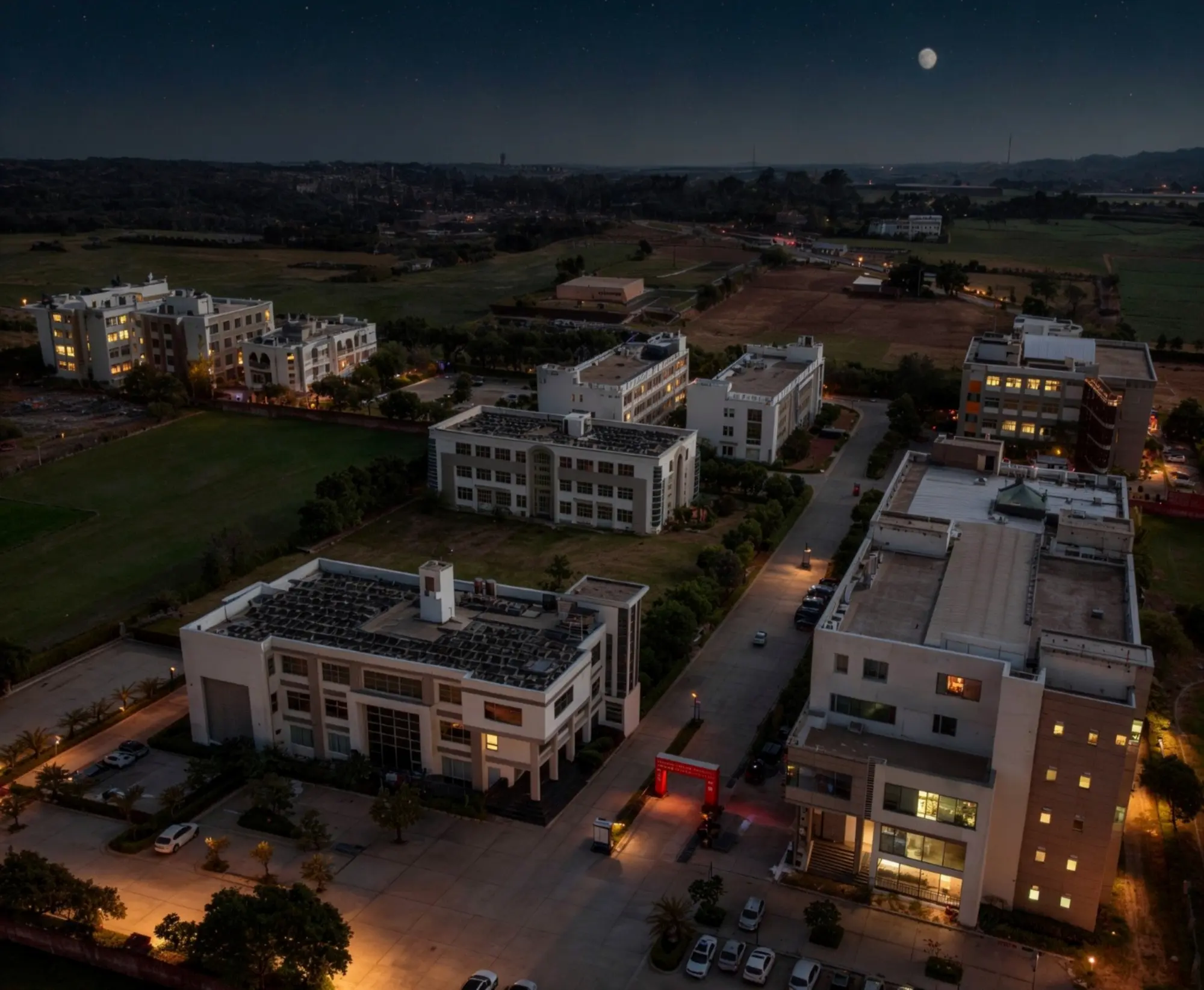
Founded in 1985, the Geeta Group of Institutions has emerged as a major educational hub with institutions spanning school education to doctoral programs. SPBSB benefits from the integrated ecosystem of:

Geeta University

AI-enabled multidisciplinary campus

Geeta Finishing School (GFS)

Communication & Corporate Readiness

Geeta Technical Hub (GTH)

Advanced Technology, Certifications, and Industry Skills
Geeta Group Campus